
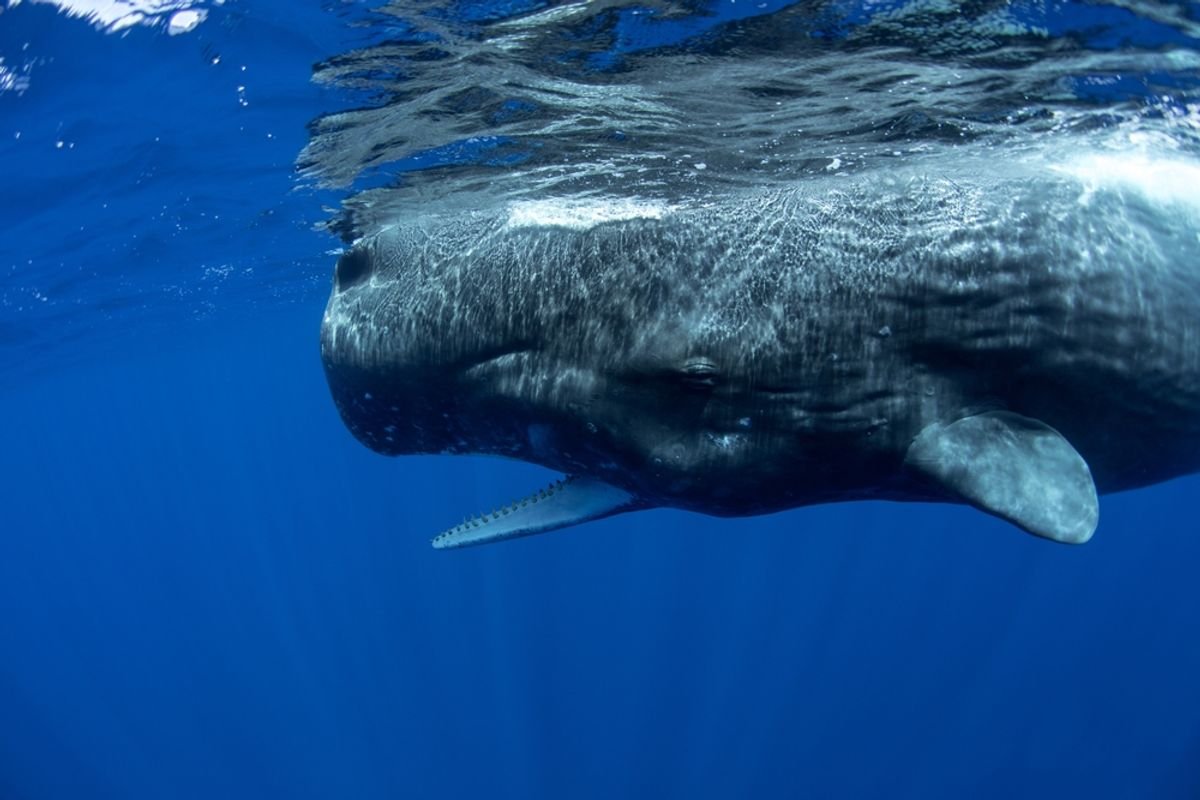
Sperm Whale Clicks Aren’t Random — They Follow Human‑Like Sound Rules

Humans like to think we sit at the top of the evolutionary ladder, largely because we have language, which is a system so flexible and expressive that it’s often taken as proof of our intelligence. However, whales may complicate that assumption.
Researchers have suspected for years that whales might be using a far more sophisticated communication system than we give them credit for. Now, a new study published in Proceedings of the Royal Society B suggests sperm whales use distinct, “vowel-like” sounds in their clicks, something surprisingly close to how humans structure speech.
The study, led by researchers at UC Berkeley in collaboration with Project CETI (the Cetacean Translation Initiative), found that these whales don’t just click randomly. They combine different types of clicks into rhythmic, structured patterns, hinting at an intentional system of communication.
“Previously it was assumed that variations in whale clicks was purely a function of their size or anatomy,” said study co-author David Gruber, founder and president of Project CETI, in a press release. “What this study shows is that these features are not incidental; they are structured, flexible, and used in ways that strongly resemble similar building blocks of human language.”
How Whales Form Sounds
Sperm whales (Physeter macrocephalus) live in tight-knit, matrilineal groups with complex social lives. And their communication may reflect that.
Instead of using vocal cords like humans, sperm whales generate clicks using structures in their nose called “phonic lips” and air sacs that act as mouths. These clicks are arranged into rhythmic sequences known as codas, which can vary between whale clans, suggesting that at least some aspects of their communication are learned.
Traditionally, researchers focused on counting clicks and measuring timing. But more recent work points to another layer: the clicks themselves appear to come in two distinct types based on their acoustic properties, similar to the formants that shape vowels in human speech. These have been dubbed “a-codas” and “i-codas.”
Read more: AI Could One Day Help Us Understand Whale, Dolphin, and Other Animal Languages
Click Patterns Resemble Human Vowels
The team analyzed recordings collected between 2014 and 2018 off the coast of Dominica, focusing on 15 female and immature sperm whales, which were carefully tagged with microphones to minimize background noise.
“It’s a real challenge, because these guys dive up to 2 kilometers [about 1.2 miles] deep. It takes a village to basically record these whales,” the study’s first author, Gašper Beguš, a linguist at UC Berkeley, told Discover.
After further analyzing the data, they found that these vowel-like clicks aren’t used randomly but follow consistent patterns, surprisingly similar to those of humans. “These vowels not only look like vowels, but also behave like human vowels,” said Beguš.
For example, a-codas tend to be longer, while i-codas split into short and long forms. Some sequences mix both types, while others rely more heavily on one, suggesting whales may be actively choosing between them. The patterns even resemble features seen across human languages, such as Mandarin, Hungarian, or Arabic, where subtle shifts in sound, such as vowel quality or length, can change meaning.
“In some ways, we want them to be different, because they’re these alien creatures. But then if you actually look at them closely, you realize, ‘Oh, wow, this is the exact same mechanism,’ and the mind-blowing thing is it’s so categorical, [like] our human language,” Beguš told Discover.
Protecting Whale’s Culture
Taken together, the findings suggest sperm whale communication may be one of the closest parallels to human phonology observed in another species, despite evolving independently.
“What was thought [were] 20 sounds, is now in the hundreds, which means that its magnitude is more complex than we used to believe,” said Beguš.
That growing complexity is pushing researchers to look beyond cataloging whale sounds toward understanding what they might actually mean and what that says about the evolution of communication. It also strengthens the case for protecting whales not just as species but as cultures with rich inner lives.
“We’re working on recognizing that [whales] have so much complexity that we have to protect more than we do now. Protect from harm, protect from anthropogenic noise, and in general, increase their legal rights,” explained Beguš to Discover. “There’s so much richness that we have to preserve their cultures, their species, their ways of life.”
Read more: A Sperm Whale Is Born — Rare Footage Reveals Social Care During the “Most Vulnerable Moments of Life”
Article Sources
Our writers at Discovermagazine.com use peer-reviewed studies and high-quality sources for our articles, and our editors review for scientific accuracy and editorial standards. Review the sources used below for this article: