
Small Rays in Shallow Waters Flaunt Fake Eyes to Ward Off Predators
Despite nature’s endless creativity in devising defense mechanisms tailored to different ecosystems, it doesn’t always reinvent the wheel. Many successful strategies get reused, appearing across a wide range of environments.
One particularly striking example is the eyespot, seen in many butterflies and birds, like the peacock. Underwater, some rays use the same visual trick. But why some species develop these markings while others don’t has remained unclear.
To answer this, researchers from Stockholm University examined 580 species of rays and skates and compared their defenses in the context of their environments and their own traits. Their results, published in Nature Ecology & Evolution, reveal which conditions favor the evolution of eyespots in this ancient group of cartilaginous fish and when other strategies, like venomous spines or electric shocks, take over.
“Our results show that you have to look at the full range of options for avoiding predators,” said study lead author Madicken Åkerman from the Department of Zoology at Stockholm University in a press release. “Eyespots evolve only under certain ecological and defensive conditions. They are one solution among many in the evolutionary arms race between predator and prey.”
Read more: How Did Animals Get Their Spots and Stripes?
Choosing From a Wide Range of Defenses

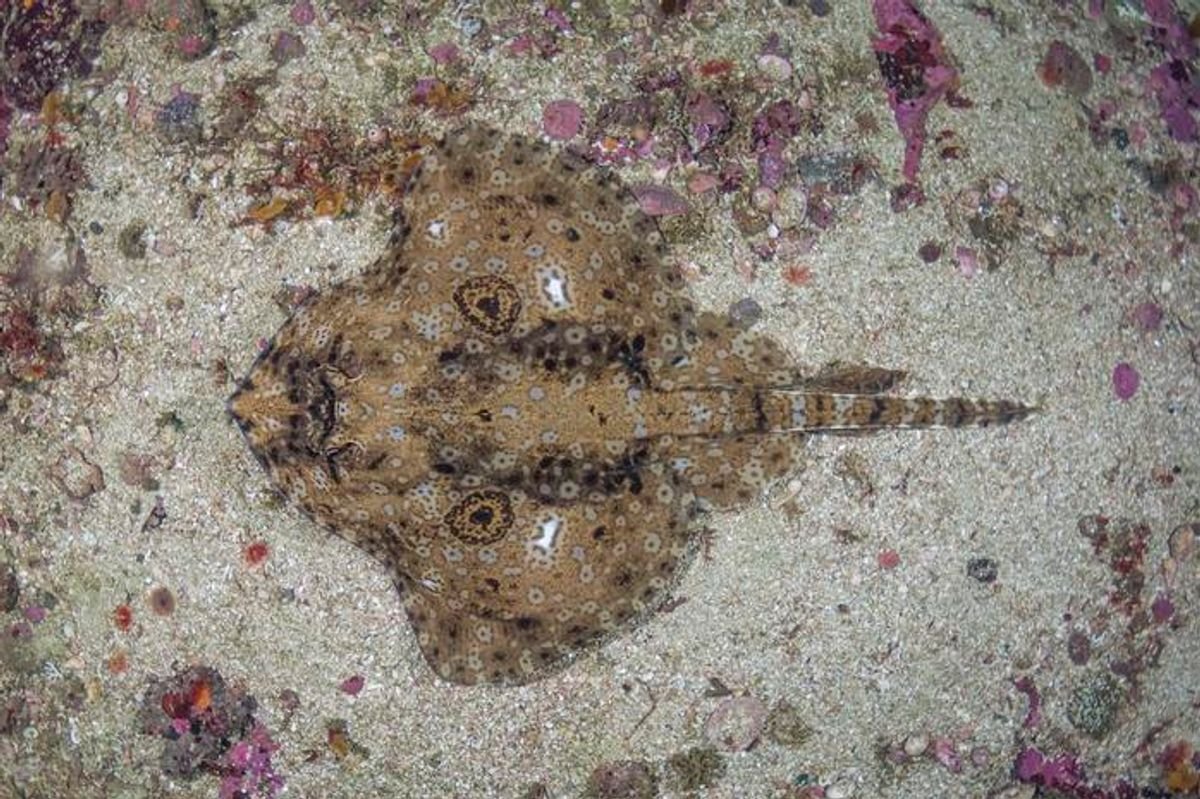
Mediterranean Rough Skate
(Image Credit: Andy Murch)
Animals rely on a mix of mechanical, visual, chemical, and behavioral tactics to deter predators and often combine several at once. But what drives the evolution of one strategy over another is still not fully understood.
It’s especially intriguing when unrelated species in very different environments develop similar solutions, a process known as convergent evolution. Eyespots are a strong example: they can intimidate predators that are themselves vulnerable to being hunted. Some even create the “Mona Lisa effect,” where the observer feels watched from any angle.
Rays and skates face threats from sharks, marine mammals, and larger fish, necessitating a versatile defensive toolkit. To understand why some species “choose” eyespots, the team analyzed the presence, type, and number of markings in 580 species (representing over 90 percent of known diversity), alongside other traits such as venomous stings, electric organs, body size, and habitat.
Eyespots Favor Smaller, Defenseless Species in Shallow Waters
Rather than focusing on eyespots alone, the researchers examined the full suite of anti-predator traits. This broader view revealed how strongly the environment shapes defensive strategies. The team described how species already equipped with powerful defenses rarely display bold visual markings.
“Evolution seems to [favor] different defensive toolkits. If you already have a strong mechanical or electrical [defense], you don’t also need a visual warning signal,” added Åkerman.
By contrast, eyespots tend to appear in smaller, more vulnerable species living in waters shallower than about 650 feet.
“Eyespots are far from random,” said study co-author John Fitzpatrick in the release. “They tend to evolve in species that lack strong physical [defenses], such as venomous tail stings or electric shocks, and that live in bright, shallow waters where visual signals are effective.”
How Eyespots Evolve and Disappear

Rasptail Skate
(Image Credit: Andy Murch)
The team also reconstructed the evolution of eyespots over time. They explain that these distinct markings rarely evolved directly but instead followed the species’ first acquisition of simpler markings, which later transformed into the classic concentric-ring eyespots we observe today.
“It appears to be a stepwise process. Other markings come first, and over time they refine into eyespots,” Fitzpatrick said.
But evolution doesn’t always move in one direction. In deeper, darker waters, where visual signals are less effective, the cost of being noticeable can outweigh the benefits. In these environments, such markings often fade or disappear altogether.
Read more: Manta Rays Dive Almost 4,000 Feet into the Deep Ocean — Not for Food, But for Directions
Article Sources
Our writers at Discovermagazine.com use peer-reviewed studies and high-quality sources for our articles, and our editors review for scientific accuracy and editorial standards. Review the sources used below for this article: