
A 14-Million-Year Climate Record Is Hidden Within Australia’s Vanishing Twelve Apostles
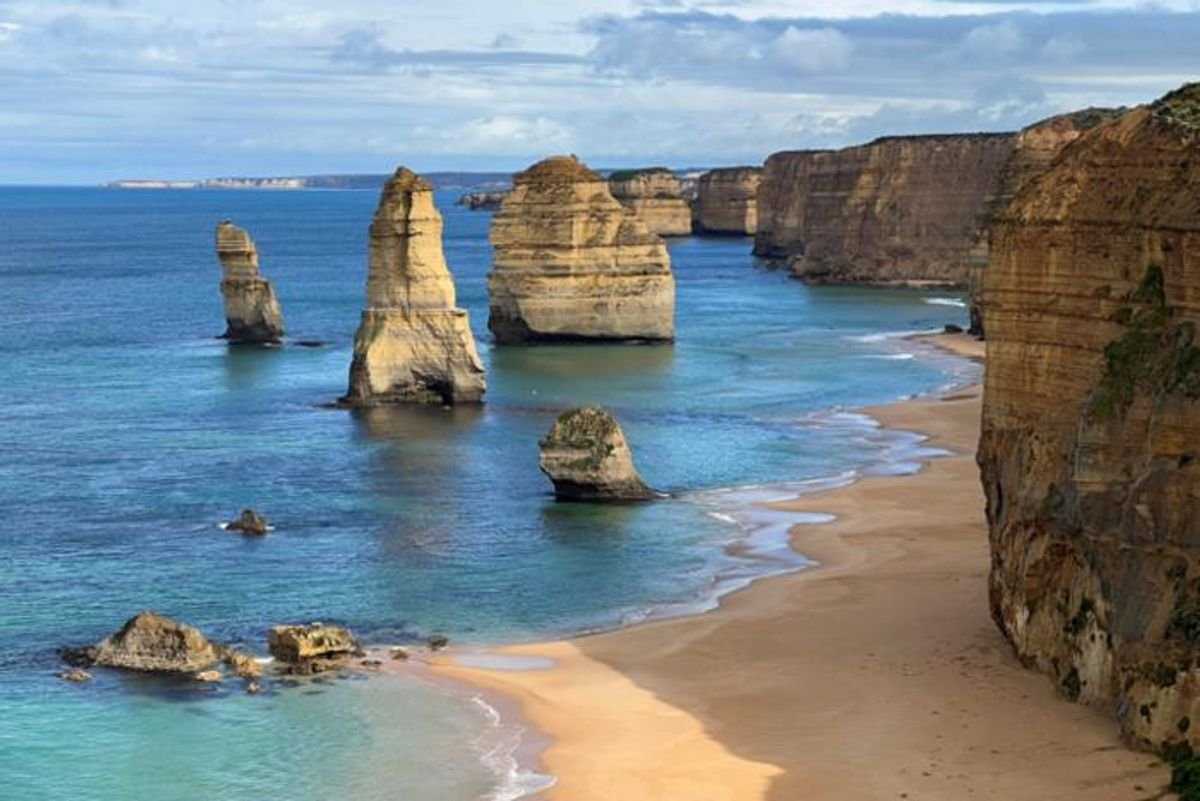
Rising dramatically from the Southern Ocean along Australia’s famous Great Ocean Road, the Twelve Apostles have long been one of the country’s most photographed natural landmarks. Although beautiful, they are impermanent, and scientists are racing to study them before they disappear.
A new study, published in the Australian Journal of Earth Sciences, is using these towering limestone stacks as detailed geological archives that can help reveal millions of years of Earth’s climate history. Additionally, researchers have — for the first time — accurately dated the Twelve Apostles, revealing that they are younger than once believed.
“We are using this ‘window back in time’ to understand where temperatures and sea levels may be heading on our current path of climate change. With only eight of the twelve Apostles remaining, we need to study and learn from them while we can,” said lead researcher Stephen Gallagher, in a press release.
What Are the Twelve Apostles?
The Twelve Apostles are a series of limestone sea stacks located along the rugged coastline of southwestern Victoria, within Port Campbell National Park. Positioned just off the Great Ocean Road, they are among Australia’s most visited natural attractions according to Parks Victoria.
Despite their name, there were never actually twelve stacks. At most, nine stood at once — and today, only six remain clearly visible. Earlier names like “the Pinnacles” and “the Sow and Piglets” were eventually replaced in the 20th century with the more marketable “Twelve Apostles,” a nod to the biblical figures.
As detailed in Britannica, they are all composed of limestone packed with microscopic marine fossils, and the tallest Apostle rises about 150 feet above the ocean surface. These stacks are also not static monuments; they are constantly reshaped by wind and waves.
Read More: The Oldest Rocks on Earth Are in Canada, and They’re 4.16 Billion Years Old
How Old Are the Apostles and How Were They Formed?

Microfossils in the layers of the Twelve Apostles
(Image Credit: Stephen Gallagher, University of Melbourne)
In this new study, scientists have put together a detailed timeline of how the Apostles came to be. Their origin stretches back millions of years, beginning with tectonic forces beneath the Earth’s surface.
Using microscopic fossils embedded in the rock layers, researchers were able to refine the age of these layers to between 8.6 and 14 million years old — more precise than earlier estimates of 7 million to 15 million years.
Shifting tectonic plates gradually lifted and tilted ancient seabed layers, raising them above the ocean. As they rose, the rock layers were warped and fractured along the way, with those distortions still visible today.
“We also uncovered that tectonic movements didn’t push up the Apostles perfectly straight. Instead, they forced layers to tilt and break along the way,” explained Gallagher. “If you look closely at the cliffs around the Twelve Apostles today, you can see the limestone layers are not flat but are, in fact, tilted by a few degrees. Small fault lines can also be seen, which are records of ancient earthquakes.”
Why Scientists Are Racing to Study the Twelve Apostles
The Twelve Apostles are changing constantly. Their layered limestone structure functions much like tree rings, offering a chronological record of past ocean conditions, climate shifts, and sea-level changes.
By analyzing these layers, researchers can reconstruct how Earth responded to different climate periods in the past — insights that are critical for predicting future climate scenarios.
“Much like an environmental time capsule, each layer of these giant structures preserved information about the Earth’s climate, tectonic activity, plants and animals over millions of years, including a key time about 13.8 million years ago when the climate was much warmer than what it is today,” explained Gallagher.
At the same time, the formations themselves are disappearing, with two of the Apostles collapsing in 2005 and 2009, respectively. That urgency is what makes this research especially significant, as the window to read the Apostles’ story is closing fast.
Read More: For Over 100,000 Years, a Hidden Magma Reservoir Grew Beneath Greece’s “Extinct” Methana Volcano
Article Sources
Our writers at Discovermagazine.com use peer-reviewed studies and high-quality sources for our articles, and our editors review for scientific accuracy and editorial standards. Review the sources used below for this article: