
7 of the Most Bizarre Geological Features in the Solar System Include Salt Glaciers and Hailing Rocks
From Madagascar’s “forest of knives” to the interlocking basalt columns of the Giant’s Causeway, Earth is replete with jaw-dropping geology. But so are the other planets and moons with which we share our little corner of the universe. Each has its own remarkable features — salt glaciers, sky-high geysers, methane seas.
Some we understand reasonably well, but many defy explanation.
“At first you say, no, that cannot be, there’s no physical mechanism to do that,” Jeffrey Kargel, a senior scientist at the Planetary Science Institute, told Discover. “It’s just utterly impossible.”
Still, he and others continue to explore the geological mysteries of extraterrestrial worlds. Kargel shared the ones that amaze him most, starting with the planet closest to the sun.
1. Mercury’s Glaciers of Salt

Mercury is too hot for ice glaciers, but it may contain salt glaciers.
(Image Credit: joshimerbin/Shutterstock)
Glaciers, as we know them, would never survive on Mercury, where surface temperatures reach 800 degrees Fahrenheit — much too hot for water, let alone ice. Yet the planet’s north pole is covered with what certainly appear to be glaciers. In a 2023 Planetary Science Journal study, Kargel and his colleagues proposed an alternative substance: halite, better known as table salt.
Under Mercury-level heat, halite becomes ductile, able to flow under its own weight as earthly glaciers do. And the same thing happens to nitrogen on Pluto, as discovered in 2015 by NASA’s New Horizons mission. Taken together, Kargel’s team wrote, these findings imply that “the glaciation phenomenon extends from the hottest to the coldest confines within our Solar System.”
They even suggest that Mercury’s salt glaciers may offer habitable ecological niches on an otherwise inhospitable world.
Questions remain, however, about where all that halite could have come from and how it could have formed without water. “It’s a complicated problem,” Kargel said to Discover, “still in the realm of mystery.”
Read More: NASA’s Magellan Mission Just Changed What We Know About Venus, Again
2. Venus Has the Longest Channel in the Solar System

Baltis Vallis on Venus
(Image Courtesy of Credits: NASA/JPL-Caltech)
Venus is hotter than Mercury, making the presence of water there even more improbable. That leaves scientists scratching their heads over the origin of Baltis Vallis, a channel that meanders 4,200 miles across the planet’s surface, outstripping Earth’s longest river, the Nile, according to NASA. What, if not a river, could possibly carve a groove of such proportions?
One obvious suspect is lava, but most kinds are so viscous that they’d lose steam long before the 4,200-mile mark. Kargel believes Baltis Vallis is likely the work of “a weird kind of lava” called carbonatite, which has a viscosity akin to that of liquid water and could behave similarly. But, he added, “that’s bizarre, too. All of the explanations are really bizarre.”
3. Mars’ Grand Canyon

Valles Marineris
(Image Credit: Valles Marineris)
Mars, despite measuring just half Earth’s diameter, is the undisputed Texas of our Solar System — everything is bigger there. Olympus Mons is, famously, the tallest mountain in our Solar System at 14 miles high, according to Britannica. But Mars is also home to the largest canyon under the sun.
Valles Marineris runs for 2,500 miles along the planet’s equator and plunges to depths of 4 miles, making it five times longer than the Grand Canyon and four times as deep, according to NASA. Overlaid on a map of North America, it spans the entire continent.
Kargel compares this gargantuan Martian canyon to the East African Rift, where two tectonic plates are slowly tearing apart over millions of years. With Valles Marineris, however, that process stopped short as the planet’s crust cooled and tectonic activity subsided. Billions of years later, the great gash remains more or less unchanged.
4. Toxic Soil on Mars
Martian oddities alone could fill this list. Much of the planet’s soil and subsurface water ice is chock full of perchlorate chemicals, which can corrode skin even in small amounts. That poses a big problem for astronauts and would-be colonizers.
“I think one of the engineers’ major challenges will be to make sure to clean that dust out so it doesn’t get all the way into the habitat,” Kargel said. “And then I don’t know what you’re going to do with the spacesuits. It’s going to take some major laundering.”
Researchers have proposed various methods to clean up this toxic mess, including deploying microbes that consume perchlorates, according to a study in Icarus. And, given that some Earth-based life forms can sustain themselves on these chemicals, it’s possible they could serve as an energy source for life on Mars as well.
Read More: Volcanic Activity on Mars Could Help in the Search for Life on Other Planets
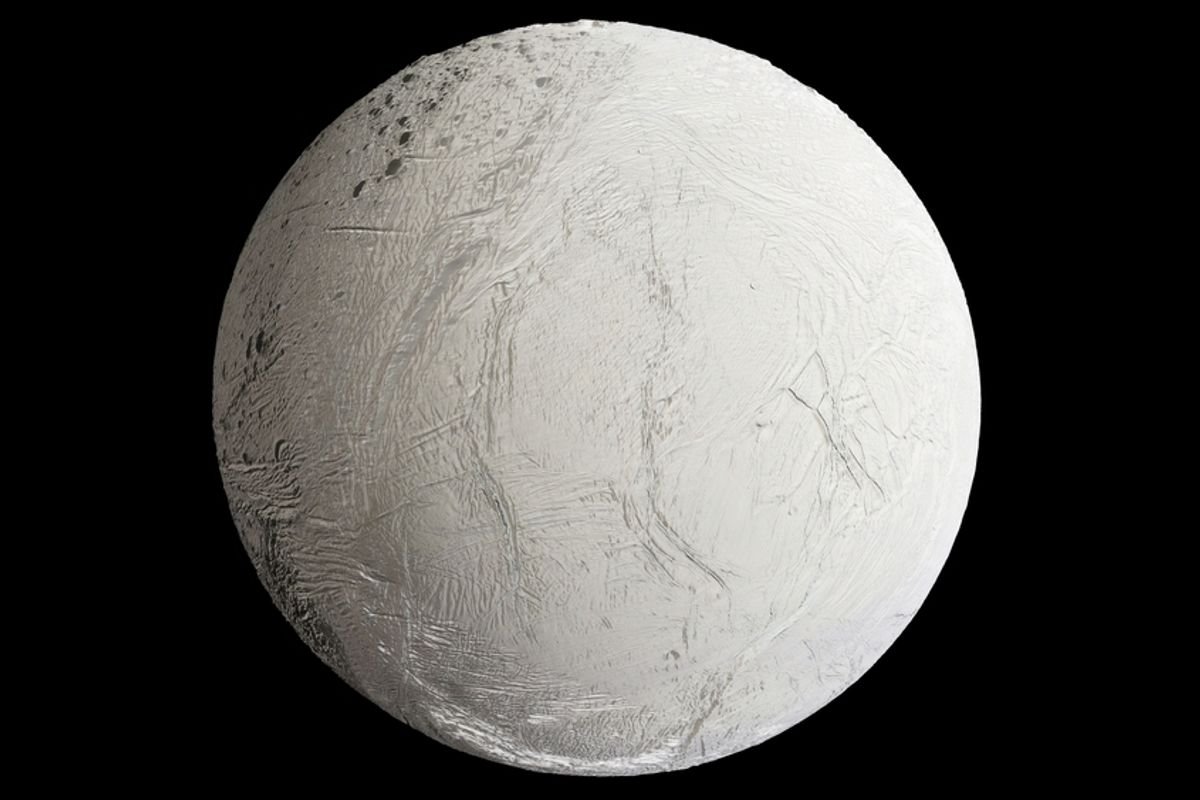
5. Atmospheric Water Jets on Enceladus

Enceladus with atmospheric jets
(Image Credit: Art Knights/Shutterstock)
Enceladus, a small moon orbiting Saturn, is covered in ice. But beneath its frozen exterior lies a vast saltwater ocean that routinely gives rise to the most spectacular waterworks show in the Solar System, according to NASA — one that puts the famous geysers of Yellowstone to shame.
Saturn’s gravitational pull alternately stretches and compresses Enceladus, generating so much tidal heat that jets of water erupt through cracks in the ice with astonishing force.
“It’s constantly spewing out geysers that shoot hundreds of kilometers up,” Kargel said. Some of that water falls back to the surface, but some escapes to form Saturn’s outermost E ring, a translucent halo of fine ice particles.
When the Cassini spacecraft flew through Enceladus’ water plumes in the late 2000s, it found that the moon’s ocean contains many of the essential chemical ingredients for biology, according to NASA.
Scientists now consider this distant world one of the most promising candidates for extraterrestrial life.
6. Titan’s Methane Seas

Representation of methane oceans on Titan
(Image Credit: Jurik Peter/Shutterstock)
Farther out in Saturn’s orbit lies Titan, a much larger — not to mention stranger — moon. Twice as large as our own moon, it’s the only place beyond Earth confirmed to have stable liquid on its surface.
Across Titan’s surreal landscape, clouds build, rain falls, and rivers run until they empty into lakes and seas, forming a complete hydrologic cycle, according to NASA. But the liquid in question isn’t water — it’s a mix of methane and ethane, which exist as gases on Earth. Boundaries between sea and land look eerily like our home planet’s coastlines.
More surprising still, Kargel told Discover, Titan has “what looks to my eyes like glacially eroded mountains.” It’s unclear what substance could have carved these rocks; at negative 300 degrees Fahrenheit, Kargel noted, “we’re not talking about glaciers of ice because ice would be as rigid as steel. It wouldn’t flow.”
7. Jupiter’s Rock Hail
You might not expect to find any geology at all on Jupiter, it being a gas giant. But far, far below the planet’s prodigious atmosphere, there’s a small core where pressure is so great that hydrogen becomes liquid metal. Deeper still is “good old-fashioned rock,” as Kargel put it, but in ultra high-density form.
We can’t know the dynamics of Jupiter’s impenetrable interior for sure, he notes — in 1995, the Galileo probe broke down after descending only a small fraction of the 43,000 miles into its atmosphere. But we can speculate, and here’s Kargel’s version: the swirling metallic hydrogen would dissolve bits of rock, which would then rise through the liquid until they precipitated once again into solid chunks. At that point, he said, “It would rain, or hail, or sleet rock.”
You can almost imagine gazing up as pebbles and stones and boulders plummet ceaselessly through this otherworldly “ocean” of “metal”— though surely those words, as we understand them, fail to capture the scene.
“The reality is probably way more bizarre than what I’m possibly able to conceive of,” Kargel said. “Those mysteries are going to last for quite some time.”
Read More: Young Martian Volcano Reveals 9 Million Years of Hidden Activity
Article Sources
Our writers at Discovermagazine.com use peer-reviewed studies and high-quality sources for our articles, and our editors review for scientific accuracy and editorial standards. Review the sources used below for this article: