
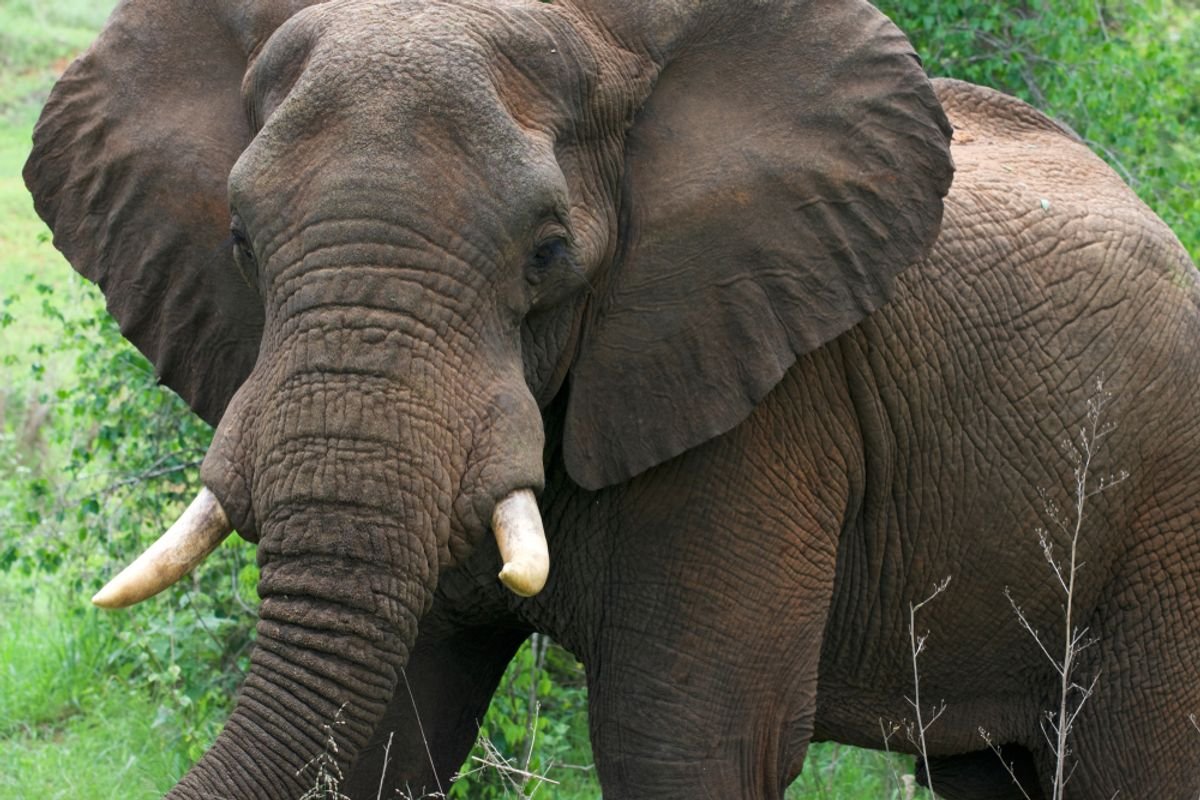
Ghost Elephants in Angola Are a Living Genetic Mystery — DNA from Their Dung Is Now Offering Answers

Ghost elephants have been roaming across a lush wetland in Angola for years, but they’re not the kind of ghosts that are invisible and haunt people. These elephants are real, albeit rarely seen — they travel by night, moving stealthily and leaving few traces behind. Most intriguing of all, though, is that they are part of an isolated population that tells a mysterious genetic tale.
The “ghost elephants” living at Lisima Lya Mwono, a high-altitude wetland that serves as a vital freshwater source in southern Africa, are the subject of a 2025 documentary directed by German filmmaker Werner Herzog, aptly titled Ghost Elephants. In the film, one question prevails: Where did these elephants come from? To find answers, researchers examined elephant dung for clues hidden within the ghost elephants’ genomes.
DNA from the fecal samples showed that the ghost elephants of Lisima are closely related to elephant populations that are hundreds of miles to the south. Now, researchers are trying to figure out why the ghost elephants’ closest relatives aren’t nearby but are instead far away.
Tracking Down Ghost Elephants
In Ghost Elephants, South African conservation biologist Steve Boyes teams up with three local trackers to find the ghost elephants of Lisima; the elephants are so elusive that, for the longest time, their existence was only rumored by locals.
But motion-sensor cameras captured one elephant on a nighttime stroll in 2024, and since then, researchers have ramped up their investigation.
Since it’s so rare to see these elephants out in the wild, researchers had to proceed using elephant dung. Taking 25 samples collected in 2024, researchers worked on sequencing the ghost elephants’ genomes, eventually confirming the existence of eight elephants (three males and five females) moving through the highlands, according to The Wilderness Project.
Read More: Elephants Have 1,000 Delicate Whiskers on Their Trunks, and They May Transform Robotics
DNA from Elephant Dung
To uncover key information on the ghost elephants, researchers from Stanford University put the fecal samples in a “bead basher,” a machine that breaks open cells to release DNA, according to Stanford Report.
One of the main reasons using fecal samples is so valuable here is because it’s non-invasive, providing insight into the elephants without disrupting them in their natural environment. Feces tells a lot about an animal as well — not just its genetic history, but its diet and health, too.
The researchers needed more than just the ghost elephant fecal samples; however, since genetic information on other wild elephant populations was lacking, they spent months collecting blood and tissue samples from other wild elephants in separate groups.
After processing these samples, the researchers were finally able to compare the genomes of the ghost elephants with those of other wild elephants. This genomic work revealed that, surprisingly, the ghost elephants are genetically distinct from nearby wild elephant populations whose genomes had been sequenced.
Instead, the ghost elephants were more closely related to elephants hundreds of miles away in Namibia and, to a lesser extent, to elephants in Botswana. Migration modeling suggests that the ghost elephants are linked to these other populations through corridors of gene flow running from the south and southwest to the Angolan Highlands, potentially establishing a connection between Lisima and the broader KAZA elephant range spanning Angola, Botswana, Namibia, Zambia, and Zimbabwe.
Searching for the Ghost Elephants’ Origins
The research on Lisima’s ghost elephants is far from over; future studies will aim to answer lingering questions—for example, why the ghost elephants have such close ties to populations in Namibia rather than to those closer to the Angolan Highlands.
Conservation, especially with the help of locals who know the Angolan Highlands well, will also remain a central focus of the project, as researchers work to improve sampling in under-surveyed areas and seek more definitive answers to explain how the ghost elephants ended up in Lisima.
Read More: Elephants Ask Humans for Food Using Non-Verbal Gestures — A First in Non-Primates
Article Sources
Our writers at Discovermagazine.com use peer-reviewed studies and high-quality sources for our articles, and our editors review for scientific accuracy and editorial standards. Review the sources used below for this article: