
After a Massive Eruption, This Underwater Volcano Removed Methane from the Atmosphere
Although volcanic eruptions are not a major driver of modern climate change, the release of climate-relevant greenhouse gases like CO2 and methane — and their behavior in the atmosphere — can give climate scientists important clues about possible levers to help turn around a challenging climate future.
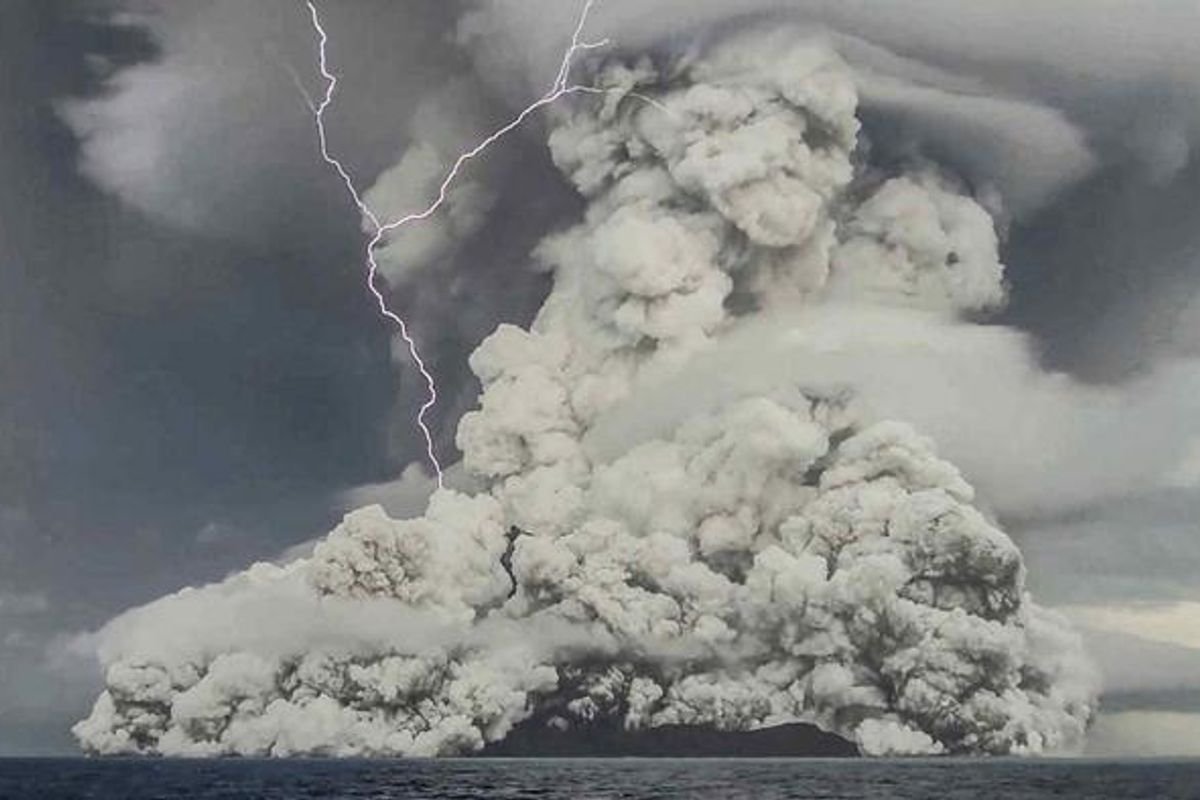
Now, a study published in Nature Communications shows that advanced satellite measurements tracked how the massive submarine eruption of the volcano Hunga Tonga–Hunga Ha’apai in the South Pacific in 2022 released around 300 gigagrams of methane, but, due to a lucky combination of chemical conditions, also removed methane equivalent to the daily emissions of two million cows from the atmosphere.
“It is known that volcanoes emit methane during eruptions, but until now it was not known that volcanic ash is also capable of partially cleaning up this pollution,” said the first author of the study, Maarten van Herpen from the Dutch Company Acacia Impact Innovation BV, in a press release.
Learning more about this phenomenon may help scientists and engineers develop technologies that could slow down global warming.
Volcano Eruption Triggers Methane Breakdown
As described by the researchers, the eruption appears to have triggered a chemical process first identified in 2023 in a very different environment. In that earlier discovery, scientists found that Saharan dust blown over the Atlantic mixes with sea salt from ocean spray, forming tiny particles called iron salt aerosols. When exposed to sunlight, chlorine atoms are released, which then react with methane and help break it down in the atmosphere.

Satellite image showing in blue the cloud of formaldehyde.
(Image Credit: van Herpen et al. (2026))
“What is new — and completely surprising — is that the same mechanism appears to occur in a volcanic plume high up in the stratosphere, where the physical conditions are entirely different,” said study co-author Matthew Johnson from the University of Copenhagen in the statement.
Due to its underwater location, Hunga Tonga–Hunga Ha’apai’s eruption blasted huge amounts of salty seawater and volcanic ash into the stratosphere. Using the TROPOMI instrument from the European Space Agency’s Sentinel-5P satellite, researchers detected unusually high concentrations of formaldehyde, which is a key sign that methane was continuously broken down in the plume for more than a week.
“Getting these corrections right was essential to confirm that what we were seeing was real,” said co-author Isabelle De Smedt from the Royal Belgian Institute for Space Aeronomy in the release.
Read More: Some Volcanoes Don’t Explode When Erupting — A Hidden Force Helps Pressure to Escape
Methane Churns Global Warming
Researchers believe the unusual chemistry inside the volcanic plume was driven by sunlight interacting with a mix of seawater, ash, and gases thrown high into the atmosphere during the eruption. This likely created highly reactive chlorine, which then helped destroy methane. The unusually large amounts of formaldehyde spotted in satellite images were a telltale sign that this breakdown was happening.
Methane is a particularly important greenhouse gas because, while it does not stay in the atmosphere as long as CO2, it traps far more heat in the short term. Scientists estimate that methane is responsible for roughly a third of current global warming and is about 80 times more powerful than CO2 over 20 years.
Because methane typically breaks down within about a decade, cutting emissions now could have relatively fast climate benefits. Researchers sometimes describe methane reduction as an “emergency brake” that could help slow warming and reduce the risk of dangerous climate tipping points.
Rapid Cleaning of the Atmosphere
The researchers say the findings could help guide the emerging field of research focused on speeding up methane removal in the atmosphere through engineered solutions, inspired by the way the volcano effectively cleaned up part of its own emissions.
A major challenge for these technologies is proving that methane is actually being removed and accurately measuring how much disappears.
“How do you prove that methane has been removed from the atmosphere? How do you know your method works?” said Jos de Laat from the Royal Netherlands Meteorological Institute in the statement. “It’s very difficult. But here we address that problem by showing that methane breakdown can in fact be observed using satellites.”
The team hopes the discovery will encourage industry to explore whether this natural process can safely be replicated on purpose to help slow global warming.
Read More: Methane from Lunar Landers May Contaminate Ancient Organic Molecules at the Moon’s Poles
Article Sources
Our writers at Discovermagazine.com use peer-reviewed studies and high-quality sources for our articles, and our editors review for scientific accuracy and editorial standards. Review the sources used below for this article: