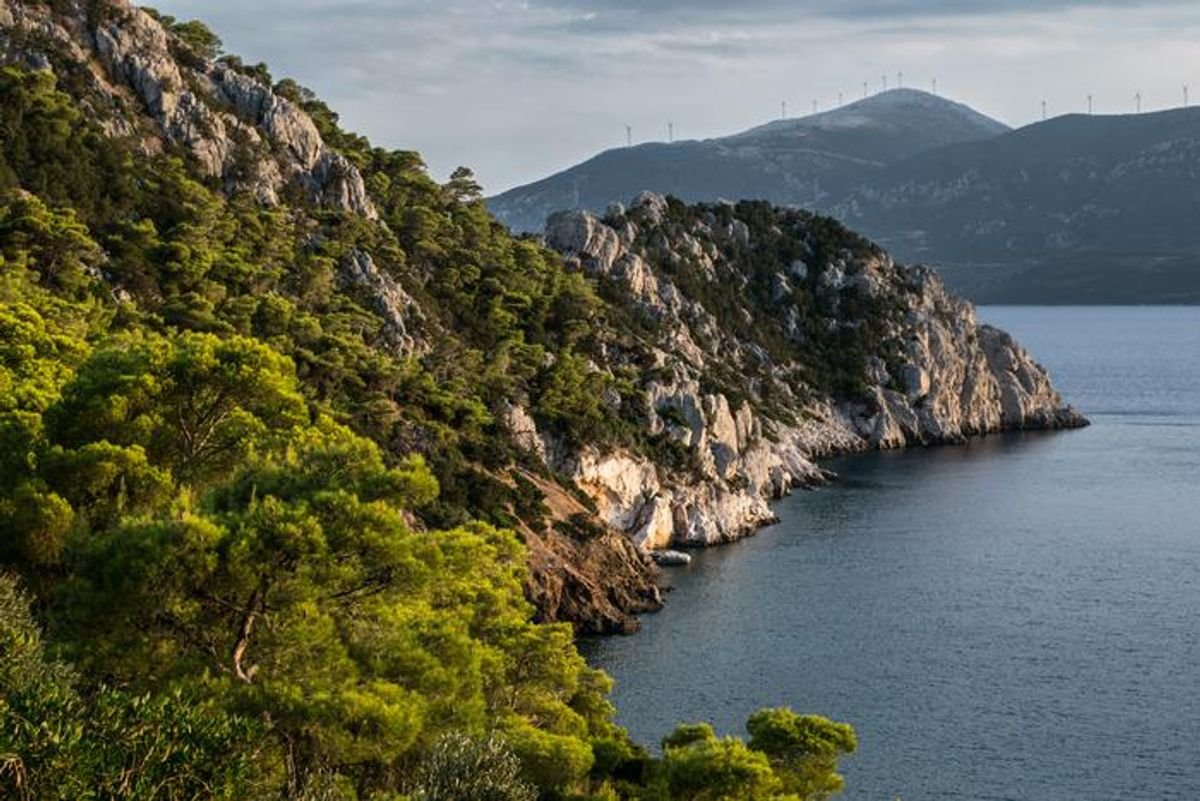
There are more extinct volcanoes across the world than active ones, with hundreds across the United States alone. One of them, Greece’s Methana volcano, seemed to be asleep for more than 100,000 years. But a new study, published in Science Advances, is changing that story.
By reconstructing hundreds of thousands of years of volcanic activity, researchers found that, deep beneath Methana, magma was steadily building. This discovery is reshaping how scientists approach so-called “dead” volcanoes — just because a volcano hasn’t erupted in millennia doesn’t mean it is now safe.
“What we learned is that volcanoes can ‘breathe’ underground for millennia without ever breaking the surface,” said senior author Olivier Bachmann in a press release.
Red lava and white pumice from a prehistoric explosion of Methana.
(Image Credit: Răzvan-Gabriel Popa / ETH Zurich)
Discovering Methana Volcano Was Still Active With a Growing Magma Reservoir
To look into Methana’s hidden past, researchers turned to zircon crystals — microscopic minerals that form inside cooling magma and preserve a detailed record of their environment. By analyzing zircon samples, the team effectively rebuilt the volcano’s internal timeline.
“We can think of zircon crystals as tiny flight recorders. By dating more than 1,250 of them across 700,000 years of volcanic history, we’ve reconstructed the volcano’s inner life with a precision and statistical power that simply wasn’t possible a decade ago,” explained Bachmann.
What those “flight recorders” revealed was that, even during Methana’s longest quiet stretch of over 100,000 years with no eruptions, magma production didn’t stop. In fact, zircon growth peaked during this period, signaling intense underground activity despite the calm surface.
Read More: Japan’s Underwater Supervolcano Is Refilling With Magma — And It Could Change How We Predict Eruptions
How Water-Rich Magma Kept Methana Quiet
One of the keys to Methana appearing dormant was the type of magma building beneath. The researchers discovered it was unusually rich in water — a feature that changes how magma behaves.
Methana sits above a subduction zone, where one tectonic plate sinks beneath another. This process drags water-rich minerals, like ocean-floor sediments, deep into the mantle. The result is “superhydrous” magma, which is molten rock infused with significant amounts of water.
“We actually believe that many subduction zone volcanoes might be periodically fed by particularly wet primitive magma, something that the scientific community has not yet fully recognized,” said lead author Răzvan-Gabriel Popa. “These so-called ‘superhydrous’ melts might be much more prevalent in subduction-related volcanoes worldwide.”
As this type of magma rises, the water begins to form bubbles, similar to carbonation in soda. But instead of triggering an eruption, the process causes the magma to crystallize and thicken. The more crystals that form, the more sluggish the magma becomes.
The researchers concluded that this bubbly process ends up slowing the magma down because it becomes too viscous to reach the surface. Instead, it accumulates underground, building a larger, potentially more dangerous reservoir over time.
Lava flow formations from Methana.
(Image Credit: Răzvan-Gabriel Popa / ETH Zurich)
Why This Changes the Future of Volcano Monitoring
Methana’s life story carries a clear message: volcanic silence can be misleading.
Many volcanoes around the world are classified as extinct simply because they haven’t erupted in tens of thousands of years. But this study suggests that some of those volcanoes may still be active beneath the surface.
This revelation has major implications for hazard assessment. If magma can accumulate unnoticed for millennia, then long-dormant volcanoes may pose a greater risk than previously thought.
“For volcano hazard authorities, for example, in Greece, Italy, Indonesia, Philippines, South and North America, Japan, etc. this means re-evaluating the threat level of volcanoes that have been quiet for tens of thousands of years but show periodic signs of magmatic unrest,” concluded Bachmann.
The next generation of volcano monitoring may need to look deeper — literally. Instead of focusing only on surface activity, scientists could increasingly rely on mineral analysis, geochemical signals, and subsurface imaging to detect hidden magma systems.
Read More: Yellowstone Is One of the World’s Largest Magmatic Systems – And It May be Missing a Key Volcanic Gas
Article Sources
Our writers at Discovermagazine.com use peer-reviewed studies and high-quality sources for our articles, and our editors review for scientific accuracy and editorial standards. Review the sources used below for this article: