
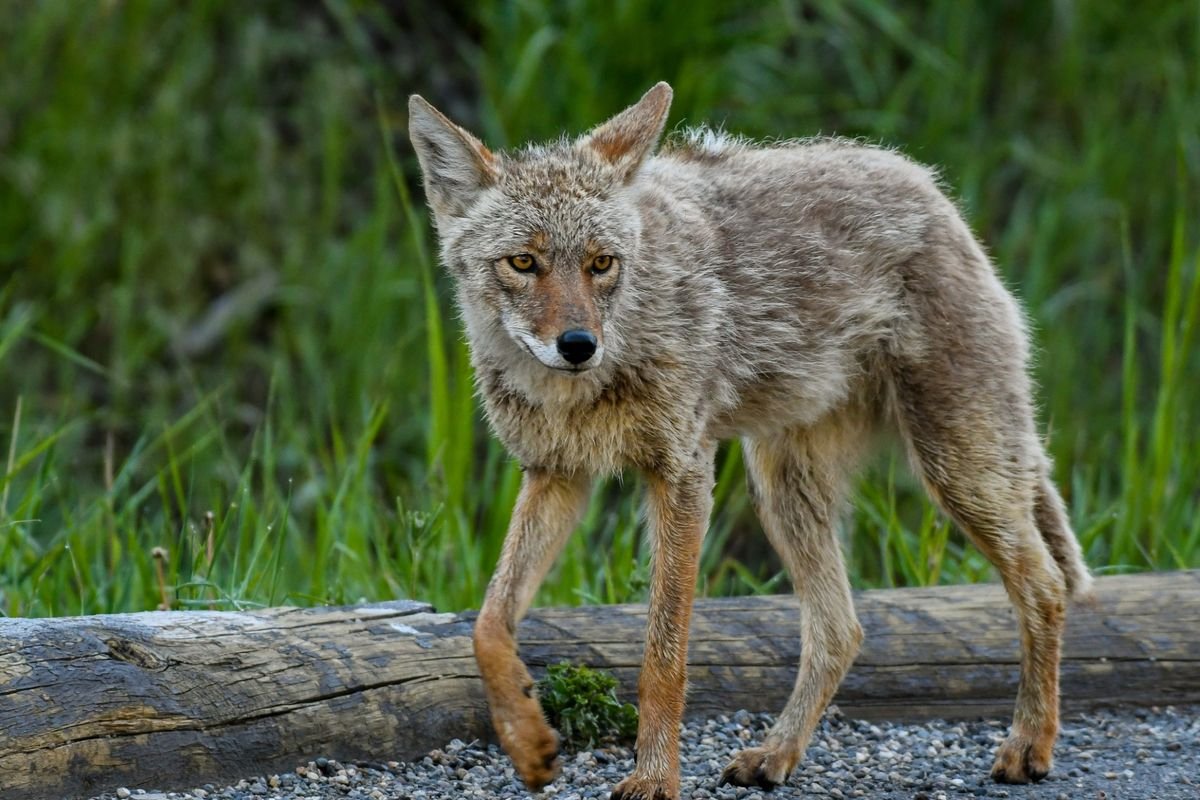
Why a Daring Coyote May Have Swum Two Miles to Reach Alcatraz Island
In January 2026, visitors to Alcatraz Island were shocked to find a coyote swimming through the frigid and choppy waters to the island. Video records of the animal show it swimming up to the rocky shore and struggling to pull itself out of the water.
Once on land, the coyote appeared exhausted and shaky, but eventually made its way around the island. After seeing the video, experts from the National Park Service (NPS) believed the coyote must have swum from somewhere nearby.
“Our working assumption was that the coyote made the swim from San Francisco because it is a significantly shorter distance,” Bill Merkle, a park wildlife service ecologist, said in a press release. “We couldn’t help being impressed by his accomplishment in making it to Alcatraz.”
San Francisco is about a mile away from Alcatraz, making for an impressive swim. However, after further research, park officials have announced that the coyote may have actually swum from a different island nearly two miles away.
Read More: How Universities Deal With Crocodiles or Coyotes on Campus
Coyote Escapes from Angel Island

One of the 14 coyotes that call Angel Island home, a likely relative of Floyd, the Alcatraz Coyote.
(Image Courtesy of the California Department of Fish and Wildlife (CDFW))
After the coyote’s arrival, park officials searched for it on the island. However, all they could find were fresh footprints and scat. Officials sent the scat to the University of California, Davis, Mammalian and Ecology Unit of the Veterinary Genetics Laboratory, where it underwent DNA analysis.
The results revealed that the coyote was male and, in fact, not from San Francisco. The coyote’s DNA matched that of a population that lives on nearby Angel Island, a state park.
“Three distinct coyote populations could have been the source of the Alcatraz coyote, San Francisco, Southern Marin, and Angel Island,” said Ben Sacks from UC Davis in the press release. “Our lab was able to take the DNA sample and match it to a coyote previously sampled from the Angel Island population.”
According to a social media post from the Golden Gate National Recreation Area, the coyote has earned the nickname “Floyd” after Floyd Hamilton, a prisoner from Alcatraz who was forced to swim back to the island after a failed escape attempt.
Why Did the Coyote Come to Alcatraz?
Alcatraz Island was once home to a U.S. military fortress that was converted into a federal penitentiary in the 1930s, where notorious prisoner Al Capone was once an inmate. However, in the 1960s, the prison was closed due to cost, according to the NPS. Today, it’s part of the Golden Gate National Recreation Area, and visitors can take a ferry to explore the island.
Floyd was likely not visiting the island as a tourist, so why would he decide to come to the island at all? Researchers still aren’t sure, but they have a few theories.
According to Brett Furnas, a quantitative ecologist and senior environmental scientist supervisor for the California Department of Fish and Wildlife, the coyotes on Angel Island likely first arrived in 2017 after a single pregnant female swam from Marin on the mainland. Further research indicates that 14 coyotes currently live on Angel Island, and Floyd’s DNA matches that of M24-8, a male from Angel Island.
In September 2025, a coyote was spotted swimming around Angel Island, then returning to shore, so the fact that Floyd made his way to Alcataz doesn’t surprise Furnas.
“My guess is that M24-8 (or Floyd, as he has been dubbed in the press) was trying to swim north but was swept about in the currents and was very lucky to struggle ashore at Alcatraz before being carried out the Golden Gate or elsewhere. Since we know M24-8 is a ‘boy,’ it is not surprising he would try to disperse off Angel Island to find his own territory – and the only way to do that is to swim,” Furnas told Discover.
The island doesn’t have a source of freshwater, except for collected rainwater, according to the Golden Gate National Parks Conservancy, so it’s not exactly an ideal location to call home. Though the site is a protected area for nesting seabirds, it could provide a food source.
Because of the nesting habitat, NPS officials wanted to quickly locate and relocate the coyote. Though they set up video and audio recording devices, after months of monitoring, there were no further signs of the coyote, and the only remains found were seabird remains.
“During the time we believe the coyote was on the island, we found bird carcasses that showed signs of predation, so we think the coyote was able to hunt and consume nesting seabirds such as Brandt’s cormorants,” Joshua Winchell, the chief of communications and special park uses at the Golden Gate National Recreation Area, told Discover.
Where Did the Coyote Go?
Because park officials were unable to find any remains or evidence that the coyote was still on the island, it is believed the coyote may have left the island and swam elsewhere.
“We don’t know what happened to the coyote,” said Merkle in the press release. “But he proved himself an expert swimmer to get to Alcatraz, and I hope he made a successful swim back home to Angel Island.”
Furnas believes that Floyd may have returned to the water and, hopefully, made it to shore in San Francisco or Marin.
“Coyotes are known to be resilient and adaptable,” Merkle said in the release, “and he certainly demonstrated those qualities.”
Read More: Three Cougar Kittens Caught on Camera in Minnesota for the First Time in 100 Years
Article Sources
Our writers at Discovermagazine.com use peer-reviewed studies and high-quality sources for our articles, and our editors review for scientific accuracy and editorial standards. Review the sources used below for this article: