
Mysterious, Deep-Sea Golden Orb May be From a Giant Sea Anemone

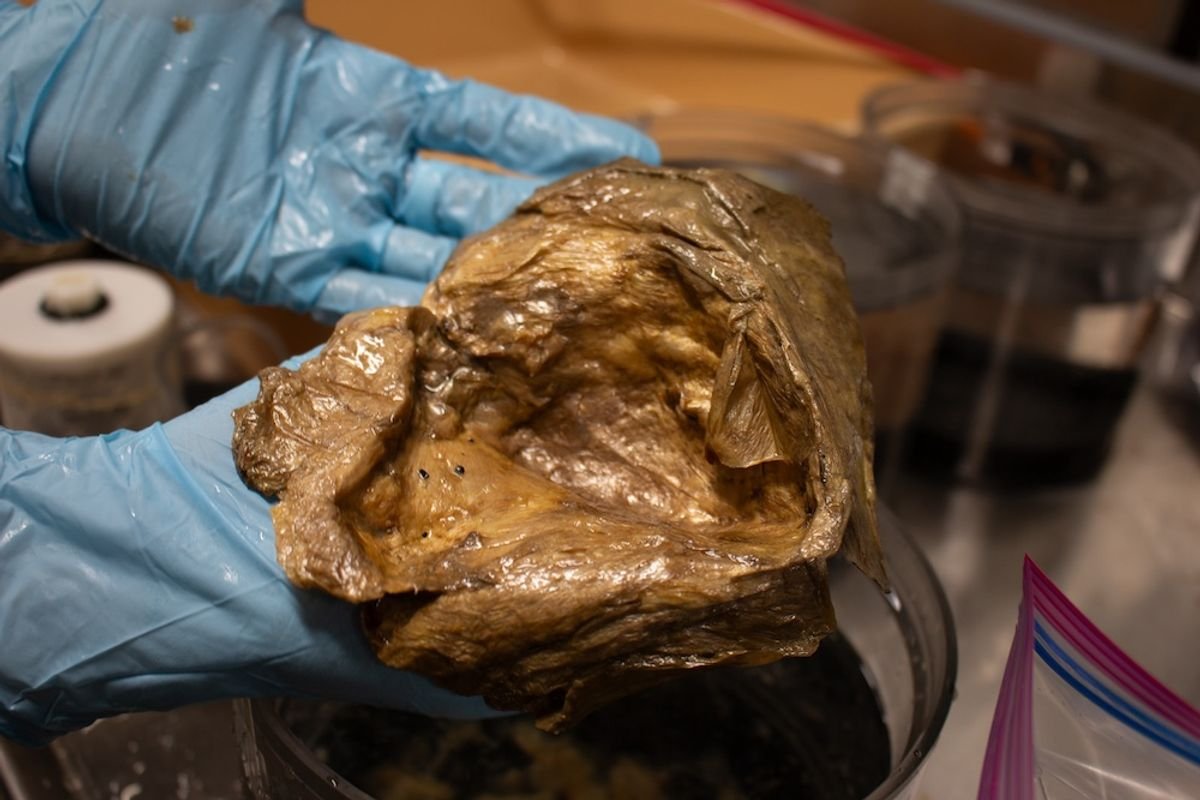
In 2023, divers taking part in a deep-sea expedition 10,600 feet (3,250 meters) below the surface discovered something highly unusual: a golden blob glued to a rock.
The curious specimen could not be categorized, but suggestions abounded. Ideas put forward included an egg case, a dead sponge, and a piece of coral. Now, researchers appear to have the answer: The golden orb is the remnants of a species of a giant deep-sea anemone called Relicanthus daphneae.
“So often in deep ocean exploration, we find these captivating mysteries, like the ‘golden orb.’ With advanced technologies like DNA sequencing, we are able to solve more and more of them,” CAPT William Mowitt, acting director of NOAA Ocean Exploration, said in a press release. “This is why we keep exploring – to unlock the secrets of the deep and better understand how the ocean and its resources can drive economic growth, strengthen our national security, and sustain our planet.”
A pre-print describing the research has been published in bioRxiv as the paper awaits peer review.
Examining the Golden Orb’s Physical Properties
The golden orb was found during a NOAA Ocean Exploration expedition in the Gulf of Alaska over two years ago, and its identity has stumped scientists ever since. To solve the mystery, researchers studied its physical characteristics and conducted a genetic analysis — only the process turned out not to be as simple as originally thought.
“We work on hundreds of different samples and I suspected that our routine processes would clarify the mystery. But this turned into a special case that required focused efforts and expertise of several individuals,” Allen Collins, a zoologist and director of NOAA Fisheries’ National Systematics Laboratory, who was involved in the research, said in a press release. “This was a complex mystery that required morphological, genetic, deep-sea and bioinformatics expertise to solve.”
During an initial investigation, the team could not identify muscle tissue or any other feature indicative of animal anatomy, but a close-up examination revealed the surface was full of stinging cells called cnidocytes. These are frequently found in cnidarians, a group of invertebrates that includes corals, anemones, and jellyfish.
It turned out the cells were a specific type of cnidocytes called spirocysts. This information enabled the team to narrow down the object’s identity even further. Spirocysts are found only in a specific group of cnidarians: Hexacorallia.
Read More: Carnivorous Death-Ball Sponge and Other New Species Have Been Found in the Deep Sea
Decoding its Genome
Attempts to identify the orb through a technique called DNA barcoding were unsuccessful — a result the researchers attribute to the confusion caused when technology picked up DNA from other microscopic life forms on the orb. However, attempts at whole-genome sequencing proved more fruitful.
Despite the orb lacking any anatomy typically associated with animals, sequencing did identify animal DNA. More specifically, it revealed genetic material from a species of giant deep-sea anemone.
When the researchers sequenced the mitochondrial genomes of the golden orb and a different specimen that had been collected during a 2021 expedition, they found both to be almost identical to a reference genome of a species of anemone called Relicanthus daphneae. These findings suggest the “golden orb” is left over dead cells from a giant anemone.
R. daphneae is globally distributed and exists at depths between 5,469 and 12,952 feet (1,667 and 3,948 meters). According to a study published in Scientific Reports, it is typically a purple-pink color and has exceptionally long tentacles that can reach lengths of two meters.
“Delightfully Strange”
While the mystery has been solved, the case goes to show the ocean is full of surprises.
“Isn’t the deep sea so delightfully strange?” NOAA Ocean Exploration’s Sam Candio said in a press release in 2023, at the time of the discovery. “While somewhat humbling to be stumped by this finding, it serves as a reminder of how little we know about our own planet and how much is left to learn and appreciate about our ocean.”
Read More: The Mariana Trench Plunges 36,000 Feet — Hiding Mysterious Creatures and a Beer Bottle
Article Sources
Our writers at Discovermagazine.com use peer-reviewed studies and high-quality sources for our articles, and our editors review for scientific accuracy and editorial standards. Review the sources used below for this article: