
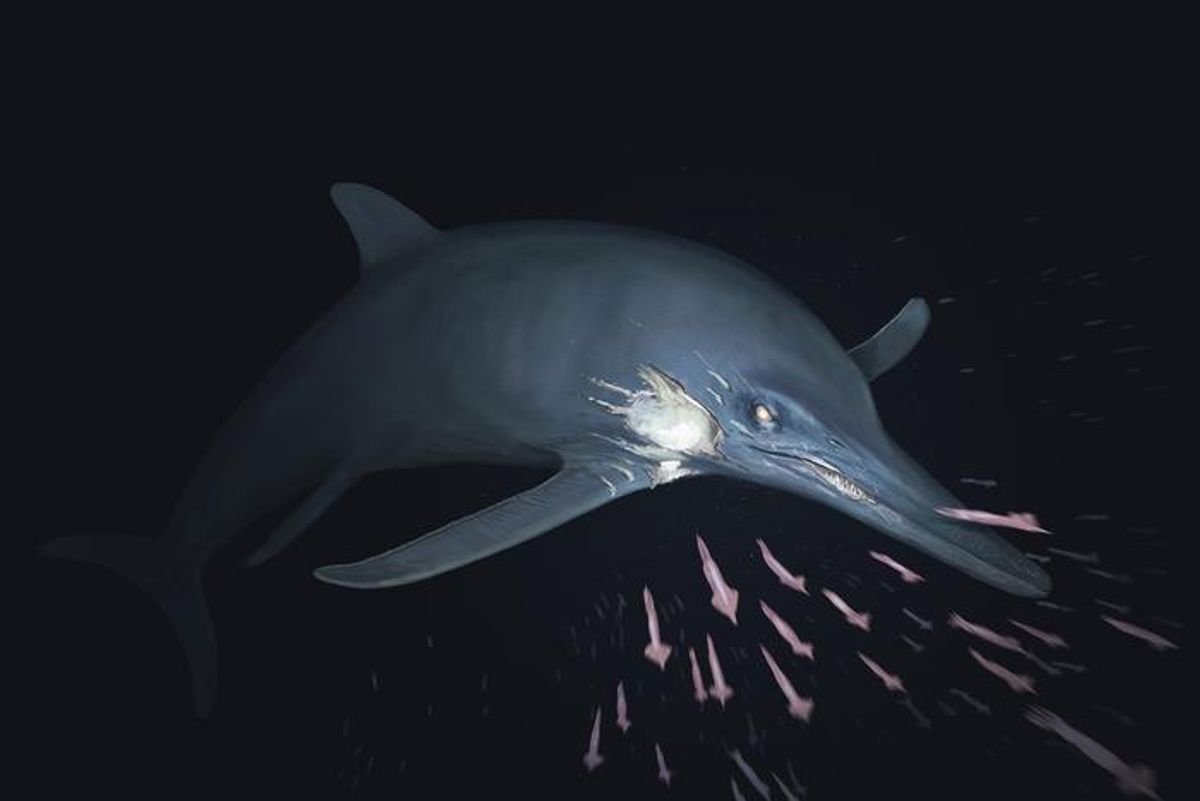
180-Million-Year-Old Ichthyosaur Found With 100 Teeth and Rocks In Its Stomach

A battered, 180-million-year-old sea predator with a stomach full of rocks may be a new example of perseverance in the face of extreme odds.
Discovered in a clay pit in northern Germany, a giant ichthyosaur showed clear signs of serious injuries that should have made hunting nearly impossible, according to a new study published in Zitteliana. However, against the odds, it lived on, leaving behind clues in its bones, teeth, and the contents of its stomach that are allowing scientists a rare look at survival in the prehistoric ocean.
“Our Temnodontosaurus fossil is one of the youngest finds of this ichthyosaur genus to date,” said author Ulrike Albert in a press release. “Until now, representatives of this genus have mainly been known from older geological layers, such as the Posidonia Shale of Holzmaden. The discovery from Mistelgau now shows that these large marine reptiles survived longer in the Southwest German basin than previously documented.”
A Giant Ichthyosaur That Beat the Odds
The fossil, unearthed in the Mistelgau clay pit near Bayreuth in Germany, belongs to the genus Temnodontosaurus, one of the largest known ichthyosaurs. These dolphin-like marine reptiles once dominated the ancient seas, and this individual was no small specimen. Based on a skull measuring just under five feet, researchers estimate the animal stretched roughly 21 feet in total length.
What makes this find stand out isn’t just its size — it’s the level of preservation. The fossil included parts of the skull and lower jaw, shoulder girdle, forefins, spine, and more than 100 teeth. Even delicate structures, like parts of the palate and eye region, were preserved in remarkable three-dimensional detail.
But the real story lies in its injuries. The skeleton showed multiple signs of trauma, particularly in the shoulder and jaw joints. This damage likely impaired the ichthyosaur’s ability to capture prey and should have shortened its lifespan.
Read More: New 183 Million-Year-Old Marine Reptile Identified in Germany Is Oldest Known in the Area
Mysterious “Stomach Stones” Offer Clues to Survival
Inside the ichthyosaur’s abdominal region, researchers identified gastroliths — small stones that had once sat in the animal’s digestive system. These “stomach stones” are occasionally found in some animals, but they are exceptionally rare in ichthyosaurs like Temnodontosaurus.
According to the University of California Museum of Paleontology, scientists aren’t entirely sure what role gastroliths played in marine reptiles. One leading idea is that they helped grind up food, acting almost like internal milling tools for breaking down prey such as fish.
In this case, the presence of gastroliths may point to something more dramatic: a dietary shift. With injuries that likely made active hunting difficult, this ichthyosaur may have adapted its feeding strategy, possibly consuming softer prey or relying on alternative methods to process food.
“The injuries likely significantly limited the animal’s ability to catch prey. The fact that it nevertheless survived is evidenced, among other things, by its heavily worn teeth and gastroliths, which we were able to identify in the abdominal region,” explained Stefan Eggmaier, another author of the study.
Combined with its heavily worn teeth, the stones hint at a survival strategy that allowed the animal to persist despite serious physical limitations.
What Ichthyosaurs Reveal About Ancient Oceans
The Mistelgau site has long been known for its well-preserved marine fossils, and excavations have been ongoing since 1998. This latest discovery adds a new layer to that work. Not only does it provide new insight into the known timeline for Temnodontosaurus in the region, but it also offers a rare glimpse into how these animals survived in an unforgiving ecosystem.
Future research will focus on analyzing the ichthyosaur’s teeth and bone structures to better understand its diet, behavior, and environment. These insights will help reconstruct the ecology of the Jurassic seas in what is now Upper Franconia.
Read More: Think Pterosaurs and Plesiosaurs Are Dinosaurs? Here’s Why These and Other Species Are Not
Article Sources
Our writers at Discovermagazine.com use peer-reviewed studies and high-quality sources for our articles, and our editors review for scientific accuracy and editorial standards. Review the sources used below for this article: