
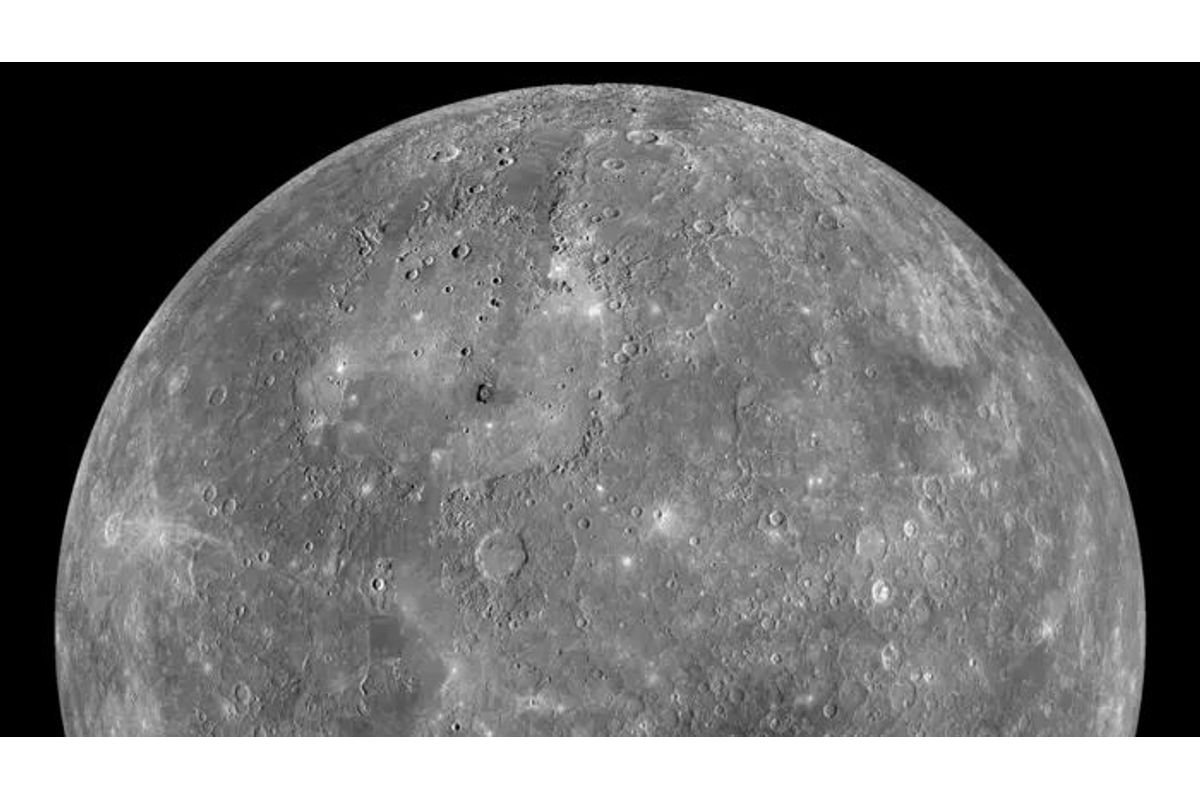
JWST Spots a Nearby Super-Earth That Could Look Like the Moon or Mercury
Exoplanet LHS 3844 b is a rocky world orbiting a cool red dwarf 48.5 light-years away. With a radius 30 percent larger and a mass more than double that of Earth’s, it officially fits the description of a Super-Earth, according to NASA. But new research suggests it resembles Mercury or the moon more than it does our home planet.
A study recently published in the journal Nature Astronomy used evidence collected from the James Webb Space Telescope (JWST) to determine LHS 3844 b’s surface composition.
“Thanks to the amazing sensitivity of JWST, we can detect light coming directly from the surface of this distant rocky planet,” Laura Kreidberg, Director of the Max Planck Institute for Astronomy in Germany, said in a statement. “We see a dark, hot, barren rock, devoid of any atmosphere.”
Read More: When Searching for Life on Exoplanets, a Lack of Its Signs Is Only a Starting Point
A Moon-Like Planet

Data collected from the JWST shows the infrared spectrum of LHS 3844 b’s hot dayside derived from the brightness contrast to its host star in ppm (parts per million = 0.0001%) at different wavelengths.
(Image Credit: Sebastian Zieba et al./MPIA)
To find out exactly how similar LHS 3844 b is to Earth, astronomers used JWST technology that can provide clues about a planet’s surface composition. Specifically, the team used the MIRI (Mid-Infrared Instrument), which measures the absorption and emission of light and radiation in the mid-infrared section of the electromagnetic spectrum.
Rather than observing the planet directly, the researchers measured changes in brightness levels compared to its host star. An additional data point, collected from observations made by the Spitzer Space Telescope, was also included. These measurements were then compared with models from the RELAB spectral database to determine which surface type could produce the observed spectrum.
The results suggest the exoplanet resembles Mercury, or even the moon, more than it does our home planet. Its surface is likely to consist of basalt or mantle rock — materials that contain high concentrations of magnesium, iron, and a magnesium-iron silicate called olivine — rather than a silicate-rich crust like Earth. There is also the possibility that the surface is composed of crushed material, such as rock or gravel, resulting from space weathering. Devoid of an atmosphere, LHS 3844 b would be and still is particularly vulnerable.
“It turns out, these processes not only slowly dissolve hard rocks into regolith, a layer of fine grains or powder as found on the moon,” Sebastian Zieba at the Harvard & Smithsonian Center for Astrophysics, who led the research, said in a press release. “They also darken the layer by adding iron and carbon, making the regolith’s properties more consistent with the observations.”
Young And Solid Versus Old And Powdery
The team identified two possible scenarios that could result in the planet’s “very dark and featureless surface.” The first is a young exterior featuring solid rock that is yet to be pulverized by space weather. The second is an old, powdery surface damaged by space weather, not dissimilar to the moon.
The researchers point out that a younger surface would imply ongoing geological activity, such as volcanism. However, there is no evidence of volcanic outgassing, which would be expected to produce carbon dioxide and sulfur dioxide. Still, they call for more observations to provide greater clarity.
What Else Do We Know About LHS 3844 b?
Researchers announced the discovery of LHS 3844 b in 2019. Unlike Earth, the exoplanet has an extremely speedy orbit. The distance between it and its host star is equivalent to just three stellar diameters, and it completes the round trip in just 11 hours.
This is the same amount of time it takes for it to rotate around its axis, the study’s authors explain. It means one side of the planet experiences permanent daytime with average temperatures of 1,340°F (725°C), while the other side undergoes constant darkness. The measurements used in the study were obtained from LHS 3844 b’s dayside.
Read More: 5 of the Strangest and Most Dangerous Exoplanets Ever Discovered
Article Sources
Our writers at Discovermagazine.com use peer-reviewed studies and high-quality sources for our articles, and our editors review for scientific accuracy and editorial standards. Review the sources used below for this article: