
Early Humans Returned to This Pyrenees Cave for 2,000 Years and Left Bones, Hearths, and Rare Jewelry
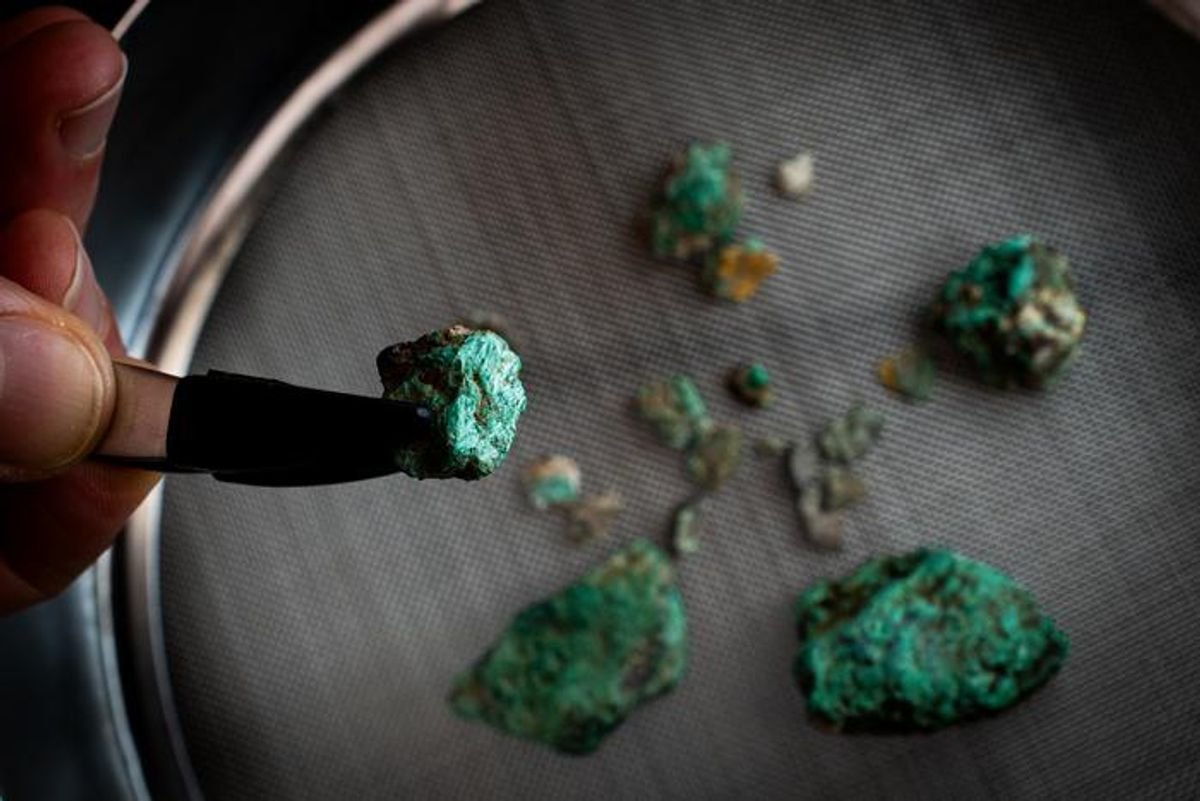
Within a cave in the Pyrenees Mountains, researchers have uncovered evidence that prehistoric humans may have used the site for copper mining; however, further digging has revealed that it may also have been used for something else — burials. Evidence, including green minerals, a finger bone, and a tooth, is changing what we know about the relationship early humans had with high-altitude places.
These findings, published in Frontiers in Environmental Archaeology, indicate that the early peoples visiting these caves were well supplied and were likely using this site for about 2,000 years, which rewrites previous research stating that early peoples did not spend long stretches of time at high altitudes.
“For a long time, high-mountain environments were seen as marginal, places prehistoric communities passed through occasionally,” said Carlos Tornero of the Catalan Institute of Human Paleoecology and Social Evolution, and lead author of the study, in a press release.
“But we found a really rich archaeological sequence, including multiple combustion structures and a very large number of green mineral fragments. We can’t say exactly how long people stayed each time, but the repeated use of the space and the density of remains suggest occupations that were short to medium in duration, but happening again and again over long periods of time,” Tornero added.
Read More: Charcoal at an 800,000-Year-Old Campsite Suggests Early Humans Were Drawn to an Abundant Supply of Driftwood
Cave 338’s Evidence of Early Humans
For this study, the research team explored Cave 338, which resides in the Freser Valley. The cave sits at about 7,300 feet above sea level, and near the entrance, the research team uncovered four layers with evidence of occupation.

Archaeologists excavating Cave 338.
(Image Credit: IPHES-CERCA)
The first layer — the youngest and most recent — was relatively thin, indicating that people were not frequenting the area as much, though it did contain some historical artifacts. Within the fourth layer, the team noted that it contained only charcoal fragments, which dated to about 6,000 years ago.
However, the second and third layers held a trove of archaeological information. In total, the team discovered 23 hearths that contained burned and crushed green mineral fragments. While more research is still needed to confirm which minerals they are, the team says the fragments appear to be malachite, a mineral that can be used to produce copper. According to the team, Cave 338 could have been a high-altitude mining camp.
While still distinct, the researchers note that the hearths cut across each other, suggesting the space was frequently reused, with longer gaps between uses. The radiocarbon dating pinpoints one hearth within the second layer at 3,000 years old, and the hearths in the third layer are about 5,500 years to 4,000 years old.
“Many of these fragments are thermally altered, while other materials in the cave are not, which clearly suggests that fire played an important role in their processing and that there was a deliberate intention behind it,” said Julia Montes-Landa of the University of Granada and study co-author in the press release. “In other words, they weren’t burned by accident.”
A Cave Full of Value
In addition to minerals, the researchers uncovered human remains in the third layer. The remains, which include a baby tooth and a finger bone, may have belonged to an 11-year-old child, though there isn’t enough evidence to indicate if the remains are from the same person or what the cause of death may have been.

Found at Cave 338, a pendant made from bear incisor.
(Image Credit: IPHES-CERCA)
The team also discovered jewelry in the second layer.
“We recovered two pendants: one made from a shell and another from a brown bear tooth,” said Tornero. “They come from prehistoric contexts, most likely around the second millennium B.C. The shell pendant is interesting because it has parallels in other sites in Catalonia, which suggests shared traditions or connections between different communities. The bear tooth pendant is much less common. That might point to something more specific or symbolic, possibly linked to the local environment.”
While more research is needed on the cave findings, the team concludes that Cave 338 was not a permanent residence for early peoples, but that something valuable about this place drew them back for thousands of years. The next steps will be to identify the green minerals and continue their excavations.
Read More: Ancient DNA Reveals Family Was Not Always About Blood and May Redefine Kinship
Article Sources
Our writers at Discovermagazine.com use peer-reviewed studies and high-quality sources for our articles, and our editors review for scientific accuracy and editorial standards. Review the sources used below for this article: