
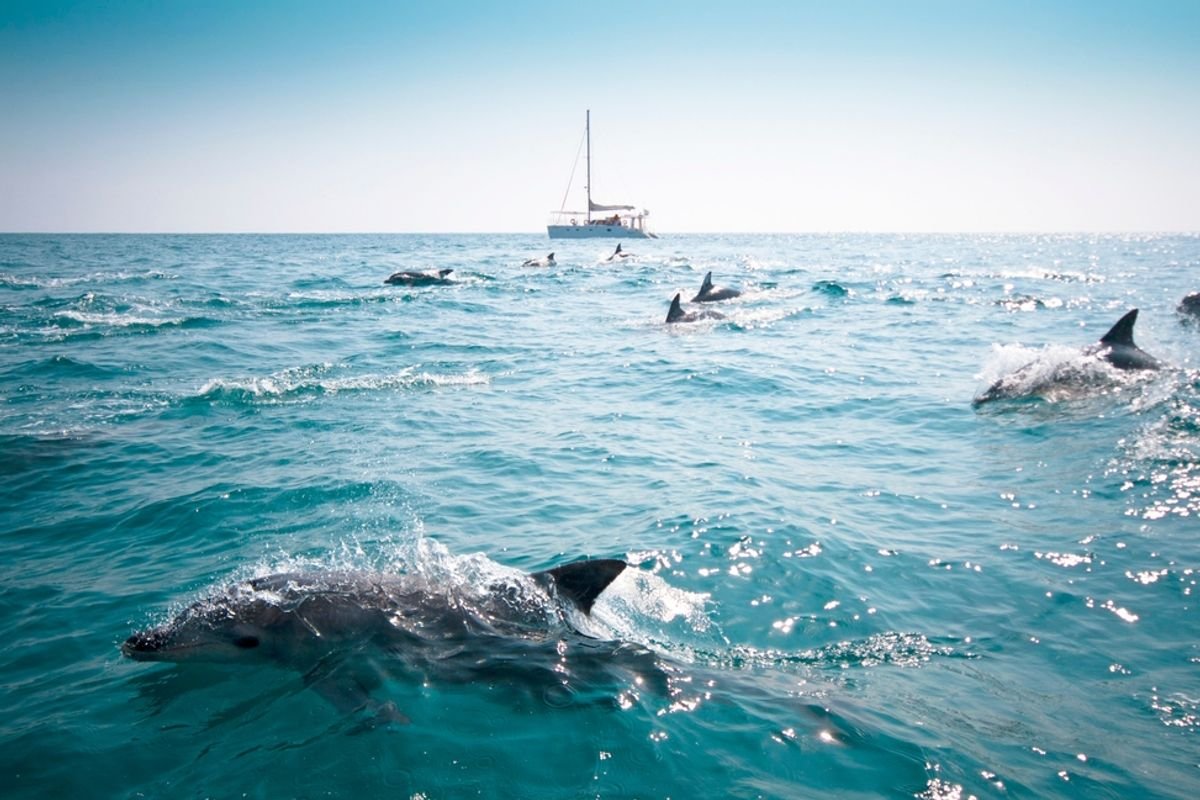
Dolphins Create Invisible Vortices With Their Tails, Helping Them Power Ahead Underwater
Dolphins are among the fastest marine mammals, with some species reaching speeds of up to 37 miles per hour (mph). But what exactly makes these agile swimmers so fast hasn’t been fully understood. Understanding the physics of animals’ speed, especially underwater, may help improve propulsion in fluid-based human-made technologies, such as submarine robots.
By running large-scale simulations of dolphins rushing through the waves under a variety of conditions, researchers from the University of Osaka, Japan, have uncovered new insights involving differently sized vortices generated by the dolphins’ tails.
In summary, the study, published in Physical Review Fluids, highlights that understanding how vortices behave within turbulence is crucial to explaining how dolphins reach these top speeds.
Tracking Dolphins’ Speed

Model of dolphin creating vorticies while swimming
(Image Credit: Yutaro Motoori)
When dolphins are hunting or surfing in boat wakes, they can reach speeds between 20 and 37 mph, leaving behind close relatives like orcas and porpoises. For comparison, competitive swimmers max out at around 8 mph.
What gives dolphins their edge is the way they flap their tails. They move their fins up and down in a powerful kicking motion, pushing water backward and generating turbulence made up of multiple swirling vortices. But from a mechanical physics perspective, it hasn’t been entirely clear how this turbulence actually propels the dolphin forward, let alone at such high speeds.
“Our goal is to understand which parts of the turbulent flow help dolphins swim so quickly,” said study lead author Yutaro Motoori, associate professor at the Department of Mechanical Science and Bioengineering at the University of Osaka, in a press release. “Using a supercomputer, we can simulate and decompose the flow to determine which components play dominant roles.”
Read more: Cocaine Pollution May be Changing How Far Atlantic Salmon Swim — with Potential Ecosystem Effects
Big Invisible Vortices Generate Thrust
The supercomputer simulations revealed that a dolphin’s tail creates two different kinds of vortices. One type consists of large-scale vortices that generate thrust by pushing water backward. The other consists of many smaller vortices that arise as byproducts of the larger ones but don’t contribute significantly to forward motion.
“Our results show that the hierarchy of vortices in turbulence is crucial for understanding dolphin swimming,” explained study co-author Susumu Goto in the release. “The largest vortices are responsible for most of the propulsion, while the smaller ones are mainly by-products of turbulent flow.”
Boosting Underwater Robot Speed
Using advanced supercomputing, the researchers were able to observe fluid motion in unprecedented detail, something that would be practically impossible to study directly in nature. Another advantage was the ability to run multiple trials under different conditions, collecting large amounts of insightful data with relatively manageable effort.
“We find that our results are unchanged across a wide range of swimming speeds,” added Motoori, highlighting the robustness of their findings.
Beyond satisfying curiosity about the physical processes behind one of the fastest swimmers on the planet, these insights into how vortices influence propulsion could help improve human technologies. Applications might include faster, more energy-efficient underwater robots or systems designed to better control turbulence.
Read more: Like Kindergarten Buddies, Male Dolphins That Keep Friendships Can Live Longer
Article Sources
Our writers at Discovermagazine.com use peer-reviewed studies and high-quality sources for our articles, and our editors review for scientific accuracy and editorial standards. Review the sources used below for this article: