
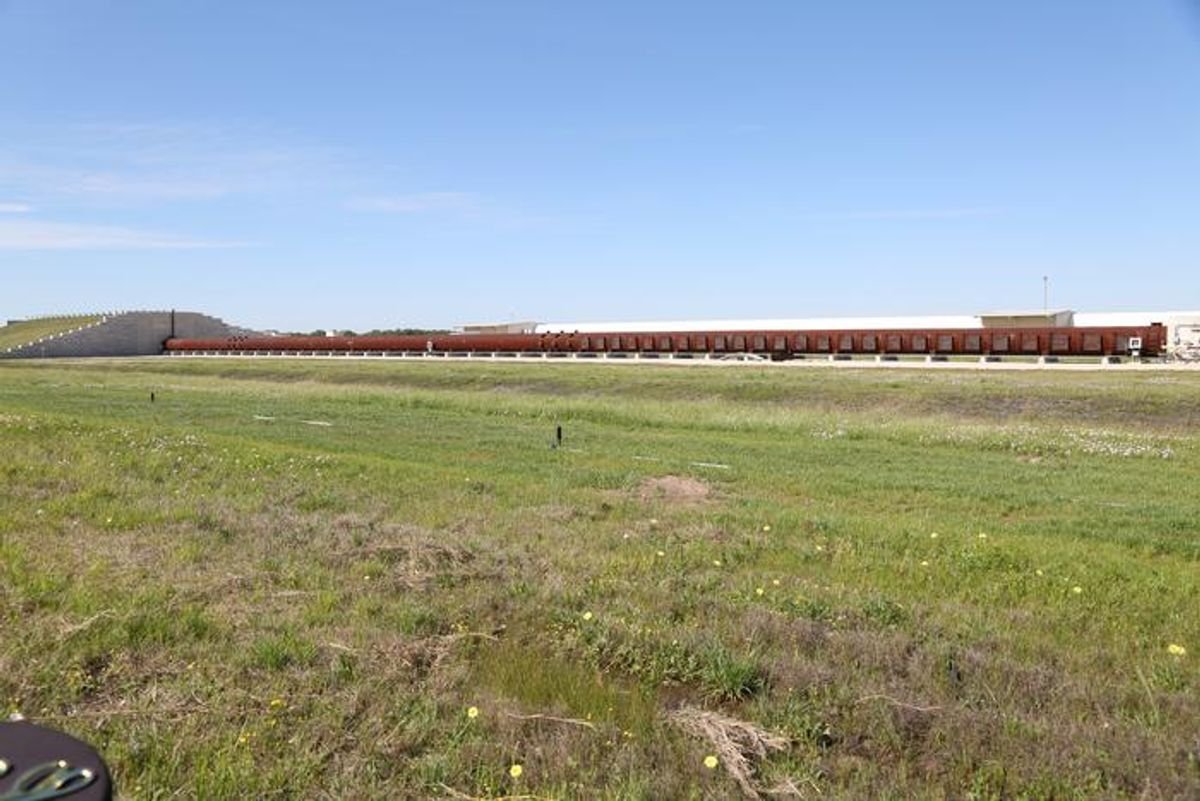
World’s Largest Explosions Lab in Texas Hopes to Ignite Breakthroughs in Hypersonic Flight and Star Death

On the list of things people want to replicate inside a building, an explosion would likely be pretty far down. But for a group of researchers at Texas A&M University, the ability to do just that is now possible thanks to a new world-first facility.
The newly unveiled Detonation Research Test Facility (DRTF) is now the largest academic lab of its kind, offering researchers the opportunity to observe explosions as they happen. With these observations, scientists hope to harness the violent forces behind explosions to answer some of the most complex questions in physics and engineering.
“The facility enables us to observe, measure and understand one of nature’s most extreme forces in ways that haven’t been scaled before, or even been possible until now,” said DRTF scientific director Elaine Oran in a press release.
How the Detonation Research Test Facility Studies Controlled Explosions
Built after years of planning and construction, the DRTF captures the split-second physics of detonation events that are normally too fast and chaotic to study. The facility is a massive steel-and-concrete structure stretching nearly two football fields in length. At its core is a long tube — nearly 500 feet — where researchers initiate and track controlled explosions with precision instruments.
Here is how a test works: researchers send an electric current through a wire embedded in a methane-air mixture. Once ignited, a powerful explosion surges through the tube, generating shockwaves that travel at speeds up to five times the speed of sound. The structure absorbs and manages the immense energy, channeling it through a sophisticated system that includes a 90-meter muffler designed to reduce noise.
“At the upstream end of the facility, where we initiate combustion, we have a concrete block that the facility is anchored to. We have a gas blower that mixes air with a reactive gas, and spanning the tube is an obstacle course of metal beams that generate turbulence. Once we initiate ignition, the shockwave moves down the tube into an open cavity muffler, which knocks down the sound signature from around 220 decibels to about 120, to limit noise to the ecosystem,” explained DRTF technical director Scott Jackson.
Each test produces a wealth of high-resolution data, allowing scientists to dissect the behaviors of extreme energy in real time.
Read More: Stars Are Born and Die Every Day — Here’s How They Evolve in Space
What Will DRTF Scientists Study?
One of the major focuses of DRTF is preventing industrial disasters, such as the 2005 Buncefield Fire in England, by studying how small instabilities can escalate into catastrophic detonations.
“We are examining these detonation disasters to develop and inform safer industrial designs and protocols that prevent unstable flames from cascading into catastrophes,” said Oran.
The facility is also advancing research into hypersonic travel — a frontier in aerospace engineering that could shorten the flight time from Los Angeles to New York City to just one hour. Unlike traditional engines, which rely on steady combustion, detonation-based propulsion systems use rapid, controlled explosions to generate thrust. Understanding this process could help unlock faster, more efficient air and space travel.
“Hypersonic is generally defined as speeds exceeding Mach 5, or five times the speed of sound, where gas is heated to the point that additional chemistry and boundary layer effects become important,” explained Jackson. “Detonations at the DRTF can reach Mach 5 in less than five seconds.”
The impact of the facility even reaches beyond Earth. Researchers are using the DRTF to better understand phenomena like supernovae — the explosive deaths of stars.
“The same fundamental processes that propagate down the DRTF’s steel tube also govern grand cosmic events, including supernovae. The scales are vastly different, but the physics is deeply connected,” said Oran.
A Training Ground for the Next Generation of Scientists
The DRTF is not just a research hub — it’s also a hands-on learning environment. Students are deeply embedded in the facility’s operations, gaining experience that blends theory with real-world experimentation.
“The students lead the facility,” said Ph.D. student Zachary Weidman. “We’re not just studying these phenomena, we’re actively contributing and building on the knowledge that will shape future applications.”
Read More: An Explosion of Twin Dead Stars May Signal the First Superkilonova Ever Seen in Space
Article Sources
Our writers at Discovermagazine.com use peer-reviewed studies and high-quality sources for our articles, and our editors review for scientific accuracy and editorial standards. Review the sources used below for this article: