
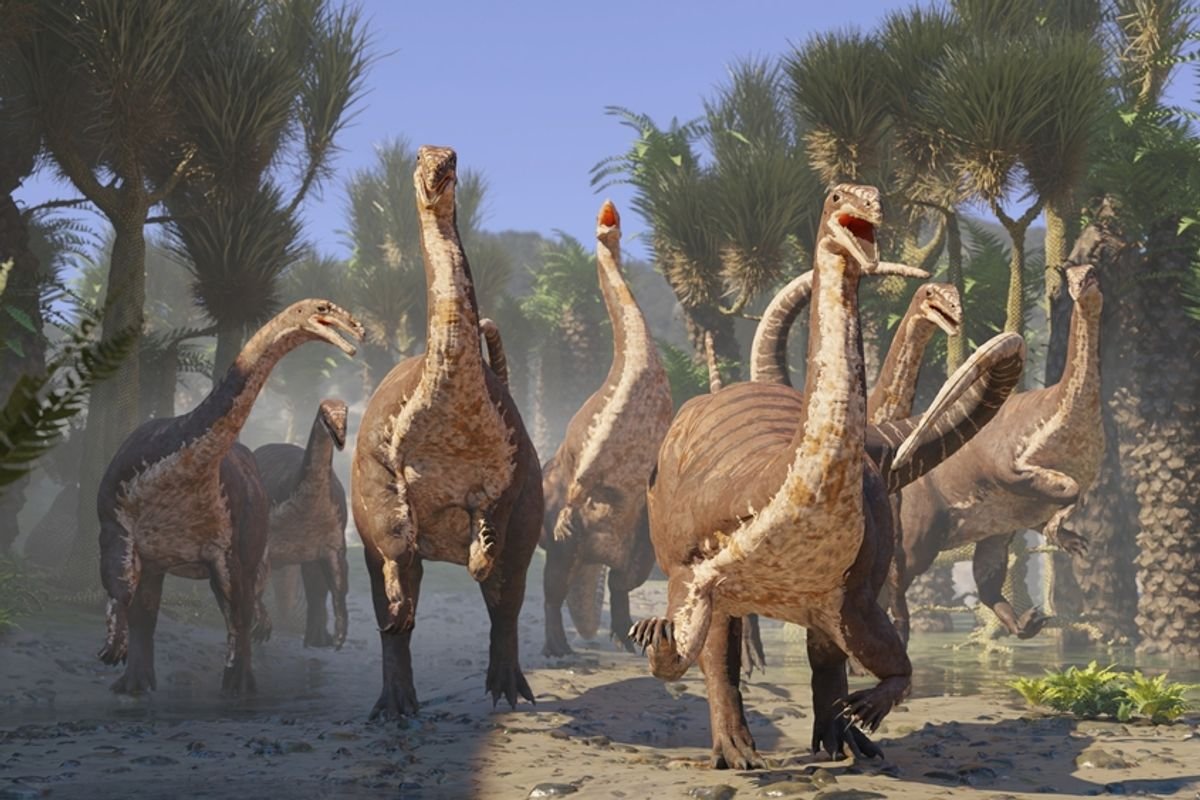
Dinosaurs May Have Emerged Earlier Than Thought—and Evolved in Rapid Bursts

The exact circumstances behind dinosaurs’ debut on this planet still aren’t fully understood, but they may have emerged earlier than originally thought. While the earliest dinosaur fossils date back to around 230 million years ago, a deep dive into dinosaurs’ evolutionary history suggests that they may have actually arisen 250 to 240 million years ago.
A study recently published in the Proceedings of the Royal Society B has determined that dinosaurs likely emerged 10 million years before their first fossils appeared. This new estimate came to light after researchers modeled the morphological evolution of dinosaurs — in other words, how dinosaurs’ physical form and structure changed over time. This revealed that dinosaurs experienced a burst of evolution early on, diversifying soon after they arrived on the scene.
The Emergence of Dinosaurs
The age of Dinosauria, the group that consists of all dinosaurs, has historically been tricky to pin down. According to the new study, this is due to the high lineage diversity of dinosaurs and their wide distribution upon appearing in the fossil record between 230 and 233 million years ago, during the early stages of the Late Triassic.
The researchers involved with the study aimed to unravel this mystery by looking at the evolution of the earliest dinosaurs. To accomplish this, they referenced nine morphological datasets to examine the evolutionary relationships between various dinosaur clades.
With this data, they came up with the estimate that dinosaurs emerged between 250 and 240 million years ago. This aligns with existing evidence of ichnofossils, or trace fossils, which represent indirect evidence of biological activity as opposed to actual preserved remains of an organism; prior research in Poland uncovered fossilized tracks — some dating as far back as 250 million years ago — that are thought to have been created by close relatives of dinosaurs, according to a 2010 study in the Proceedings of the Royal Society B.
Read More: The First Known Dinos Grew at a Rapid and Continuous Rate
Tracking the Tempo of Dinosaur Evolution
From the datasets, the researchers also pinpointed the rate, or tempo, of early dinosaurs’ morphological evolution. They found that soon after the emergence 250 to 240 million years ago, dinosaurs diversified into multiple lineages and went through a period of rapid evolution.
All of these lineages likely branched off within 5 million years of the dinosaurs’ origin; species in each lineage began to develop distinct body changes and traits. However, rates of morphological evolution dropped sharply in the late stages of the Triassic, potentially extending into the Jurassic, according to the researchers.
How Mass Extinctions Create Opportunities
The study’s results reflect a broader trend in dinosaur history: throughout their existence, they’ve evolved in multiple, sporadic bursts.
The researchers suggest that one of the main factors driving the bursts of evolution is mass extinction events. This may seem paradoxical at first, but mass extinctions can open up a wide range of ecological niches; this causes the rapid diversification of lineages, a process referred to as adaptive radiation, according to the University of California, Berkeley. Mammals, for example, diversified upon filling niches that were left open when dinosaurs went extinct following the Cretaceous-Paleogene extinction event around 66 million years ago.
The emergence of dinosaurs, the researchers write in the study, may have been driven by ecological opportunities becoming available after the End Permian extinction 252 million years ago. Despite a pattern of mass extinctions preceding rapid bursts of evolution, it doesn’t seem to hold for the Triassic-Jurassic extinction, which marks the boundary between the Triassic and Jurassic periods approximately 201 million years ago. The researchers didn’t detect a shift in morphological evolution during this time, which they say could simply be due to incomplete sampling of relevant dinosaur lineages.
Like dinosaurs, many lineages of plants and animals that exist today experienced rapid bursts of evolution. Examining evolutionary relationships, as demonstrated by the new study, can help scientists piece together how dinosaurs and other organisms evolved over time.
Read More: A Complete Dinosaur Timeline to Extinction: How Long Did They Roam Earth?
Article Sources
Our writers at Discovermagazine.com use peer-reviewed studies and high-quality sources for our articles, and our editors review for scientific accuracy and editorial standards. Review the sources used below for this article: