
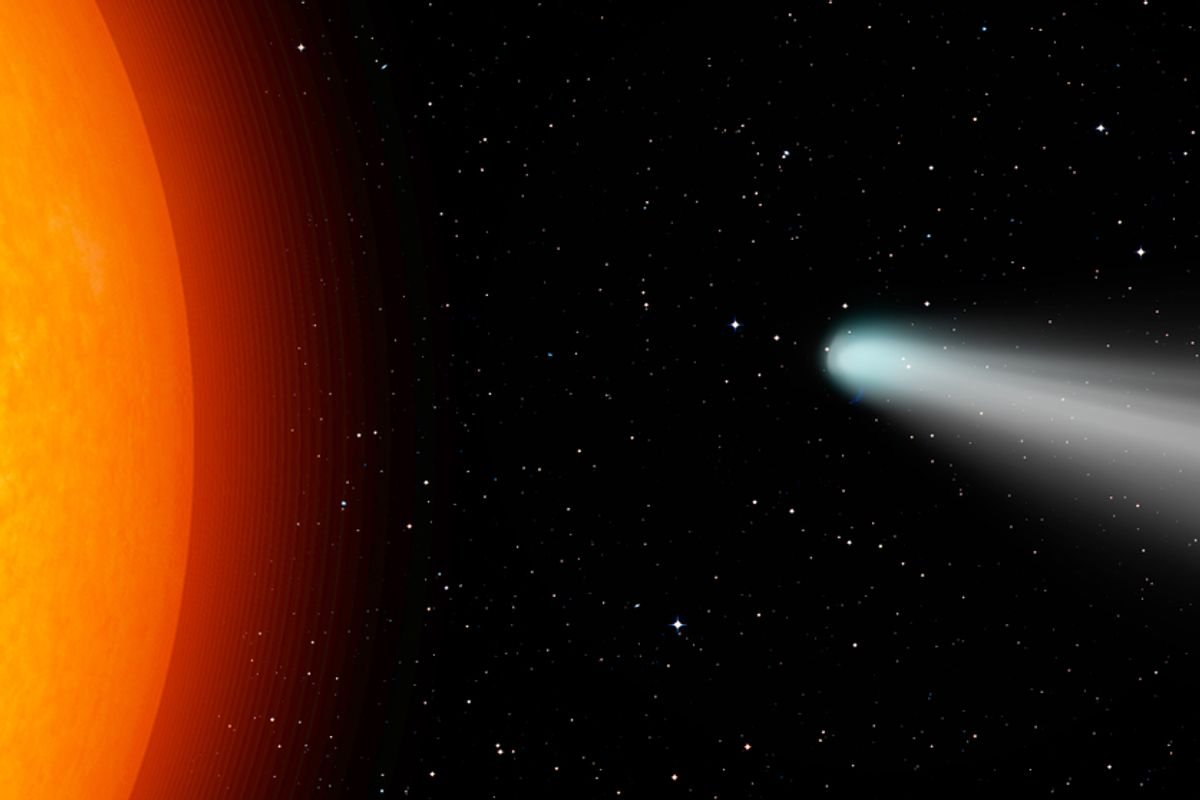
Comet MAPS Breaks Apart Near the Sun, Becoming a Rare Headless Wonder

A comet that once looked bright enough to light up the sky never made it past the sun. In early April 2026, Comet C/2026 A1 (MAPS) swept inward on a steep trajectory, passing closer to the sun than most objects survive. By the time it emerged from behind the sun’s glare, its core was gone — leaving behind what astronomers call a “headless wonder” (a comet whose tail continues on without its nucleus).
The comet skimmed just 160,000 kilometers (about 99,000 miles) above the sun’s surface on April 4, 2026. Instruments recorded a sudden brightening near its closest approach, followed by a disappearance. When it came back into view, only that trailing debris remained.
Comet MAPS Breakup Captured by SOHO Near the Sun
The event unfolded in data from the SOHO (Solar and Heliospheric Observatory), which uses coronagraphs to block the sun’s glare and reveal nearby objects. From Earth, the comet was impossible to follow. From space, however, its passage could be tracked continuously.
As reported by SpaceWeather.com, a brightening around 03:00 UTC likely marked the moment the nucleus failed under extreme heat and pressure. For a short time, the comet passed behind the instrument’s central disk. When it reappeared, the core had vanished, leaving a diffuse stream of dust.
That debris did not spread evenly. Instead, it formed narrow, parallel streaks known as striae — bands that can appear when large amounts of material are released at once. The result was a tail that looked structured, even though the comet itself had already disintegrated.
Read More: Astronomers Spot a New Sungrazer Comet — Could It be Bright Enough to See in Daylight This Spring?
Spotted Early, It Raised Hopes It Might Survive
Comet MAPS stood out months before its destruction. According to astronomer Alain Maury’s account from San Pedro de Atacama Celestial Explorations, it was first detected roughly 300 million kilometers (about 186 million miles) from the sun — about 82 days before its closest approach. That is unusually far for a sungrazing comet, which is often discovered much later.
First observed on January 13, 2026, by a small team using robotic telescopes in Chile, the comet was already active, showing a faint coma and tail. Because it was spotted so early, astronomers suspected it might be larger than typical sungrazers, with estimates placing its nucleus at up to roughly 2.4 kilometers (about 1.5 miles) across, though later evidence suggests it was smaller.
It also belonged to the Kreutz family, a group of comets thought to be fragments of a much larger object that broke apart centuries ago. Some of the brightest comets in recorded history have come from this group, raising the possibility that MAPS could survive its solar passage and become visible in daylight. Instead, it behaved more like a fragile fragment, breaking apart before it had the chance to fully develop
Why Sungrazing Comets Break Apart
Sungrazing comets follow extreme orbits that carry them very close to the sun, where conditions are far more intense than in the outer Solar System.
A preprint study on arXiv suggests MAPS may have been structurally weak before entering the inner solar system. As it approached the sun, that weakness began to show.
Solar radiation rapidly heats the surface, causing trapped gases to escape and pressure to build. At the same time, the sun’s gravity can stretch and distort the object. Sometimes these forces act gradually. In other cases, they trigger a sudden structural failure.
Observations from SOHO suggest MAPS reached that point just before its closest approach. The nucleus did not survive, leaving behind a stream of dust that will gradually disperse.
NASA’s Astronomy Picture of the Day (APOD) later highlighted that aftermath, focusing on the faint debris rather than the comet itself — showing how quickly something that has traveled for millions of years can disappear in a single pass by the sun.
Read More: Other ATLAS Comet Appears Fragmented After Close Encounter with The Sun
Article Sources
Our writers at Discovermagazine.com use peer-reviewed studies and high-quality sources for our articles, and our editors review for scientific accuracy and editorial standards. Review the sources used below for this article: