
Ancient DNA Reveals Family Was Not Always About Blood and May Redefine Kinship

Family doesn’t always follow a family tree. There are people we grow up with who feel like family, even if there’s no biological connection. New research suggests that kind of relationship may have been just as meaningful thousands of years ago.
A study published in the Cambridge Archaeological Journal finds that people buried together in ancient communities were often not biologically related. By comparing ancient DNA with burial patterns across sites in Europe and western Asia, researchers show that shared lives — not just shared genes — helped define kinship in the past.
“People buried together are often not genetically related. This suggests that belonging was not defined by biology alone. Ancient communities, therefore, recognized kinship through shared practices such as commensality and adoption, alongside other socially recognized forms of relatedness,” lead author Sabina Cveček told Discover. “Kinship does not follow a simple, linear path of evolution.”
How Ancient DNA Reveals Family Relationships
Much of what we know about ancient relationships comes from archaeogenetics — the study of DNA preserved in human remains. Though genetic material degrades over time, traces can survive in dense bones like the inner ear.
Scientists can now extract and sequence those fragments, but what they recover is incomplete. Instead, they rely on statistical models to reconstruct biological relationships.
That work can map ancient family trees, but it also reveals a limit: DNA shows who was related, not what made them family.
Read More: Ancient DNA Reveals Ibiza Was a Global Crossroads in the Medieval Mediterranean — and a Case of Leprosy
A House Full of Strangers
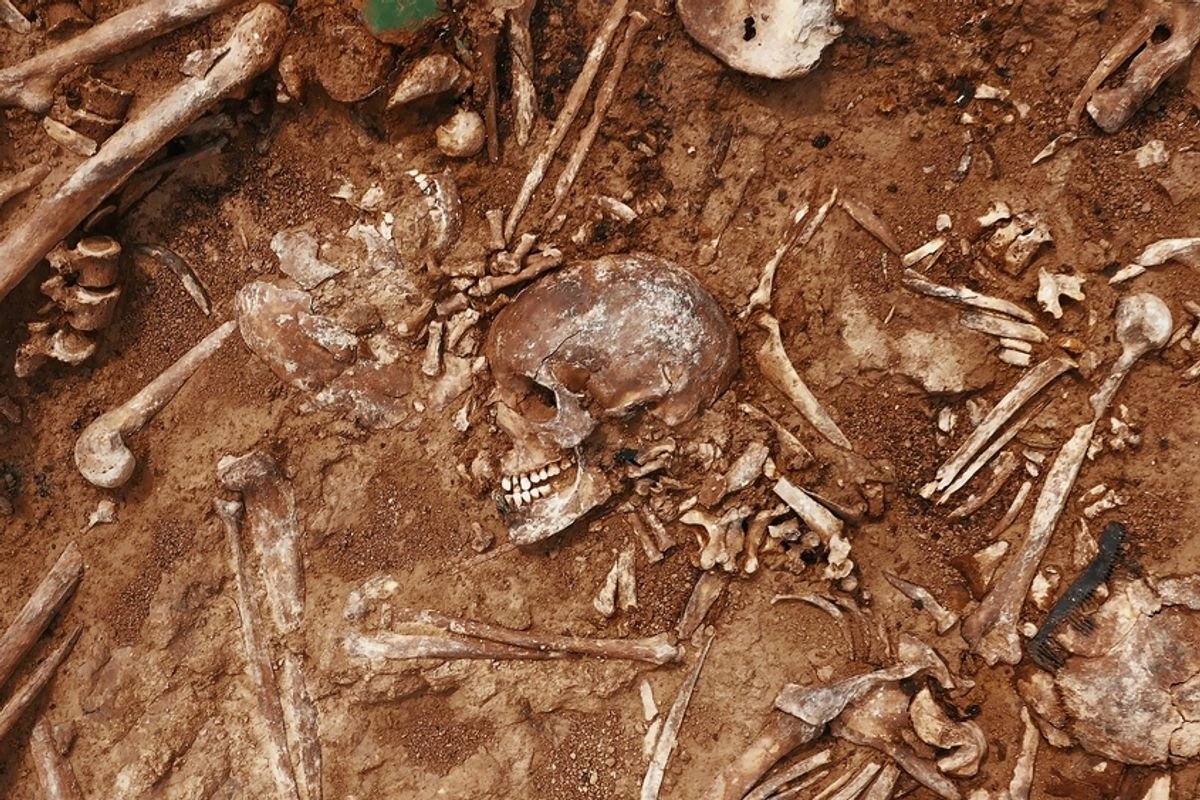
That gap becomes clear at Çatalhöyük, an 8,000-year-old settlement in Central Anatolia, where the dead were buried beneath the floors of homes.
For years, archaeologists assumed these burials reflected biological families. But genetic analysis has revealed that many individuals buried within the same house were not related.
“Çatalhöyük […] provided the evidence that many individuals buried together were not closely related. It suggests that people at Çatalhöyük created kinship through everyday co-residence — sharing space, food, and social ties — rather than just through blood,” Cveček shared with Discover.
The burial practices themselves suggest additional layers of meaning. In some cases, infants were buried separately from adults, a pattern seen across similar sites in Anatolia and the Balkans — possibly reflecting a form of “delayed personhood,” where social identity developed over time.
This pattern is forcing archaeologists to rethink long-standing assumptions. If people buried together weren’t necessarily related, then kinship in these communities may have been shaped less by ancestry and more by shared experience.
It also complicates how family systems evolved over time. Rather than following a single trajectory, the evidence points to variation and change. Some early farming societies in Europe appear to have been organized along paternal lines, while later Iron Age communities in Britain show signs of matrilineal structures. Together, those shifts point to kinship not being fixed or universal.
Rethinking What Counts as Family
The findings point to a broader shift in how researchers approach ancient societies. Ancient DNA has made it possible to reconstruct biological relationships, but those reconstructions capture only one layer of human connection.
Instead of relying on genetics alone, researchers are now pushing for a wider lens.
They propose “a framework that brings together context, ethics, training, and interpretation to rethink what counts as kin. This allows us to move beyond genetics alone and recognize multiple ways of becoming kin — including co-residence, care, and shared practices — across past communities,” Cveček told Discover.
In the end, the research points to family has never been defined by DNA alone, but by the relationships people build and choose to sustain.
Read More: Ancient DNA Reveals How Farming Spread in the Southern Andes of Argentina
Article Sources
Our writers at Discovermagazine.com use peer-reviewed studies and high-quality sources for our articles, and our editors review for scientific accuracy and editorial standards. Review the sources used below for this article:
- This article references information from a study published in the Cambridge Archaeological Journal: Kinship Trouble : What, When, Where, Why, and How — and So What?