
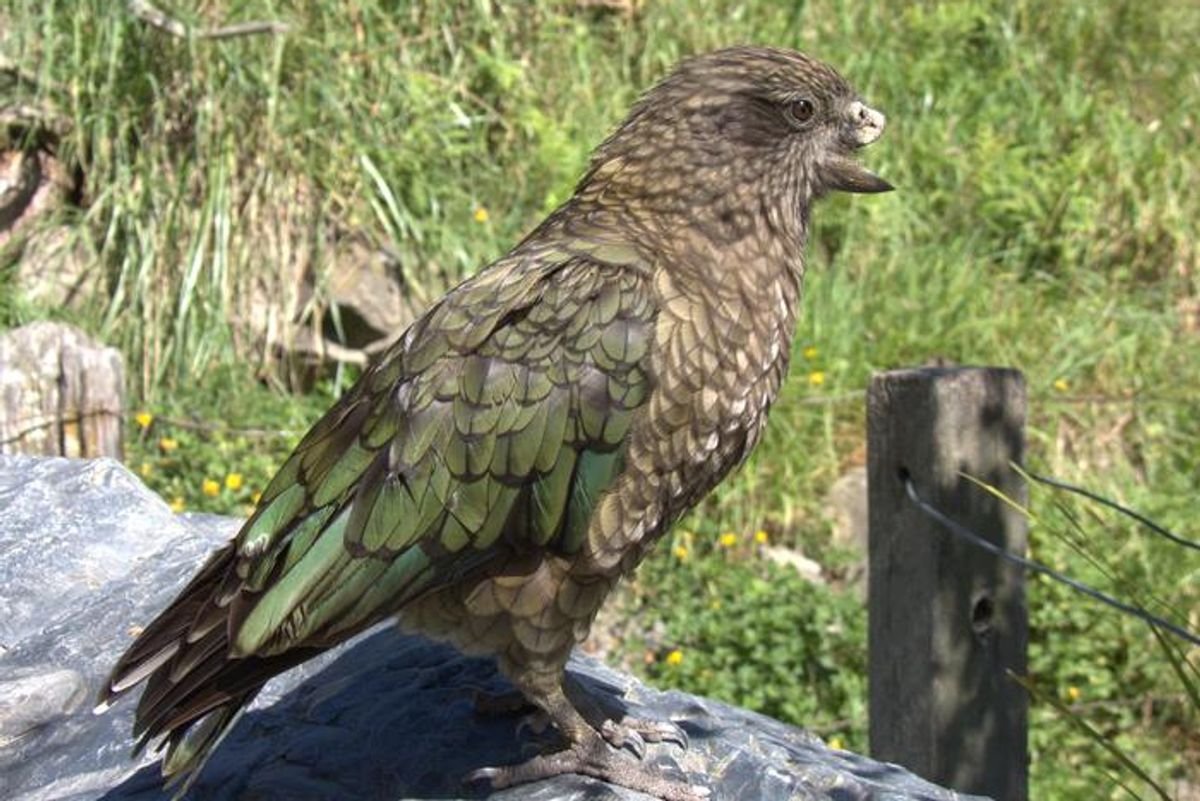
Bruce the Parrot Has No Upper Beak Yet Is the Undefeated Alpha Male Thanks to a “Jousting” Technique

Bruce is missing his entire upper beak, yet he’s the dominant male in his group. For most parrots, that’s the tool they rely on to fight, feed, and hold their place.
Bruce, an endangered kea living at Willowbank Wildlife Reserve in New Zealand, developed a fighting technique no other bird in his group uses, one that helped him rise to the top.
In a study published in Current Biology, researchers tracked Bruce and found that he uses his exposed lower beak in a jousting motion to outcompete other males, gain access to food, and maintain dominance, all while showing lower signs of stress. The work points to how behavioral innovation can enable animals to adapt to, and in some cases overcome, physical disabilities.
“Bruce is the alpha male of his group,” said study first author Alexander Grabham in a press release. “He achieved this status by himself with the aid of a completely novel fighting technique — a jousting thrust with his exposed lower beak — that beak-intact kea cannot replicate.”
How Bruce Uses a Unique Fighting Strategy
Kea usually fight at close range, using their beaks to push and control one another. Since Bruce can’t rely on that kind of contact, he keeps a bit of distance, striking with quick, targeted thrusts that catch other birds off guard. His approach also lets him hit angles other birds aren’t used to defending against, and even compared with kicking, another common tactic, it proved more effective.
Across the study, researchers recorded 227 agonistic interactions among 12 kea — 9 males and 3 females — including 162 encounters between males. Within that group, Bruce took part in 36 interactions and won every one.
Most of those encounters didn’t last long. In 73 percent of cases, his strikes caused opponents to retreat on contact, ending fights before they could escalate.
Read More: Wild Parrots May Follow Language-Like Rules — Including Syntax
Dominance Extends Beyond the Fight
Bruce’s advantage doesn’t stop when the fights end; it carries into the rest of his daily life in the group. He gets first access to food and holds his place, reinforcing his position without needing to fight as often.
Additionally, he was the only male observed receiving allopreening from other males. This is a form of social grooming that includes cleaning around the beak and is usually tied to trust and status.
Compared with the other birds, Bruce had the lowest levels of corticosterone metabolites, a biological marker associated with stress.
What Bruce Teaches Us About Animal Adaptation and Disability
Bruce was already missing his upper beak when he arrived at the reserve. What stands out is not just that he adapted, but that he did so without relying on the advantages typically associated with dominance.
In most animals, higher rank depends on physical strength or support from others. Injured individuals who maintain status often do so with allies, but Bruce does not have any.
He wins on his own, using a technique no other bird in the group appears to copy. That goes against what you would usually expect, where better-equipped animals tend to come out on top. Instead, Bruce reached and held the top rank through behavioral innovation alone.
“Bruce shows us that behavioral innovation can help bypass physical disability, at least in species with the cognitive flexibility to develop new solutions,” Grabham said.
It also raises a question: if an animal can adjust this effectively on its own, interventions like prosthetics or added support may not improve its quality of life, and in some cases, may not be needed at all.
Read More: Ancient DNA Reveals a Pre-Inca Trade Network That Carried Parrots Alive Across the Andes to Coastal Peru
Article Sources
Our writers at Discovermagazine.com use peer-reviewed studies and high-quality sources for our articles, and our editors review for scientific accuracy and editorial standards. Review the sources used below for this article: