
Ancient Organic Matter Found on Mars Could Share Traits With “Building Blocks” of Life
NASA’s Curiosity rover has been patrolling the surface of Mars since 2012. But over a decade later, the robot is still making discoveries.
In a new paper published in the journal Nature Communications, researchers detailed the results of a new Curiosity experiment that identified organic molecules on the surface of Mars, including those considered central to the origin of life on our planet.
The molecules could indicate that Mars also hosted life eons ago, but researchers warned they could also have originated from crash-landing meteorites or geological processes.
“We think we’re looking at organic matter that’s been preserved on Mars for 3.5 billion years,” said Amy Williams, an astrobiologist at the University of Florida and co-author of the study, in a statement.
Williams, who worked on both the Curiosity and Perseverance Mars rover missions, added, “It’s really useful to have evidence that ancient organic matter is preserved, because that is a way to assess the habitability of an environment. And if we want to search for evidence of life in the form of preserved organic carbon, this demonstrates it’s possible.”
Ancient Organic Matter on Mars
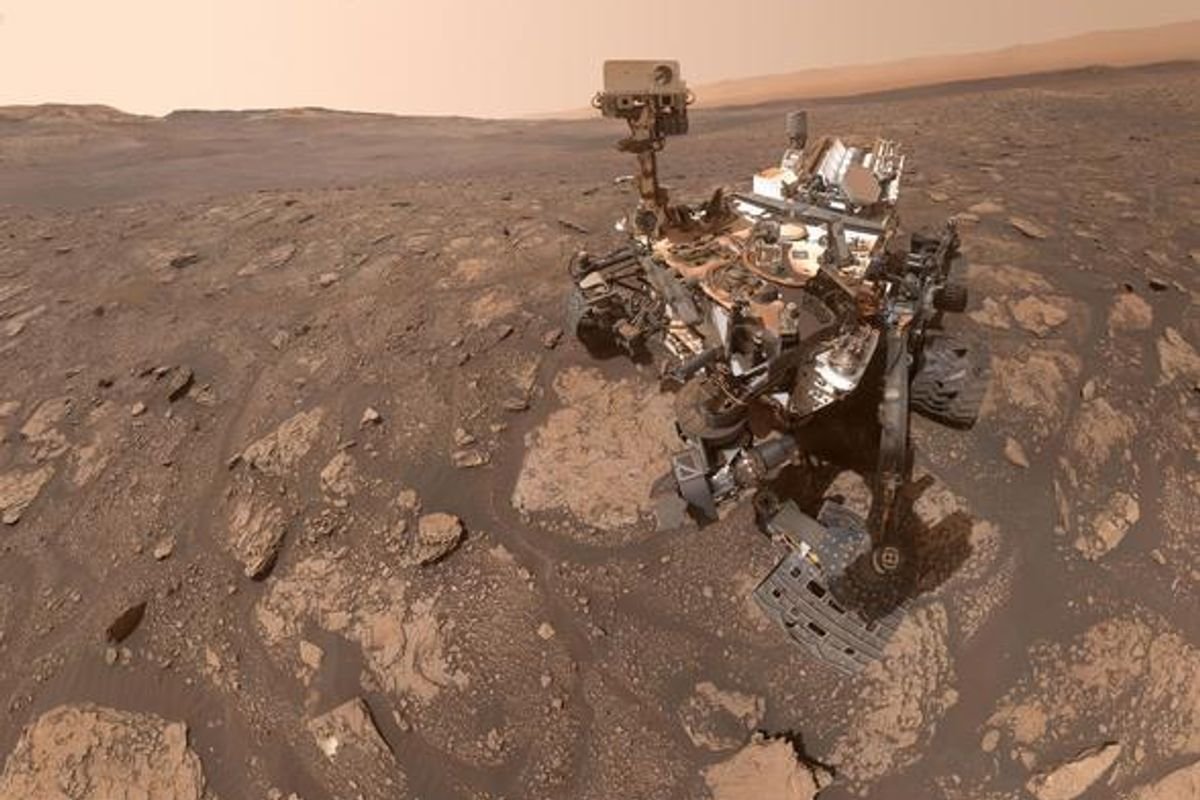
Curiosity landed in Mars’s Gale crater, a former lakebed. The robot carried out the experiment detailed in the new paper in 2020, in the Glen Torridon region of the crater. This area is rich in clay, a strong indicator that the region once held water. The region appears to have dried up and been dampened multiple times over the planet’s history. Clay deposits readily attach to and preserve organic compounds.

Sample locations on Mars.
(Image Credit: NASA/JPL-Caltech/MSSS)
Inside the rover is a complex micro laboratory called the Sample Analysis at Mars (SAM). The rover drills rock samples, pulverizing them into powder. The robot adds this powder into a cup of tetramethylammonium hydroxide (TMAH) solvent inside the SAM chamber, which breaks down the clay samples into their constituent volatile fragments.
According to NASA’s Jet Propulsion Laboratory, which led the project, there are only two such cups on board the SAM, complicating the decision of which areas of Mars to sample.
The experiment released 21 different carbon-based molecules. Seven had never been detected on Mars before. One molecule called a nitrogen heterocycle resembles chemical precursors to the nucleic acids DNA and RNA that are key to life on Earth. This type of molecule has never been found on Mars.
Another was benzothiophene, a chemical that often reaches planets via meteorites. These meteorites may have played important roles in bringing the building blocks of life to planets across the developing solar system.
“The same stuff that rained down on Mars from meteorites is what rained down on Earth, and it probably provided the building blocks for life as we know it on our planet,” Williams said in the release.
Read More: A Resilient Fungus Could Survive the Trip to Mars — and Possibly Other Planets
Comparing Samples on Mars
The researchers compared their findings on Mars with samples taken from the Murchison meteorite, a four-billion-year-old rock that has been extensively studied.
When the researchers added a sample of the meteorite to TMAH solvent on Earth, they recorded some of the same molecules as seen on Mars, suggesting that the samples on the red planet may have once been even more complex organic compounds.
“We now know that there are big complex organics preserved in the shallow subsurface of Mars, and that holds a lot of promise for preserving large complex organics that might be diagnostic of life,” Williams said.
Read More: Giant Spiderweb Formations on Mars Contain Ancient Evidence of the Planet’s Waterlogged Past
Article Sources
Our writers at Discovermagazine.com use peer-reviewed studies and high-quality sources for our articles, and our editors review for scientific accuracy and editorial standards. Review the sources used below for this article: