
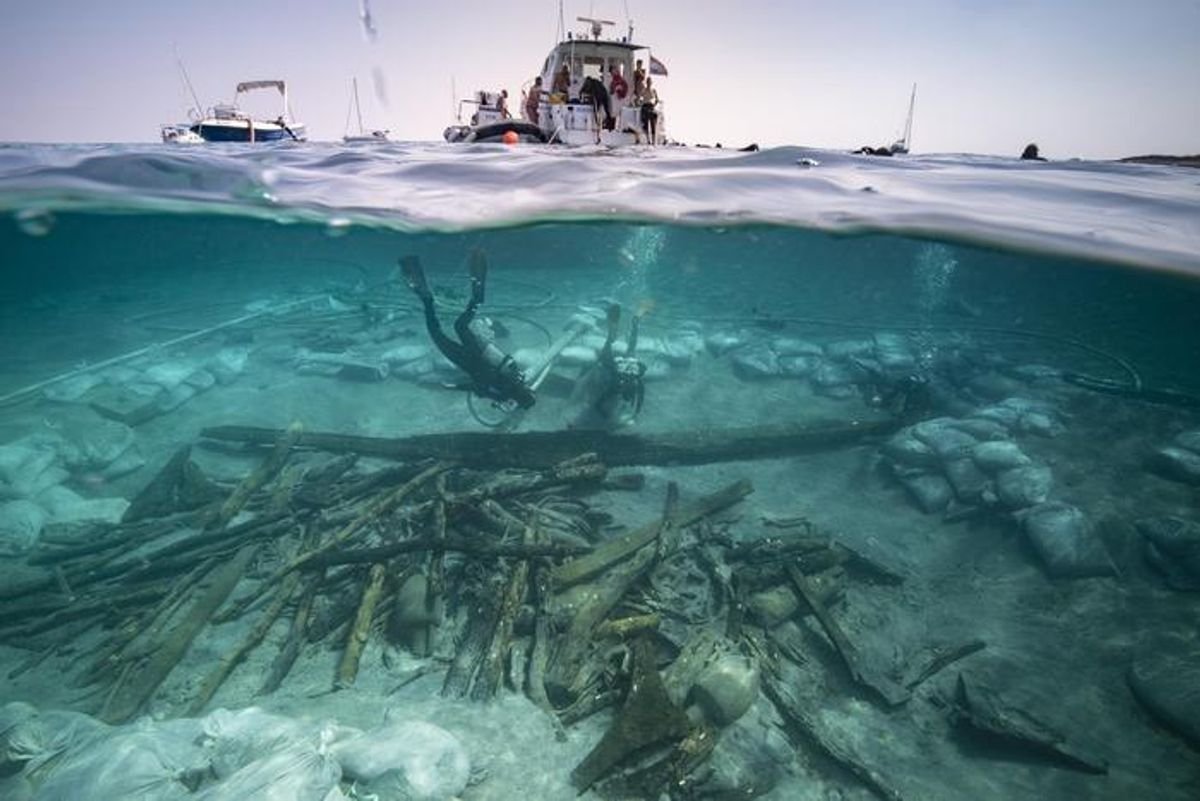
2,200-Year-Old Ancient Roman Shipwreck Uncovers Hidden Repairs Across the Adriatic
Most shipwrecks tell you where a ship died — not how it stayed afloat. The materials that kept ancient vessels seaworthy have rarely been studied. Now, a Roman wreck is offering a record of repairs made as it sailed across the Mediterranean.
In a new Frontiers in Materials study, researchers from France and Croatia examined the waterproof coating preserved on the shipwreck Ilovik–Paržine 1, which sank about 2,200 years ago off the coast of present-day Croatia. They found the vessel had been treated with two distinct coatings, one made of pine tar, or pitch, and another made from a mixture of pine tar and beeswax. Together, these materials indicate the ship was likely built near present-day Brindisi in southern Italy and repaired multiple times as it moved across the Adriatic.
“These coatings bear witness to the ship’s life over time and to its movements on the sea. It highlights common patterns and regional specificities, notably in relation to the availability of natural resources. Finally, this research also demonstrates the evolution of practices and the transfer of technologies over time,” corresponding author Armelle Charrié, told Discover.
Ancient Roman Shipwreck Coatings Reveal Repairs Once Thought Invisible
Ancient ship maintenance is one of the least visible aspects of the archaeological record, making it difficult to reconstruct how ships were repaired over time.

Orthophoto of the stern area at the end of 2021 excavation campaign.
(Image Courtesy of (V. Dumas, L. Damelet, CNRS/CCJ, Adriboats; P. Dugonjić, HRZ))
“We don’t know any archaeological evidence or sources that address the subject of ancient Roman ship maintenance. However, it is highly likely that over the ship’s lifetime, the protective coatings will have deteriorated and required repair. The question is how to identify these repairs if no written records exist,” Charrié shared.
That’s what makes the Ilovik–Paržine 1 wreck unusual. Instead of a single coating, parts of the hull preserved multiple layers, offering a unique opportunity to compare how the material changed over time.
To do that, researchers combined chemical analysis with the study of pollen trapped inside the coating, allowing them to distinguish between batches that might otherwise appear identical.
Read More: Ancient Shipwreck Cargo Sheds Light on Iron Age Trade And a Lost Mediterranean Seaport
Two Coatings Point to a Shared Shipbuilding Tradition
Looking across the hull, the researchers weren’t seeing a single uniform coating. Instead, they found differences between layers.
Most of those layers were made from pitch, a sticky, water-resistant substance derived from heated conifer resin and widely used in ancient shipbuilding
One sample stood apart. “Chemically, on this wreck, the surprise was the discovery of a sample composed of pitch and beeswax, in contrast to the majority of samples which consisted solely of pitch,” Charrié shared with Discover.
That second mixture would have made the coating more flexible and easier to apply when heated. It also connects the ship to a longer tradition. Ancient sources describe similar blends — including a reference by Pliny the Elder — and archaeologists have identified them on earlier vessels, such as a shipwreck found off Marseille dating to the 7th century B.C.E.
“This example thus illustrates the circulation of technical knowledge and the phenomena of technological transfer across the Mediterranean basin,” Charrié added.
Pollen Traces Reveal Where the Ship Was Repaired
The pollen preserved in the coating helped pinpoint where those repairs likely took place. The samples reflected a mix of environments: coastal, inland, and even mountainous.
In some cases, pollen provided the only distinction. Layers that appeared chemically identical could still be separated based on the traces they contained.
The ship appears to have undergone four to five distinct applications, with the stern and central sections sharing one layer while the bow preserves several others. This pattern reflects repeated repairs over time.
On most shipwrecks, these coatings survive as little more than a brown residue. Here, they preserved one of the clearest records of how the vessel was maintained.
“They are part of the heritage materials, and their study [is] potentially rich in information: they tell a story,” Charrié explained to Discover.
Read More: A 2,000-Year-Old Pleasure Barge Resurfaces in Cleopatra’s Harbor, Telling Us of Life in Roman Egypt
Article Sources
Our writers at Discovermagazine.com use peer-reviewed studies and high-quality sources for our articles, and our editors review for scientific accuracy and editorial standards. Review the sources used below for this article: