
An Unexpected Landslide in Alaska Triggered a Tsunami Taller Than The Eiffel Tower

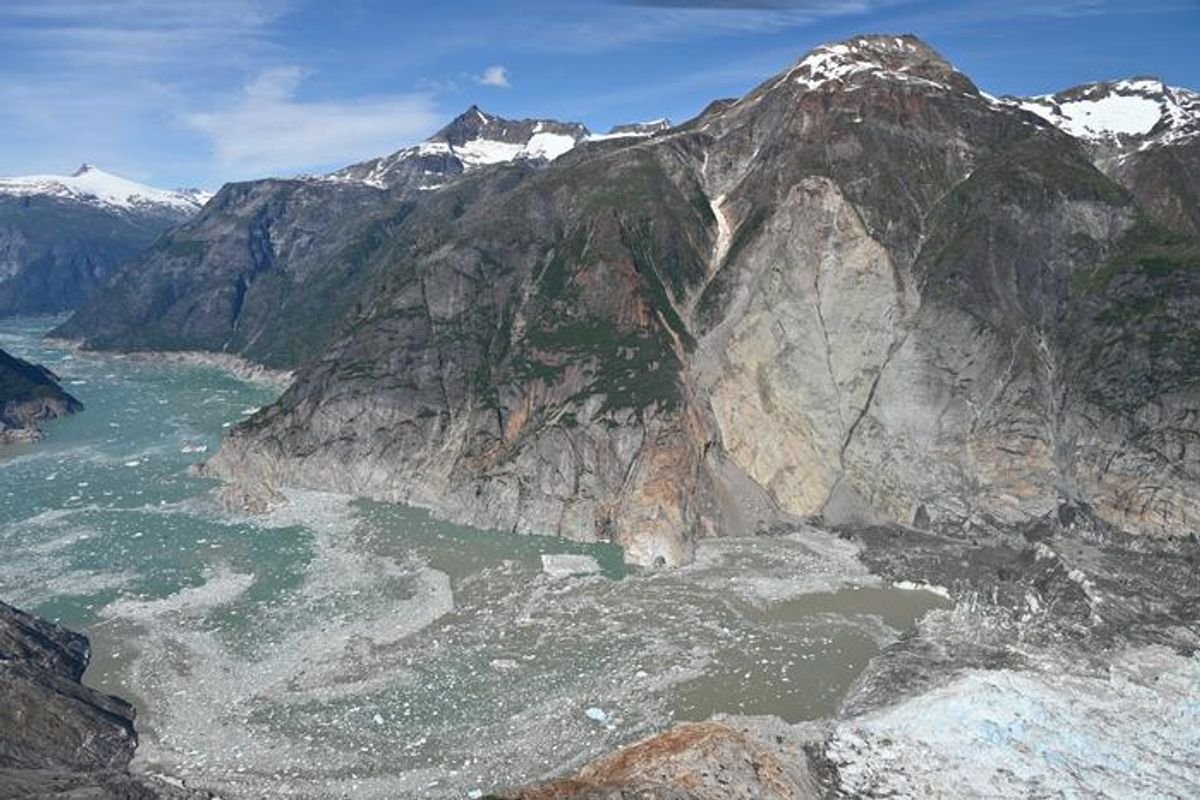
Spending an early morning watching the sun rise over the glaciers of Alaska would typically sound like a dream. But on Aug. 10, 2025, that serene image was disrupted by a massive landslide-triggered tsunami that sent water surging more than 1,500 feet up the Tracy Arm fjord wall.
This tsunami — the second largest ever recorded — struck a region visited daily by cruise ships and kayakers, yet luckily, no one was caught in the wave. In a new study, published in Science, researchers say that the near disaster was a warning sign of what’s to come as climate-driven glacier retreat destabilizes mountainous coastlines.
Using new technologies, the research team reconstructed the event in unprecedented detail and hope to identify similar hazards before disaster strikes.
“Until now, we simply didn’t have a way to observe these waves directly, but our study has demonstrated that using data from the new Surface Water Ocean Topography satellite can reveal the full sea-surface structure of these events, even if no one witnesses them directly,” said study co-author Thomas Monahan in a press release.
How Did This Record-Breaking Tsunami Happen in Alaska?
In the early morning hours of August 10, a massive wedge of rock suddenly gave way, releasing tens of millions of cubic feet of debris. That material slammed into a glacier’s edge, violently displacing both ice and seawater. The result was a towering wave that raced across the fjord and climbed 1,578 feet — roughly one-and-a-half times the height of the Eiffel Tower.
What made this event especially concerning to researchers is how little warning it provided.
“Normally with these gigantic rock avalanches, they often give some sort of warning signs in the weeks, months, years prior when the slope is slowly moving down the mountain. It’s sagging and then it catastrophically gives way in a rock avalanche,” explained lead author Dan Shugar. “In this case, that didn’t happen. This one was truly a surprise.”
Scientists suspect long-term glacier retreat triggered the collapse. As warming temperatures shrink glaciers, it leaves slopes increasingly unstable and prone to sudden, unexpected collapse.
Read More: Submarine Landslide May Have Contributed to This Devastating 1957 Tsunami
How Scientists Reconstructed a Tsunami
Because the tsunami occurred in a remote area with few direct witnesses, the team had to piece together the event using a mix of human observation and high-tech data.
“We reconstructed the event from a suite of perspectives, including eyewitness accounts from a variety of ship passengers and kayakers,” said Shugar.
Among the eyewitnesses were a group of kayakers who reported waking up around 5:45 a.m. and seeing water rushing past their campsite, carrying away their gear. Elsewhere, an observer described a six-foot wave along the shoreline, while passengers aboard a nearby cruise ship noticed unusual currents and churning white water — but no record-breaking tsunami wave.
To fill in the gaps, researchers turned to satellite imagery, seismic records, and numerical modelling. One of the most important tools was the Surface Water Ocean Topography satellite, a next-generation satellite system capable of detecting subtle changes in ocean surface height across vast distances.
This combination of data sources allowed the team to reconstruct not just the landslide, but the full life cycle of the tsunami as it moved through the fjord.
What This Near-Disaster Means for the Future
The Alaska megatsunami highlights a growing reality that these kinds of events may become more common and more dangerous over the years.
That raises the stakes for improved surveillance. The research team notes that satellite-based monitoring, expanded seismic networks, and better hazard mapping could help identify high-risk zones before disaster strikes.
“Ultimately what we hope is that coastal municipalities, the cruise ship industry and other stakeholders take these threats seriously,” concluded Shugar.
Cruise ship companies are already heeding the warning, with multiple cruise lines adjusting their Alaskan routes in response to ongoing risks in the Tracy Arm fjord.
Read More: Deep-Sea Deposits of Amber May Document Massive 116-Million-Year-Old Tsunamis
Article Sources
Our writers at Discovermagazine.com use peer-reviewed studies and high-quality sources for our articles, and our editors review for scientific accuracy and editorial standards. Review the sources used below for this article: