
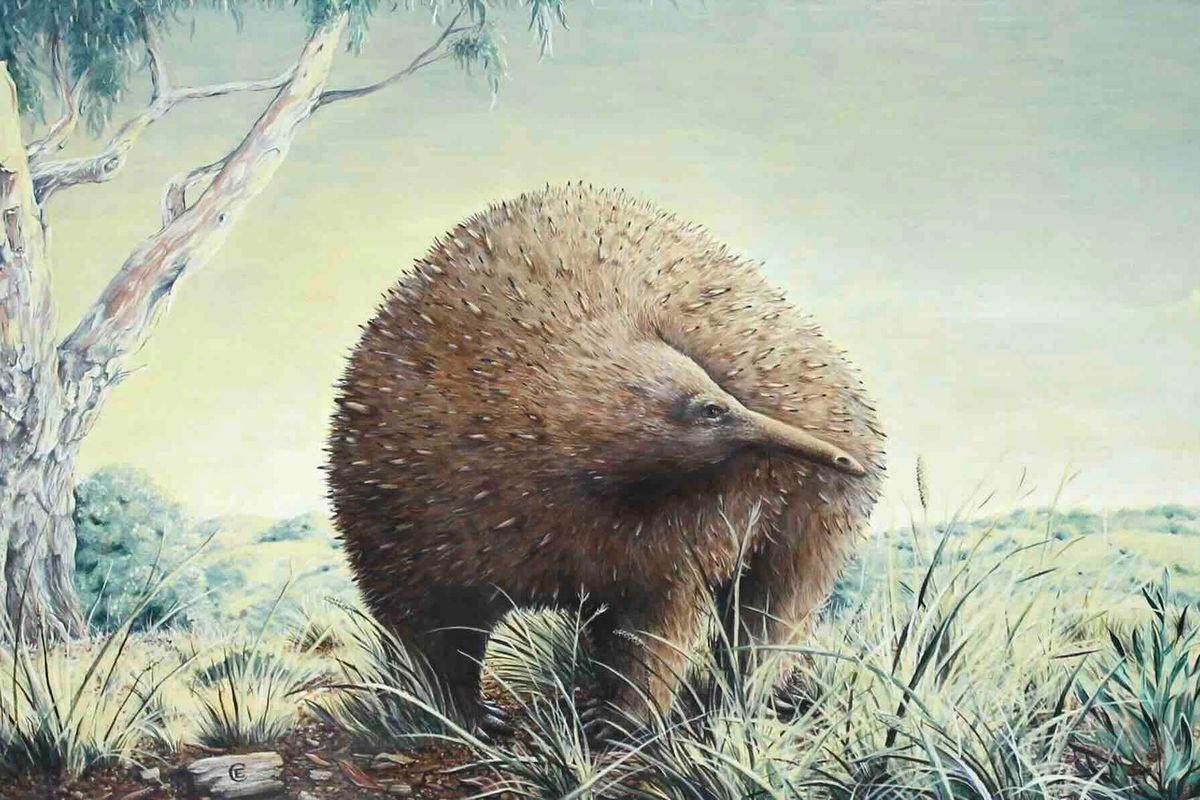
An Extinct Giant Echidna Roamed Ice Age Victoria, Filling a Huge Gap in its Australian Range
In 1907, an Australian naturalist spotted a shard of a bone from the Ice Age, buried in the sediment at Buchan’s Foul Air Cave in Victoria, Australia. Back then, the cave and its diverse deposits of fossils were a new discovery, but the specimen was never analyzed.
Instead, the bone was set aside in the Museums Victoria’s Palaeontology Collection, where it sat unaddressed for nearly 120 years.
Now, a new study in Alcheringa: An Australasian Journal of Palaeontology has described the specimen as a skull fragment from the extinct giant echidna Megalibgwilia owenii. According to the study authors, the description provides important insights into the range and distribution of Australia’s Ice Age megafauna, revealing that extinct echidnas lived in southeastern Australia during the Pleistocene Epoch (approximately 2.6 million to 11.7 thousand years ago).
Read More: Scientists Reclassify An Ancient Kangaroo Species Outside of Australia
Expanding the Extent of M. owenii
Of the three extinct echidna species in the fossil record of Australia — M. owenii (first described in the 1860s), Megalibgwilia robusta (named in 1896), and Murrayglossus hacketti (named in 1914) — M. owenii is the only species whose fossils have been found widely in Australia, from Western Australia and South Australia, all the way to New South Wales and Tasmania.
But discoveries of M. owenii specimens have been strangely absent from Victoria on the southeastern side of the continent, despite the area’s ideal Ice Age climate conditions and abundant Pleistocene fossils.

At less than 3 inches long, the skull fragment was found at Foul Air Cave around 120 years ago, where organic gases emit an overwhelming stench.
(Image Credit: Museums Victoria, CC BY-NC)
Addressing this absence in the Museums Victoria’s Palaeontology Collection, the authors of the new study spotted a bone fragment from Victoria that looked like it came from M. owenii and opted to check its identity and origins with a handful of paleontological and archival approaches. The results of these analyses, including 3D measurements and scans, revealed that the fragment is, indeed, an M. owenii fossil, which was found by museum officer Frank Spry during the 1907 expedition at the Foul Air Cave.
“Museum collections preserve the link between science, heritage and people,” said study author Tim Ziegler, the collection manager of vertebrate palaeontology at the Museums Victoria Research Institute, according to a press release. “Over a century ago, Spry along with scientists and locals investigated Buchan’s caves with little more than ropes and kerosene lamps, and they inspired us to carry on their work.”
Filling a Gap With Fossil Fragments
At as many as 3.3 feet from snout to tail and 33 pounds, M. owenii was bigger and stronger than the echidnas that live in Australia today, with broader shoulders and appendages and a sturdy, straight snout. These traits suggest that the species — named after the Greek word for ‘great,’ the Wemba Wemba word for ‘echidna,’ and the Australian anatomist Richard Owen — dug into thick logs and soils to search for food (like large, crushable insects).
To clinch their identification, the authors of the new study compared the skull fragment with extinct and modern echidna specimens from Australian museums, proving that the fossil fills the approximately 620-mile span that separates past M. owenii finds.
According to the study authors, the results stress the importance of museum collections and the potential for future fossil discoveries from the Foul Air Cave, whether they’re made in the shelves of a museum or the sedimentary layers of a cave.
“Previous research by Museums Victoria has shown the Buchan Caves preserve an exceptional record of Australia’s unique megafauna, including the short-faced kangaroo Simosthenurus occidentalis and the giant marsupial Palorchestes azael,” Ziegler added in the release. “The next amazing discovery could come from inside the museum, from continued fieldwork, or the keen eyes of a citizen scientist. I can’t wait to find out.”
Read More: We May Now Know Why an Ancient, Hippo-Sized Wombat and Other Megafauna Went Extinct
Article Sources
Our writers at Discovermagazine.com use peer-reviewed studies and high-quality sources for our articles, and our editors review for scientific accuracy and editorial standards. Review the sources used below for this article: