
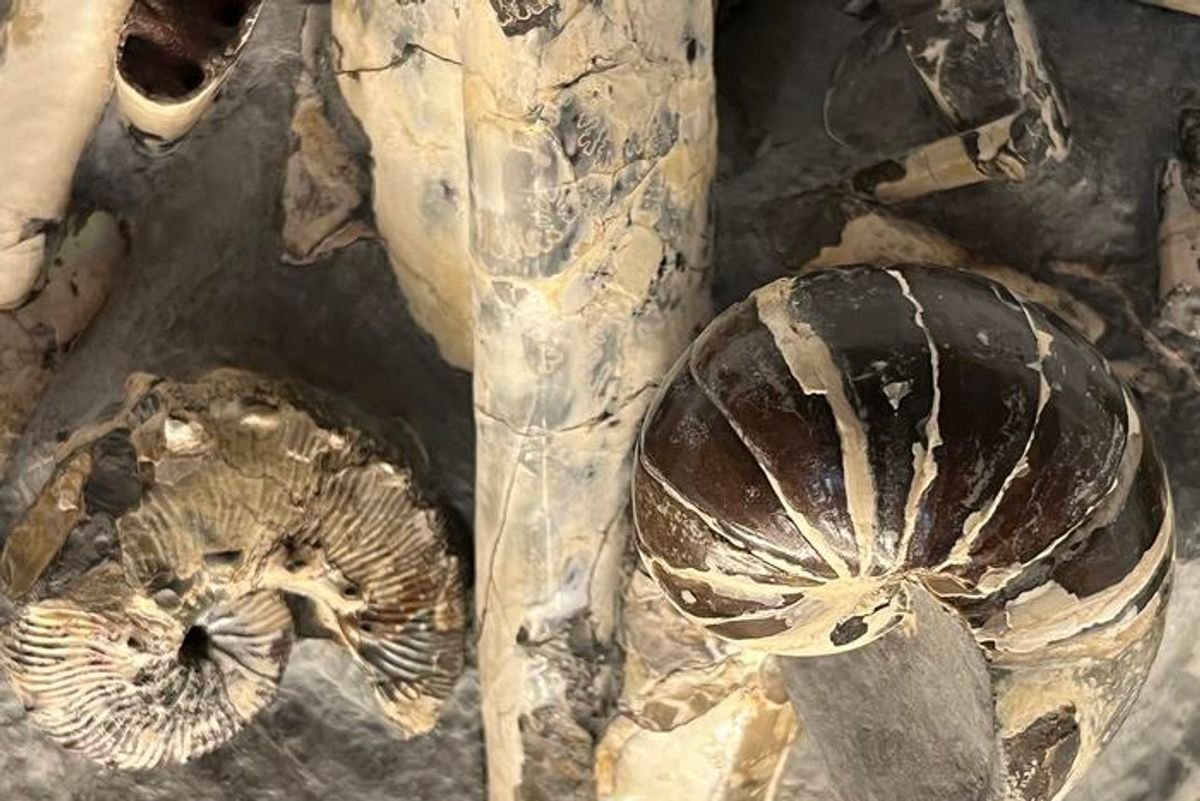
After 350 Million Years of Survival, Egg Size May Help Explain Why Ammonites Didn’t Make It Through the End‑Cretaceous Extinction

Life in the ancient oceans wasn’t easy, but few creatures handled it better than ammonites. These spiral-shelled animals thrived for more than 350 million years, surviving multiple mass extinctions and spreading across seas around the world. Then, about 66 million years ago, they disappeared.
A new analysis presented at the EGU General Assembly returns to a familiar question: Why did ammonites vanish while their relatives, the nautiloids, survived? Researchers compared ammonites with nautiloids, a much less diverse group that made it through the same extinction event. The extinction followed the asteroid impact that wiped out non-avian dinosaurs and disrupted marine ecosystems. Their survival may have been influenced by how they reproduced, and how those strategies played out as ecosystems collapsed.
Ammonites laid vast numbers of tiny eggs, releasing small hatchlings into the open ocean, where only a few survived. Nautiloids took the opposite approach, producing fewer, larger eggs that hatched into more developed young and likely grew more slowly.
“Having large, yolk‑rich eggs allowed nautilus embryos to develop longer and hatch at a larger size, which might have given them an edge when marine ecosystems collapsed, and food was scarce,” said Michael Schmutzer, an evolutionary biologist at the University of Oxford, in a press release.
Read More: The Permian Extinction: Life on Earth Nearly Disappeared During the ‘Great Dying’
Why Ammonites Went Extinct While Nautiloids Survived
Ammonites were marine relatives of modern squid and octopus, known for their coiled shells and range of shapes and sizes. At their peak, they evolved into thousands of species. Nautiloids are a simpler, less diverse group of shelled cephalopods, and some still survive today, including the chambered nautilus found in the Indo-Pacific.
They had already survived some of the most extreme events in Earth’s history, including the Permian-Triassic extinction about 252 million years ago, which wiped out roughly 96 percent of marine species.
“It’s a tragic story, because this incredibly diverse group made it through multiple mass extinctions, including the most dramatic mass extinction event in history,” Schmutzer added in the press release.
To revisit the problem, Schmutzer and his colleagues assembled the largest dataset yet on Late Cretaceous shelled cephalopods, combining fossil records with data on body and egg size and specimens stored in museum collections, some of which had rarely been studied. Some of these fossils are sometimes referred to as “dark data” because they have not been fully analyzed.
One idea focused on geography. Nautiloids lived across wider areas, which may have helped them survive in places where conditions stayed more stable after the impact. But this new analysis doesn’t find strong evidence that range alone made the difference. Instead, nautiloids appear to have taken a more conservative approach to growth and reproduction.
Egg Size May Be Part of the Explanation
The story isn’t so simple. The few ammonite groups that survived briefly after the extinction were those with the smallest eggs, not the largest. That runs against the idea that bigger, more developed hatchlings were the key to survival.
What mattered may have been how each group lived. After the asteroid impact, sunlight faded, temperatures dropped, and marine food webs fell apart. Entire marine ecosystems unraveled. Traits that once helped ammonites thrive may have suddenly worked against them.
In the end, survival may not have favored the most successful group, but the one whose life cycle happened to fit a changing world. Maybe ammonites were just unlucky, Schmutzer said.
The findings will be presented at the EGU General Assembly 2026, held May 3 to 8.
Read More: The Late Permian Mass Extinction Explained
Article Sources
Our writers at Discovermagazine.com use peer-reviewed studies and high-quality sources for our articles, and our editors review for scientific accuracy and editorial standards. Review the sources used below for this article: