
Rare Arctic Seafloor Footage Captures Narwhals, Backward-Swimming Fish, and Panicked Copepods
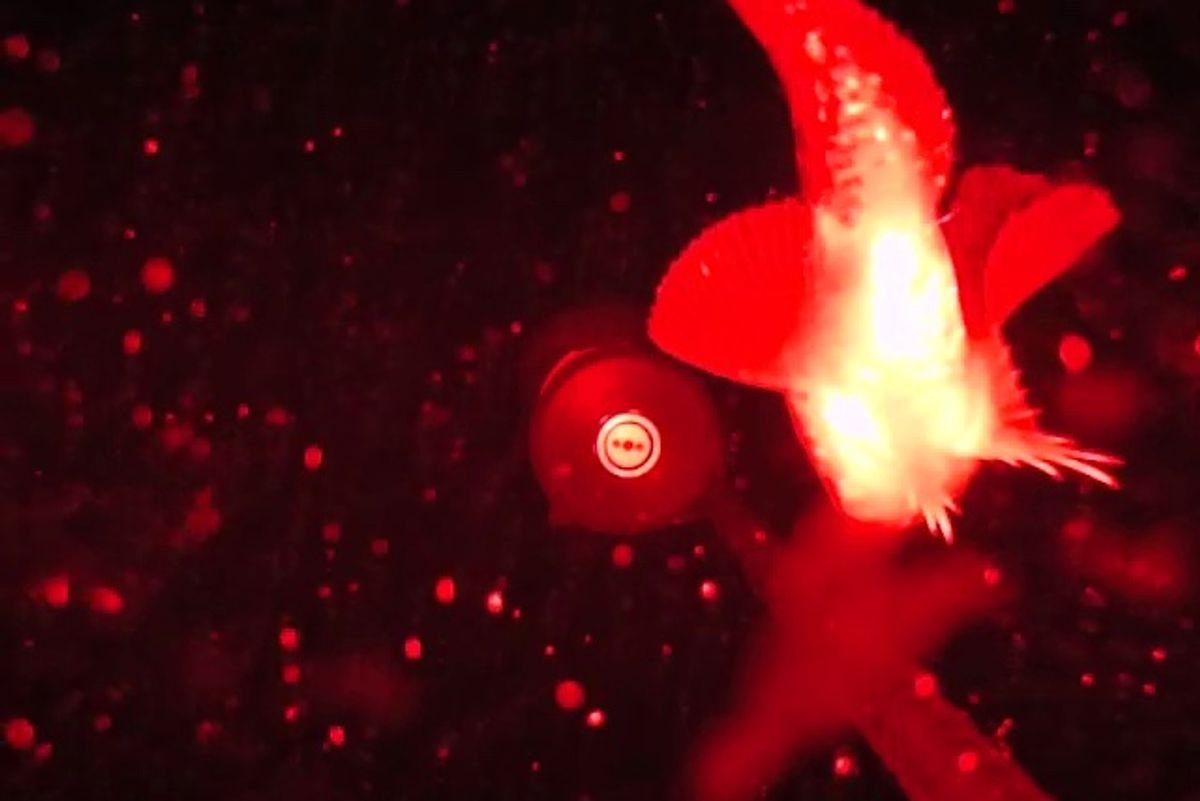
At first glance, the footage looks almost abstract: red light, swirling particles, and tiny glowing specks drifting through dark Arctic water like a living snowstorm. After staring at it for hours, researcher Evgeny Podolskiy likened the scene to the dotted psychedelic artwork of Japanese artist Yayoi Kusama.
But within those hypnotic videos, scientists captured something they rarely get to see — animals alive on the Arctic seafloor, moving naturally through one of the least observed ecosystems on Earth.
A new study published in PLOS One used an underwater camera and hydrophone anchored 853 feet (260 meters) deep in a Greenland fjord to record life near the seafloor for days at a time. The system captured everything from drifting marine snow and distant narwhal calls to tiny creatures moving through the darkness beneath Arctic ice.
“These glimpses into their brief passages reveal their behavior down there, including the lazy backward swimming of fish, the panicked escape of copepods, the characteristic undulatory locomotion of arrowworms, and the hectic rush of amphipoda, known as scavengers of the seafloor, which look like they are sniffing around for something to snack on,” Podolskiy told Discover.
Underwater Camera Reveals Life on the Arctic Seafloor
The researchers deployed their monitoring system in Inglefield Bredning, a glacial fjord in northwest Greenland. The setup included a camera, hydrophone, red LED lights, and oceanographic sensors designed to observe life near the seabed without attracting or disturbing animals.

Researcher deploying underwater camera.
(Image Courtesy of Evgeniy Podolskiy)
Over 37 hours of footage, the team identified at least 11 groups of organisms, with amphipods and copepods accounting for most observations.
Copepods sprang away from the mooring line, folding their antennae tightly against their bodies in a predator-avoidance response.
“I was surprised that copepods were surprised to bump into our equipment. They usually passively drift with the current, and at the instant of collision, the copepods jumped away from the mooring line with amazing speed,” Podolskiy shared.
The camera also recorded a snailfish curling its tail and drifting backward with the current before disappearing into the darkness.
“I also had no idea about relaxed fish drifting backward,” Podolskiy told Discover. “I do not want to insult any fish, but seemingly there is little to do down there.”
Read More: The Mariana Trench Plunges 36,000 Feet — Hiding Mysterious Creatures and a Beer Bottle
Narwhals Came Close, But Mostly Ignored the Camera
The hydrophones detected narwhals almost every day. Researchers even captured the movement of a tusk while loud vocalizations echoed through the fjord.
“Each time I heard that their sounds were getting louder and thus the narwhals were getting closer, my heart skipped several beats as I was expecting them to appear really close in front of the camera and touch or even chew my equipment,” Podolskiy said.
Instead, the narwhals appeared largely uninterested, unlike larger underwater monitoring systems that can attract curious narwhals.
“If narwhals are really not that interested in small moorings, this is great news for oceanographers, who do not want to disturb animals in any way,” Podolskiy shared with Discover.
A Changing Arctic Seafloor Ecosystem
The Arctic is changing, with shrinking sea ice reshaping ecosystems that scientists still know very little about.
“The Arctic is undergoing the most unprecedented change in human history, with less sea ice and basically a new ocean opening up, and we have little idea what the seafloor ecosystem looks like,” Podolskiy told Discover. “Thus, it is important to establish baseline knowledge about the current state down there, so that we can detect changes and understand other changes in the ecosystem that might be connected to the seafloor.”
Glacier fjords attract seabirds, seals, and whales partly because glacial meltwater pulls nutrients upward from deeper water. Understanding what lives near the seafloor could help researchers track how those Arctic food webs change as the region warms.
For now, the videos reveal brief moments from an Arctic ecosystem rarely seen alive and in motion.
Read More: 8,000 Suggestions Later, a Newly Discovered Deep-Sea Species Gets Its Name
Article Sources
Our writers at Discovermagazine.com use peer-reviewed studies and high-quality sources for our articles, and our editors review for scientific accuracy and editorial standards. Review the sources used below for this article: