
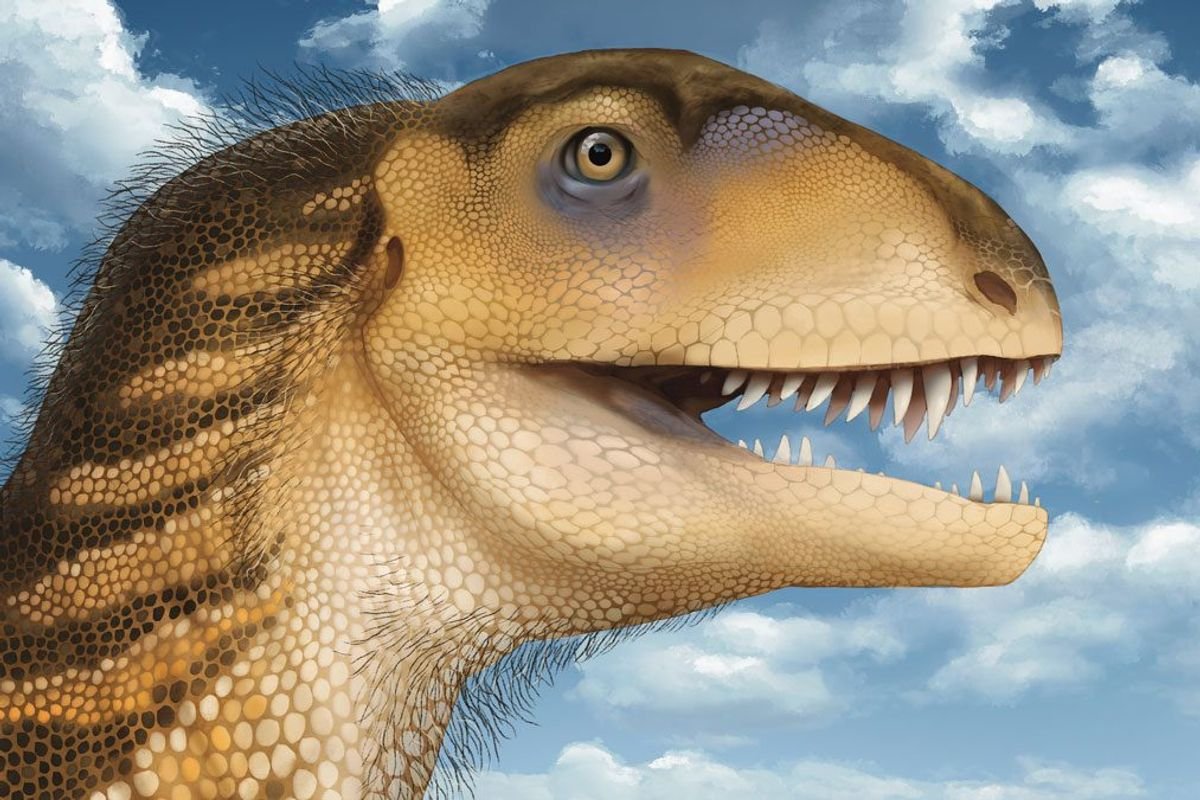
A “Uniquely Sucky Specimen,” This Smashed 205-Million-Year-Old Skull Demonstrates Early Dinosaur Diversity
The smashed and folded fossil doesn’t look like much. Mangled and misshapen, it’s difficult to believe that it’s actually the skull of a dinosaur. “This is a uniquely sucky specimen,” said Simba Srivastava, an undergraduate student at Virginia Tech, in a press release. “If you saw a human skull in this way, you’d throw up.”
But according to an analysis by Srivastava and Sterling Nesbitt, a professor at Virginia Tech, the 210-million to 205-million-year-old fossil — which was probably trampled before it was buried — isn’t too squashed to study. Instead, it’s in solid shape for reconstruction, with models revealing that it came from a carnivorous dinosaur around three times older than Tyrannosaurus rex.
Published in Papers in Paleontology, the analysis provides important insights into dinosaur diversity in the Triassic Period (around 252 million to 201 million years ago), before the dinosaurs became the rulers of the Jurassic Period (around 201 million to 145 million years ago). The study even suggests that the end-Triassic extinction between the two periods might have had a larger impact on the dinosaurs than previously assumed, which “would be interesting,” Srivastava told Discover, “because the general thought is that major dinosaur groups did not die out in that extinction.”
Read More: What Was the Most Dangerous Carnivorous Dinosaur?
Reconstructing a Squished Skull
Discovered in the Late Triassic deposits of New Mexico in 1982, the fossil sat in storage at the Carnegie Museum of Natural History in Pennsylvania for more than 30 years before it was spotted by Nesbitt, who moved the skull to Virginia Tech for further study.

Simba Srivastava, an undergraduate student at Virginia Tech, harnessed computed tomography (CT) technology to reconstruct the smashed skull.
(Image Credit: Photo by Spencer Coppage for Virginia Tech)
“The specimen is a skull that looks as if it ran into a wall! The snout is pushed back over the top of the skull, the jaws are folded over the left cheek, and the braincase is flattened against the roof of the mouth,” Srivastava told Discover. “Nevertheless, a lot of the skull is still there, including enough of the bones in the snout, jaws, and around the eyes to get an idea of what its face looked like.”
With the help of computed tomography (CT) scans, Srivastava and Nesbitt built digital and 3D-printed reconstructions of the skull, which revealed that the specimen came from a carnivorous dinosaur with a broad braincase and big cheekbones — traits that haven’t been seen in the Late Triassic dinosaurs before. Based on this, the species (at around 45 to 90 pounds) was named for its unique traits, as well as its unusual preservation.
“We landed on Ptychotherates bucculentus,” Srivastava said in the release, “which means ‘folded hunter with full cheeks’ in Latin.”
The Last of a Lineage
Analyzing the skull further, Srivastava and Nesbitt determined that P. bucculentus was one of the final surviving species of Herrerasauria, a family of carnivorous dinosaurs from the Late Triassic, before the dinosaurs became top predators in the Jurassic. In the Late Triassic, dinosaur carnivores were mostly small or medium-sized species that were outcompeted by larger predators, like crocodiles and mammals.
According to the study, P. bucculentus may have lived long enough to see the start of the end-Triassic extinction, making it one of the last of the Herrerasauria family. In fact, the fossils of all other herrerasaurian species have been found in earlier Triassic deposits to date, and never in Jurassic deposits.
“This forces us to reconsider the impact of the end-Triassic extinction as something that wiped out not just the competitors to dinosaurs,” Srivastava said in the release, “but some long-standing dinosaur lineages.”
According to Srivastava, there’s still more to study within this skull, from the anatomy of its cheekbones to the shape and size of its brain. And more could be gleaned from additional fossil finds. But for now, the folded skull will remain one of the final traces of the herrerasaurian line.
“This specimen, it fits in my hands, but it is the only proof that any of these dinosaurs lived this long,” Srivastava added in the release. “All these billions of individuals that existed through time are spoken for by this one specimen.”
Read More: How T. rex Came to Rule the World
Article Sources
Our writers at Discovermagazine.com use peer-reviewed studies and high-quality sources for our articles, and our editors review for scientific accuracy and editorial standards. Review the sources used below for this article: