
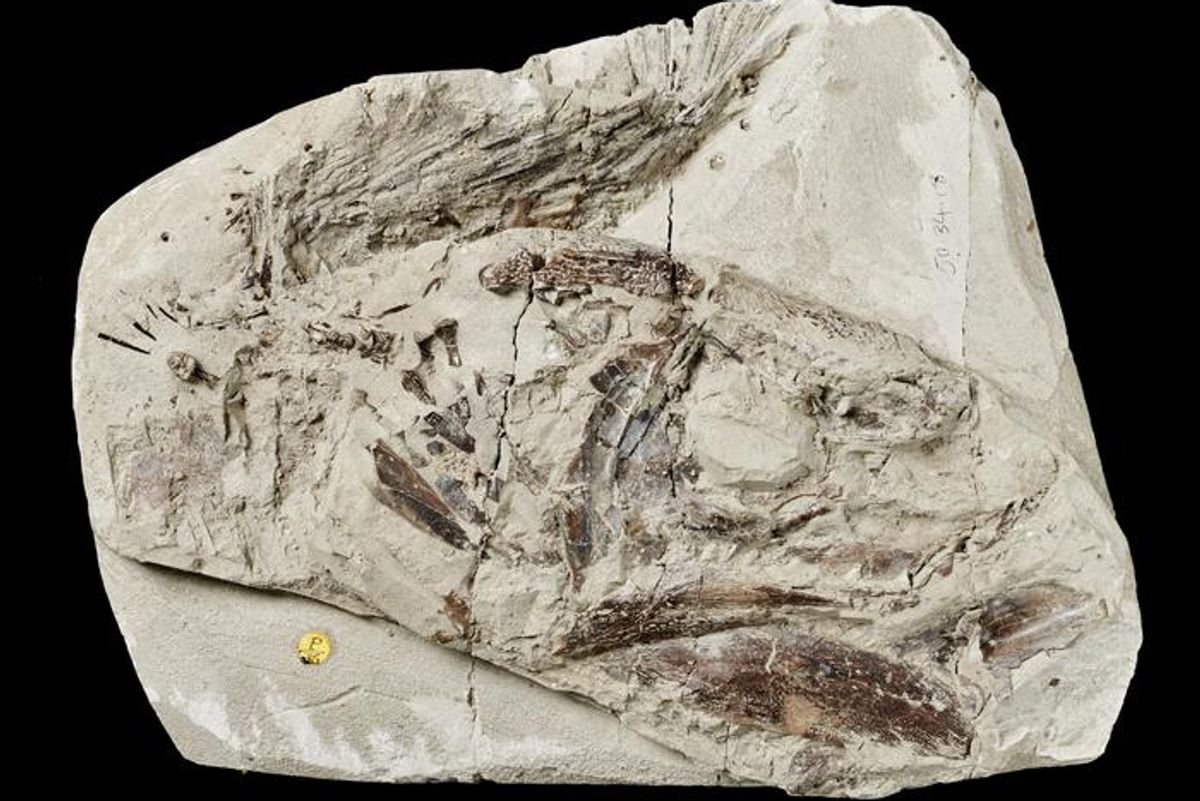
A New Coelacanth Species Was Hiding in a Museum for 150 Years — and It Fills a 50-Million-Year Gap

A dusty fossil tucked away in a museum drawer for more than a century has transformed what scientists know about one of the most mysterious fish on Earth.
In a new study published in Papers in Palaeontology, researchers have identified a new species of coelacanth from a 150-year-old specimen. The find fills a massive gap in the evolutionary record and reveals that these so-called “living fossils” have a more complex history than once believed.
“Coelacanths are famously known as ‘living fossils,’ having changed relatively little over hundreds of millions of years. However, key stages in their evolutionary history have remained elusive — until now,” said David Martill, from the University of Portsmouth, in a press release.
A New Coelacanth Species Hiding in Plain Sight
The newly identified species, named Macropoma gombessae, represents the oldest known member of its genus and a key evolutionary missing link. Coelacanths are famous for their ancient lineage, but that apparent stability has also left major gaps in their evolutionary story. This new species helps fill one of the most puzzling of those gaps, offering insight into how modern coelacanths came to be.
“It’s incredibly exciting that such an important specimen has been hiding in plain sight for over a century,” said Jack L. Norton, who discovered the fossil. “Only now that we have the technology available to examine these fossils in minute detail at the Natural History Museum do we understand its significance.”
The species name gombessae honors “Gombessa,” a traditional name used by Malagasy communities and fishers in the Comoros for living coelacanths. The term means “inedible fish” or “worthless fish” — a reminder of how little value was once placed on a creature now considered a scientific treasure.
Read More: Mass Extinction 445 Million Years Ago Paved the Way for Jawed Fishes to Take Over
How Modern Technology Helped Reveal The New Species
The fossil itself came from the Lower Cretaceous Gault Formation in southern England, a site known for preserving marine life from roughly 100 million years ago. Yet its true importance remained hidden until recently.
Researchers used advanced imaging techniques, including X-ray computed tomography, to peer inside the fossil without damaging it. This allowed them to reconstruct its internal anatomy in unprecedented detail.
“To manipulate a specimen with such importance and antiquity in 3D was truly fantastic,” said Norton.
This kind of non-destructive imaging is rapidly changing paleontology, allowing scientists to revisit historical specimens and uncover details that earlier generations simply couldn’t access. As a result, museum collections are becoming dynamic research hubs.
“Specimens collected generations ago can still transform our understanding of evolution when studied using modern techniques,” explained Martill.
The Long, Strange History of the Coelacanth
Coelacanths have long captivated scientists because of their seemingly impossible survival story. Once thought to have gone extinct alongside the dinosaurs, they stunned the world when a living specimen was discovered off the coast of South Africa in 1938.
Since then, they’ve become icons of evolutionary persistence as they appear to have resisted major change for millions of years. But, with the discovery of this new species, it appears coelacanths may have undergone more subtle and complex changes than previously understood.
“This shows the scientific value of museum collections, and why it is important to continue holding specimens in trust for society while also continuing to research them,” concluded Emma Bernard, fossil fish curator at the Natural History Museum. “Who knows what else technology will reveal about these specimens in years to come!”
Read More: Pivotal Ancient Fish Fossils Mark a Key Turning Point in a Slow Evolution
Article Sources
Our writers at Discovermagazine.com use peer-reviewed studies and high-quality sources for our articles, and our editors review for scientific accuracy and editorial standards. Review the sources used below for this article: