
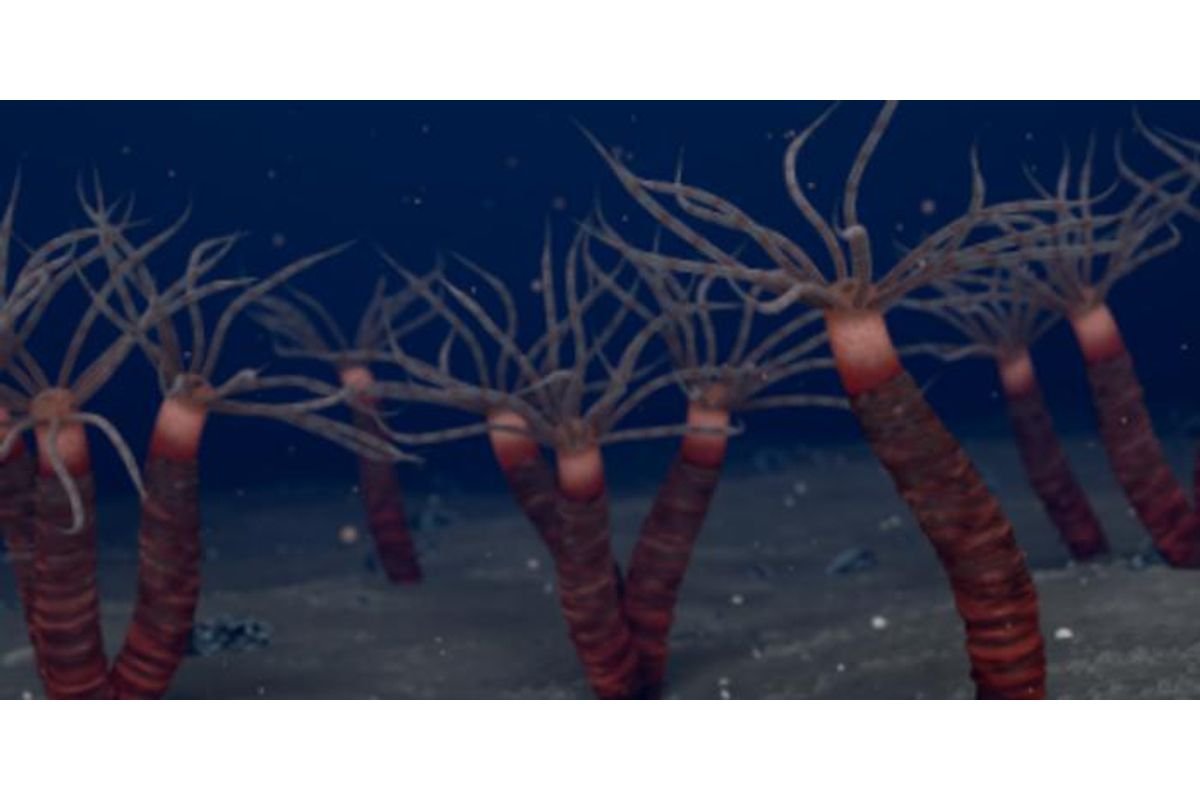
450‑Million‑Year‑Old Jellyfish Relative Reveals New Species and Clues to Early Evolution
Fossils often preserve shells, bones, and other hard parts. Soft-bodied creatures tend to disappear without a trace. That’s why a newly identified species discovered near Quebec City is so unusual.
Researchers have identified a 450-million-year-old organism called Paleocanna tentaculum, a tube-shaped animal with a ring of tentacles, closely related to modern jellyfish. The fossils were found about 50 kilometers (about 31 miles) northeast of Quebec City and are described in a new study published in the Journal of Paleontology, which examines early marine life from the Ordovician period.
“Soft-bodied organisms do not preserve as well as hard-bodied organisms, usually making any soft-bodied fossil more valuable to understanding the history of life,” said Louis-Philippe Bateman, study co-author, in a press release.
Read More: Eggshells Fill a 30-Million-Year Fossil Record Gap for Dinosaur Migration
A Fossil That Fills in a Missing Chapter of Jellyfish Evolution

Fosil of Paleocanna tentaculum.
(Image Credit: Greta Ramirez-Guerrero)
Jellyfish and their relatives are among the oldest animal groups on Earth, with roots stretching back hundreds of millions of years. Finds like this are less about adding another species and more about filling in missing pieces.
To understand where Paleocanna tentaculum fits, researchers analyzed fossils preserved across 15 slabs of shaly limestone, representing roughly 135 individual specimens. Of those, 39 were measured and photographed. The team compared their physical features with 69 fossil and living jellyfish-related species, using a set of anatomical traits to determine evolutionary relationships.
That analysis placed Paleocanna closer to the lineage that gave rise to modern jellyfish, helping connect anchored, polyp-like organisms to the free-swimming forms seen today.
What This Ancient Jellyfish Relative Looked Like
Unlike modern jellyfish drifting through the water, Paleocanna likely lived anchored to the seafloor, extending upward into the surrounding water.
Each individual occupied a narrow, upright tube of organic material, with its soft body emerging from the top opening. Around that opening sat a tight cluster of tentacles. In some specimens, those tentacles appear fine and finger-like, while in others they take on a more feathery form.
The animals were relatively small, measuring only a few centimeters in length, with elongated bodies and a central digestive cavity that ended blindly rather than passing through the body. This simple internal structure is consistent with early cnidarian body plans.
Some individuals lived alone, while others formed small clusters of multiple tubes attached at their bases, suggesting a flexible lifestyle that could shift between solitary and semi-colonial living.
These features point to a passive feeding strategy, with tentacles capturing microscopic food carried by ocean currents.
How Fossil Conditions Preserved Soft-Bodied Jellyfish Features
The preservation of delicate features, including tentacles and soft body structures, comes down to how these animals were buried and how quickly it happened.
The fossils are preserved across those same slabs, with many individuals aligned in the same direction. That consistent orientation points to rapid burial in place, with sediment sealing the organisms before their soft tissues could break down.
The surrounding environment was likely calm and low in oxygen, conditions that slowed decay and limited scavenging.
As a result, the fossils are preserved as thin carbon-rich films — a form of fossilization that retains traces of original organic material, something rarely preserved in Ordovician rocks.
The discovery also highlights how much of Quebec’s fossil record remains underexplored.
“I’ve often caught myself saying that we have a less glamorous fossil record than places like British Columbia or Alberta,” Bateman explained. “Discoveries like this one show that many things have yet to be discovered and described here.”
“Once you find them, these kinds of sites tend to keep producing spectacular new material and species for many years, so I’m expecting many more new interesting discoveries to come,” he concluded.
Read More: Deep-Sea Corals Vanished for Over 1,000 Years in the Galápagos — We May Now Know Why
Article Sources
Our writers at Discovermagazine.com use peer-reviewed studies and high-quality sources for our articles, and our editors review for scientific accuracy and editorial standards. Review the sources used below for this article: