
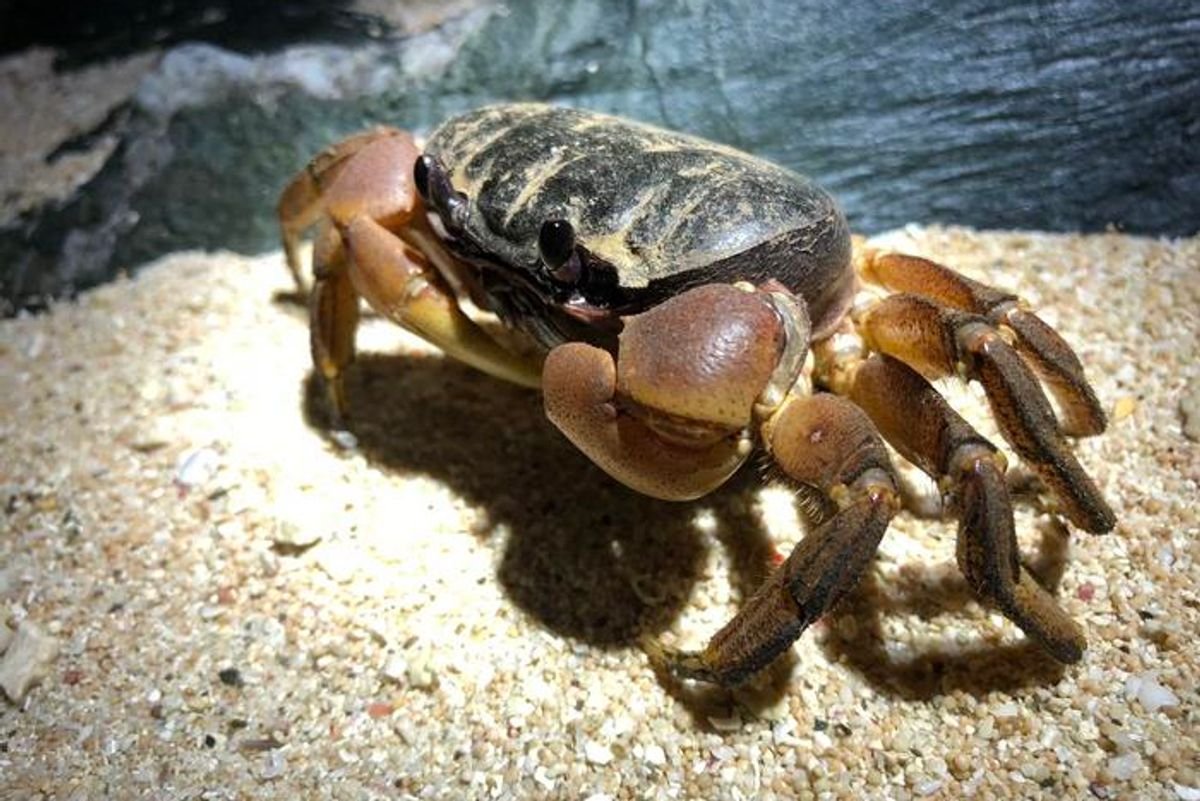
200 Million Years Ago Crabs Started Walking Sideways — and It Shaped Their Success
There’s no obvious reason crabs should move the way they do. Most animals move forward. Crabs don’t. They move sideways, slipping across the sand without turning, in a motion that feels oddly precise. It looks built in, but it isn’t.
A new study published as a reviewed preprint in eLife finds that sideways walking evolved once, roughly 200 million years ago, in a forward-moving ancestor of true crabs — the group that includes most modern crab species. By combining behavioral observations with evolutionary data, researchers traced the movement to that single origin and found it has remained largely unchanged ever since.
“Sideways locomotion may have contributed significantly to the ecological success of true crabs,” said senior co-author Yuuki Kawabata in a press release.
Tracking the Evolution of Sideways Walking in Crabs

A collage of true crab species
(Image Credit: Tsubasa Inoue and Junya Taniguchi (CC BY 4.0))
To understand how this behavior emerged, researchers began by observing crabs in motion. They recorded 50 species, filming each for 10 minutes in controlled environments designed to reflect their natural habitats. Due to practical constraints, one representative individual was observed per species.
From those recordings, 35 species were classified as sideways walkers, while 15 primarily moved forward. If sideways walking defines modern crabs, forward movement hasn’t disappeared entirely, as some species still rely on it.
To place those observations in context, the team paired them with a large evolutionary dataset built from genetic sequences across 344 species. Because the behavioral and genetic datasets didn’t perfectly align, the researchers scaled the analysis to 44 genera, along with several families and a superfamily, allowing closely related groups to serve as stand-ins where needed.
Sideways walking appears to have evolved once from a forward-moving ancestor and has remained highly conserved across true crabs.
“This single event contrasts starkly with carcinization, which has occurred repeatedly across decapod species,” Kawabata explained.
Carcinization refers to the repeated evolution of crab-like body shapes across different groups.
Read More: Partially Eaten Remains Reveal Cannibalism Is the Biggest Threat to Young Blue Crabs in Chesapeake Bay
Why Sideways Walking Helps Crabs Survive
At first glance, moving sideways might seem like a limitation; however, sideways walking allows crabs to move quickly in either direction without turning their bodies. That means they can react faster when threatened, shifting direction instantly instead of reorienting first. For prey animals, that unpredictability can be critical.
That flexibility may be part of why crabs are so successful. Today, nearly 8,000 species live in environments ranging from the deep ocean to freshwater and even on land.
The movement also comes with downsides. Walking sideways can make activities such as burrowing, feeding, and mating more difficult. That may be one reason this kind of motion is rare, showing up in only a few unrelated animals.
Timing May Have Shaped the Rise of Modern Crabs
The timing may have mattered, too. The study places the origin of sideways walking around 200 million years ago, just after the Triassic–Jurassic extinction. That was a period of major change, as continents began to break apart and shallow seas spread.
In that shifting landscape, even a small advantage could have made a difference. A new way of moving may have helped early crabs navigate changing habitats and move into new ones.
Exactly how much that shift mattered, though, is still unclear.
“To disentangle the relative roles of innovation and environmental change, we need further analyses of trait-dependent diversification, fossil-informed timelines, and performance tests that link true crabs’ sideways movement to adaptive advantages,” Kawabata said.
For now, the findings point to how a single shift in an animal’s movement can persist for hundreds of millions of years and help define an entire group.
Read More: Evolution Only Thinks About One Thing, and It’s Crabs
Article Sources
Our writers at Discovermagazine.com use peer-reviewed studies and high-quality sources for our articles, and our editors review for scientific accuracy and editorial standards. Review the sources used below for this article: