
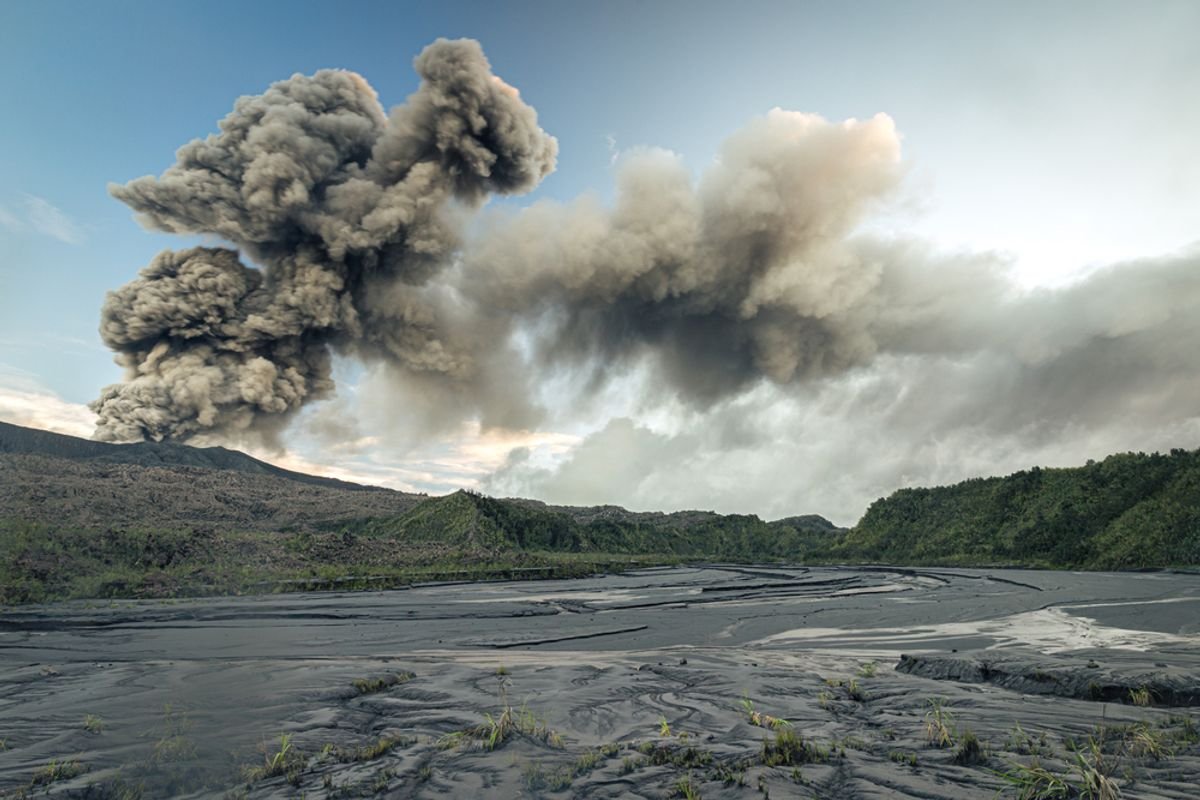
Volcanic Eruption at Indonesia’s Mount Dukono Takes the Lives of 3 Hikers, Sends Ash Plume Skyward

A volcanic eruption at Indonesia’s Mount Dukono has rocked a local community after killing three hikers and sending a massive plume of ash skyward. The eruption, which happened Friday, May 8, 2026, at 07:41 local time, is the latest outburst in a months-long spell of heightened activity that Mount Dukono has been experiencing since March 2026.
Prior to the eruption, a group of 20 hikers had begun scaling the approximately 1,355-meter (4,445-foot) volcano despite hiking restrictions issued by local authorities. The eruption left three of the hikers dead — two foreigners from Singapore and one local resident — while reports indicate that the other 17 have been safely evacuated. Concerns are now shifting to the volcanic ash ejected from Mount Dukono, which has begun spreading northward.
“The latest eruption was recorded on a seismogram with a maximum amplitude of 34 mm [1.3 inches] and a duration of 967.56 seconds [over 16 minutes]. The eruption was also accompanied by a booming sound and produced a volcanic ash plume, which requires caution for residents in the affected area,” said Lana Saria, the acting head of Indonesia’s Geological Agency, in a translated statement.
A Deadly Eruption at Mount Dukono
Mount Dukono, located in the North Maluku Province of Halmahera Island, is one of the most active volcanoes in Indonesia. The volcano has been erupting continuously since 1933, according to the Smithsonian Institution’s Global Volcanism Program. The eruptions are characterized by frequent ash explosions and sulfur dioxide plumes, occasionally accompanied by lava flows.
The latest eruption on May 8, 2026, sent a white-gray column of ash 10 km (6 miles) into the sky. The ongoing spread of ash has led Indonesia’s Geological Agency to categorize Mount Dukono at alert level II (on a scale of 1 to 4), as ashfall may pose public health and environmental cleanliness risks.
Residents living around Mount Dukono have been advised to wear masks or nose/mouth coverings to stay safe from ash; people who are exposed to volcanic ash often experience nasal and throat irritation, as well as bronchitic symptoms (hacking cough, wheezing, and shortness of breath), especially in those with asthma or pre-existing respiratory issues, according to the International Volcanic Health Hazard Network.
Read More: Some Volcanoes Don’t Explode When Erupting — A Hidden Force Helps Pressure to Escape
Escalating Volcanic Activity
Although Mount Dukono experienced a decrease in eruptive activity in August 2025, eruptive activity resumed in March 2026. Since then, there have been nearly 200 eruptions recorded.
Before the May 8, 2026, eruption, Mount Dukono had erupted numerous times in April, prompting authorities to issue safety restrictions to prevent people from hiking up the volcano. The public was warned to stay 4 km (2.5 miles) away from the Malupang Warirang Crater, which is the center of Mount Dukono’s activity.
Why Does Indonesia Have So Many Volcanoes?
Mount Dukono’s eruptive bout isn’t the only volcanic commotion to send shockwaves through Indonesia in recent years. In 2025, Mount Lewotobi Laki-Laki, a volcano on the Indonesian island of Flores, experienced multiple major eruptions, including one in early July 2025 that ejected an ash plume 18 km (11 miles) high.
With 127 active volcanoes, Indonesia is one of the countries that experiences the most volcanic activity in the world; of the top 10 deadliest eruptions in history, four have occurred in Indonesia, according to Oregon State University. The reason for Indonesia’s rampant volcanism is that its islands lie along the Ring of Fire, a chain of volcanoes that stretches nearly 40,250 km (25,000 miles) around the Pacific Ocean.
Much of the volcanic activity in the Ring of Fire, according to the National Oceanic and Atmospheric Administration, is caused by subduction, where one tectonic plate slips under another. Indonesia sits at an especially active part of this volcano chain, a plate boundary where the Eurasian, Indo-Australian, Pacific, and Philippine Plates converge, according to a study in Journal of Volcanology and Geothermal Research.
The Ring of Fire remains an important area for seismologists and volcanologists to study, especially for those monitoring volcanoes in Indonesia, to understand why their eruptions are so frequent and deadly.
Read More: A Zombie Volcano Shows Signs of Activity — Could it Rise From the Grave?
Article Sources
Our writers at Discovermagazine.com use peer-reviewed studies and high-quality sources for our articles, and our editors review for scientific accuracy and editorial standards. Review the sources used below for this article: