
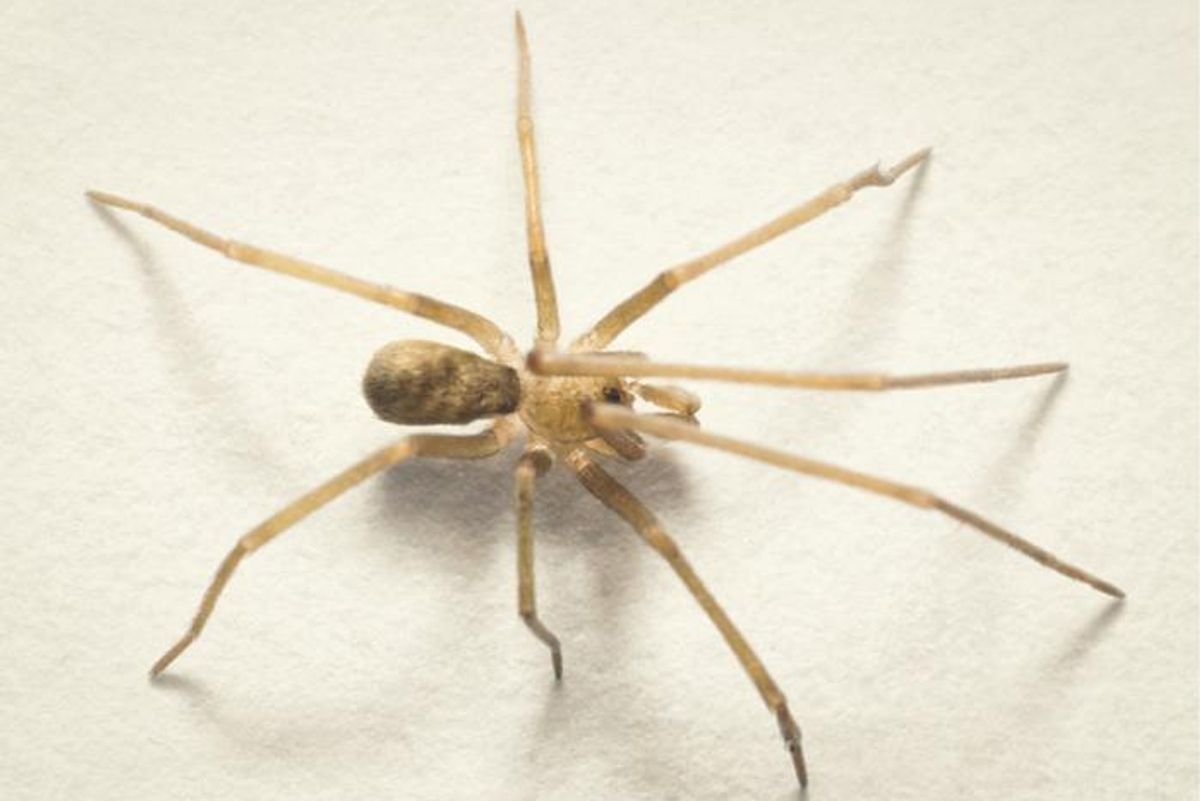
Newly Discovered Spider Named After Pink Floyd, Thriving in the Cracks of Urban Walls
The Pikelinia floydmuraria perfectly encapsulates the phrase “small but mighty.” The newly discovered arachnid is a diminutive 3 to 4 millimeters, but is known to snack on larger ants and insects.
Researchers writing in the journal Zoosystematics and Evolution have named the new species of crevice weaver spider after the rock band Pink Floyd after discovering the tiny critter hiding in the cracks of walls.
“This discovery highlights how little we still know about biodiversity, even in everyday environments like the walls of our homes,” co-author Leonardo Delgado-Santa of the University of Quindio in Colombia, told Discover. “Species like Pikelinia floydmuraria remind us that urban ecosystems can host unique and ecologically important organisms, and that taxonomy remains essential for understanding and conserving biodiversity.”
A New Spider Species Named After Pink Floyd
While P. floydmuraria is new to science, it appears to have been hiding in plain sight. The small critter, discovered in Colombia, is an urban dweller and seems to have adapted its way of living to exploit the conveniences of modern-day living.

Pikelinia floydmuraria attacking a cockroach.
(Image Credit: Julio C. González-Gómez/CC BY)
Specifically, the species is known to build webs close to artificial light, which acts as a kind of bait and draws in prey attracted to the glow. In the paper, the researchers note the spiders appear to be particularly prevalent on walls near streetlights, where they can gather in concentrations of 20 to 30 individual spiders.
“This parallel underscores a broader trend of urban-adapted spiders exploiting household arthropods,” the researchers wrote in the study.
Indeed, the researchers suggest P. floydmuraria may play an important ecological role when it comes to managing household pests. The spiders are known to feast on ants, flies, mosquitoes, and beetles, and have been observed punching far above their weight. This includes preying on flies and beetles up to two times as large as their prosoma (head and thorax), and ants up to six times as large.
Read More: Spiders May Seem Creepy — but A World Without Them Is Far Scarier
Finding Its Place on the Evolutionary Tree
The researchers identified the new species thanks to differences in its genitalia and other subtle traits, including leg coloration patterns. However, it shares much in common with a relative, Pikelinia fasciata, found only in the Galapagos Islands – which raises intriguing biographical and evolutionary questions, said Delgado-Santa.
The similarities raise the possibility that there is a close evolutionary relationship, but the researchers caution that it could simply mean that the two species have undergone similar adaptations in response to their environment.
The team hopes that molecular and DNA-based dietary analyses will shed more light on this creature and its evolutionary history, as well as its diet and ecological role in urban ecosystems.
Still More to Discover about Spiders
There are about 192 known species of crevice weavers worldwide, but it is just the third to be recorded in Colombia and only the second of its genus (Pikelinia).
“In megadiverse countries like Colombia, discovering new species is still relatively common, especially among invertebrates,” Delgado-Santa told Discover. “Many groups remain understudied, and even organisms living in close association with humans – like this spider – can go unnoticed for a long time.”
“In fact, this is only the second species of the genus recorded in Colombia, suggesting there is still much to discover,” Delgado-Santa added.
Read More: New Frankenstein Spider Found in Thailand Is Half Male and Half Female
Article Sources
Our writers at Discovermagazine.com use peer-reviewed studies and high-quality sources for our articles, and our editors review for scientific accuracy and editorial standards. Review the sources used below for this article: