
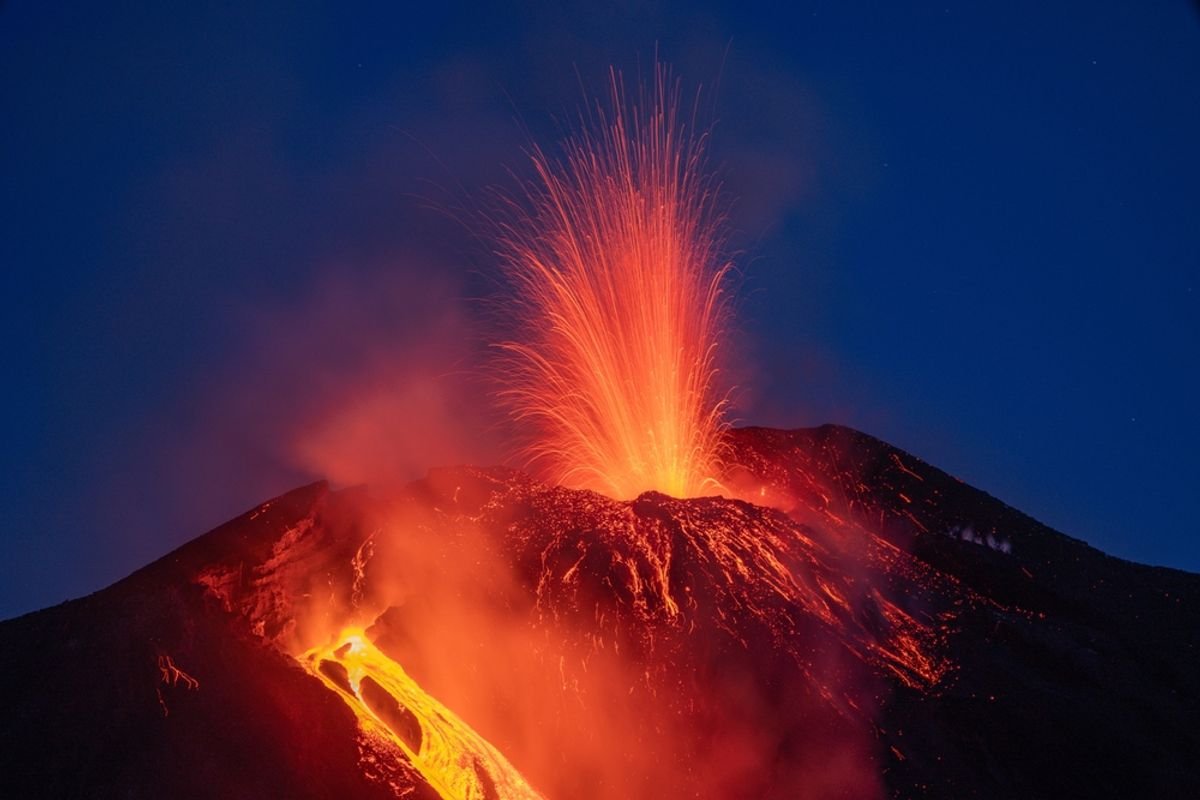
Mount Etna May Stem From a Rare Magma Mechanism, Explaining the Volcano’s Puzzling Origins

Europe’s tallest active volcano, Mount Etna, may belong to an obscure group of volcanoes that are shaped by magma in an unorthodox way. Although Mount Etna provides endless research opportunities, erupting several times a year, scientists have never fully understood how the massive volcano was formed.
A new study published in the Journal of Geophysical Research: Solid Earth has come up with an unexpected explanation for Mount Etna’s origins, explaining that it may have been built by a process seen in submarine “petit-spot” volcanoes that involves pockets of magma being forced out of fractures in tectonic plates.
Mount Etna’s Unusual Formation
With a volatile history of eruptions on the Italian island of Sicily, Mount Etna is unlike most other volcanoes. According to the new study, this is because it doesn’t fit neatly into the three main categories of volcano formation. The three categories are as follows, per the British Geological Survey:
- First, constructive plate boundary volcanoes form when two tectonic plates are moving apart, giving space for material from Earth’s mantle to rise and melt.
- The second form deals with destructive plate boundary volcanoes. They form when two tectonic plates are moving toward each other. An example of this is at subduction zones, where one plate slips underneath another. Water within the subducting plate is gradually released, lowering the mantle’s melting point; this generates magma and creates some of the most explosive volcanoes.
- A third type of volcano arises from hotspots in the middle of tectonic plates, where plumes of superheated magma flow upward from the mantle, forming island chains like Hawaii as a tectonic plate moves over the stationary hotspot.
Mount Etna, however, isn’t formed primarily by any of these mechanisms alone. Researchers know this because of the volcano’s chemical composition; while Mount Etna is located near a subduction zone, it erupts lava rich in alkalis and trace elements. This is similar to lava from hotspot volcanism, not volcanoes formed at subduction zones. Yet, there’s not a hotspot anywhere near Mount Etna.
Read More: Mount Etna Erupts During the Holidays, Ending an Active Volcanic Year in a Grand Finale
A Unique Volcanic Mechanism
To get to the bottom of Mount Etna’s puzzling origins, researchers collected samples from the volcano to reconstruct the chemical evolution of its lavas. The results showed that the composition of Etna’s magmas has mostly stayed the same over the years.
Based on this data, the researchers believe Mount Etna was formed in a way similar to petit-spot volcanoes, which were first described in 2006 by geologists from Japan. These small underwater volcanoes are found in regions where oceanic plates bend and wring out magma.
Unlike most volcanoes, where magma forms shortly before an eruption, petit-spot volcanoes are fed by pre-existing pockets of magma that are thought to lie in the upper mantle. Mount Etna, researchers propose, is driven by the same process. Small amounts of magma, roughly 50 miles (about 80 kilometers) beneath the surface, rise from the mantle due to the collision of the African and Eurasian plates.
Continued Volcanism at Mount Etna
Mount Etna has been causing volcanic commotion in Sicily since prehistoric times; according to the Smithsonian Institution’s Global Volcanism Program, it has one of the world’s longest documented records of volcanism, dating back to 1500 B.C.E.
Most recently, eruptive activity was observed from Dec. 29, 2025, through Jan. 4, 2026, producing ash emissions and lava flows near the Valle del Bove, a valley on the eastern flank of Mount Etna.
Read More: Massive Magma Reservoir Comparable in Volume to Yellowstone Discovered Beneath Tuscany
Article Sources
Our writers at Discovermagazine.com use peer-reviewed studies and high-quality sources for our articles, and our editors review for scientific accuracy and editorial standards. Review the sources used below for this article: