
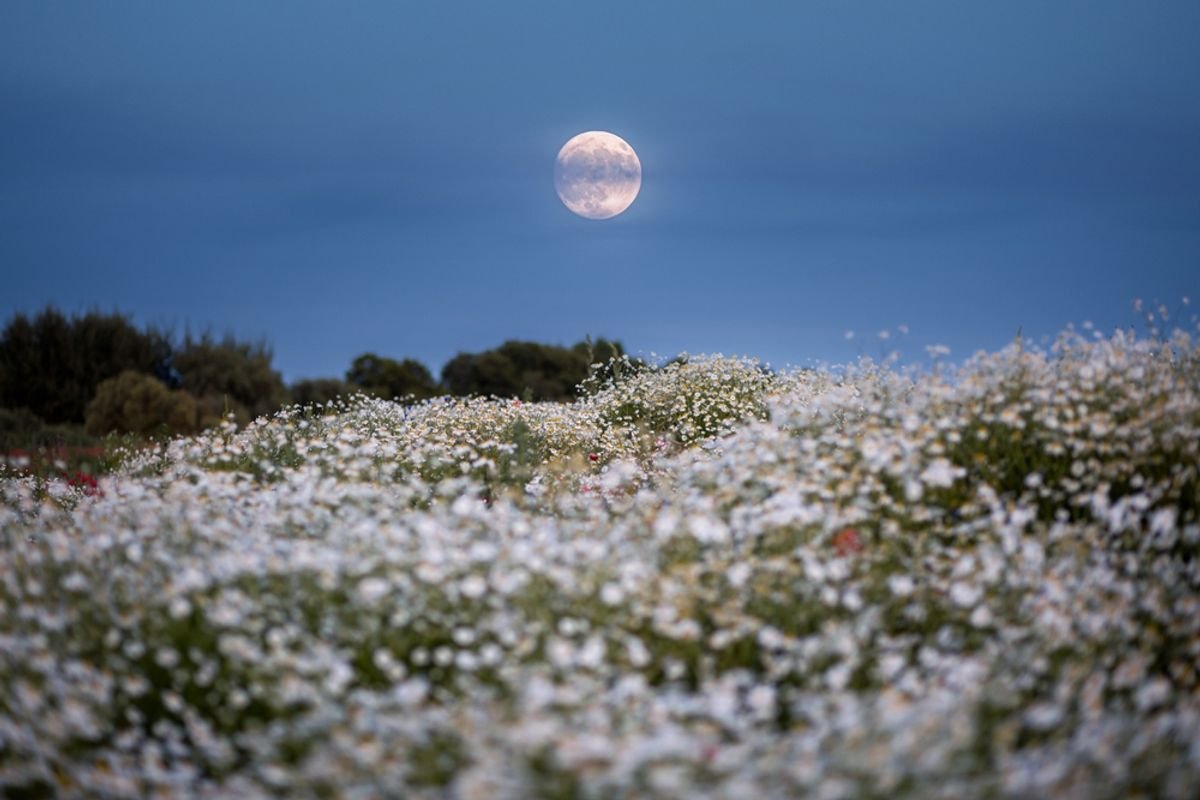
How to See May’s Flower Moon as It Peaks in Daylight — Part of a Rare Double Full Moon in 2026

The first full moon of May is arriving with perfect timing — and a bit of cosmic irony.
Known as the Flower Moon, it will reach peak illumination on May 1, 2026, at 13:23 EDT, meaning the exact “full” moment happens during the daytime for much of North America. While that timing might sound disappointing, the Flower Moon will still be visible during the nights before and after its peak time.
Why It’s Called the Flower Moon
The name “Flower Moon” is rooted in seasonal observations, according to Time and Date. In the Northern Hemisphere, May is when landscapes erupt into bloom, with wildflowers reaching one of their most vibrant peaks. Indigenous communities, including Algonquin peoples who likely coined the name, used these natural cycles to track time, assigning full moon names that reflected environmental changes.
That’s how this lunar phase came to represent flourishing plant life. Other traditional names — like the Budding Moon or Planting Moon — echo the same idea.
The Almanac notes that this year, the Flower Moon coincides with May Day, a long-standing celebration marking the seasonal midpoint between the spring equinox and summer solstice. Historically, it’s been observed with rituals tied to fertility and abundance, from dancing around maypoles to sharing baskets of flowers.
Read More: Artemis II Crew Returned to Earth Safely — What’s Next for NASA’s Moon Exploration Program?
A Rare Month With Two Full Moons
May 2026 doesn’t stop at one full moon. According to Farmer’s Almanac, it will also feature a second full moon on May 31 — commonly called a Blue Moon. In modern usage, a blue moon refers to the second full moon within a single calendar month, a phenomenon that occurs roughly every two to three years.
But this one comes with an added detail: it will also be a micromoon. That means the moon will be near its farthest point from Earth in its orbit, making it appear slightly smaller and dimmer than usual. It’s a subtle difference that most people won’t notice with the naked eye.
Together, the Flower Moon and the later blue micromoon make May an unusually eventful month for skywatchers.
Why Does the Full Moon Peak During the Day?
The timing of this full moon — early afternoon in Eastern time — might seem counterintuitive. After all, full moons are usually associated with nighttime viewing. But astronomically, the definition of a full moon has nothing to do with when you can see it.
A full moon occurs at the precise moment the moon is directly opposite the Sun relative to Earth. As reported by Time and Date, this alignment is calculated based on orbital mechanics, not visibility from a specific location. Because Earth is always half in daylight and half in darkness, that exact alignment will inevitably happen during the daytime somewhere on the planet.
If your location happens to face the Sun at that moment — as is the case for much of North America on May 1 — you won’t see the moon at its peak. Instead, it will appear full the night before and after, when it rises in a darker sky.
Read More: April’s Full Pink Moon of 2026 Won’t Have a Rosy Hue but Will Still Glow — Here’s What to Know
Article Sources
Our writers at Discovermagazine.com use peer-reviewed studies and high-quality sources for our articles, and our editors review for scientific accuracy and editorial standards. Review the sources used below for this article: