7 Stages of Business Growth: A Complete Guide to Scaling Your Business Successfully
 By Seema Parmar
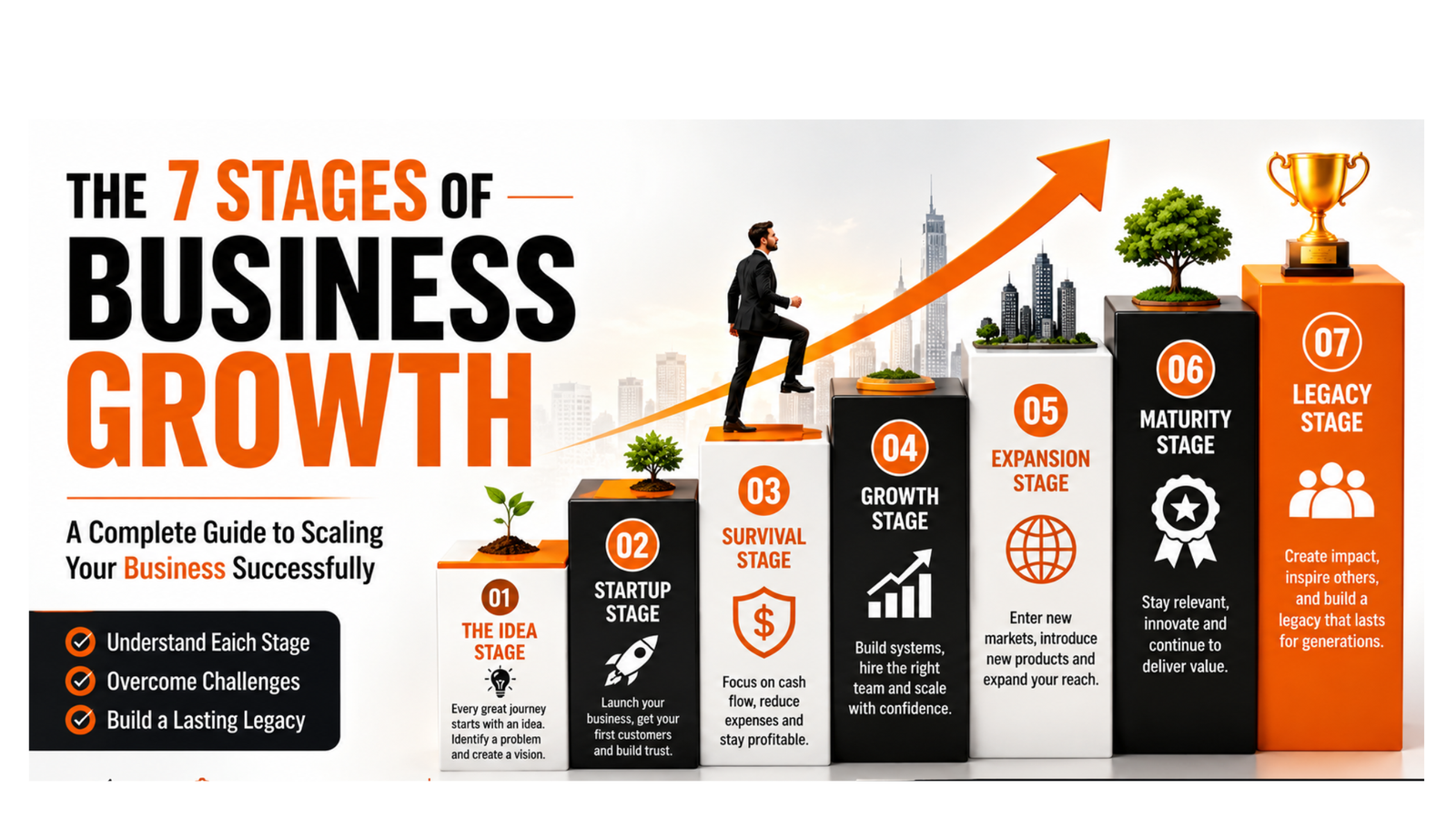
7 Stages of Business Growth: From a Small Dream to a Lasting Legacy
"Every successful business you see today was once just an idea in someone's mind."
Behind every thriving company is a story of courage, sleepless nights, difficult decisions, failures, and unwavering determination. Building a business is one of the most rewarding journeys a person can undertake, but it's also one of the most challenging.
Many entrepreneurs believe that once they launch a business, success will naturally follow. Unfortunately, reality is different. Every business goes through distinct stages of growth, and each stage brings new opportunities, new risks, and new lessons.
Understanding these stages can help you make better decisions, avoid common mistakes, and prepare your business for long-term success.
Let's explore the 7 stages of business growth and discover what it really takes to build a business that stands the test of time.
Stage 1: The Dream Stage – Every Business Starts with a Vision
Every business begins with a dream.
Maybe you've always wanted financial freedom. Maybe you want to solve a problem that no one else has addressed. Or perhaps you're simply passionate about creating something meaningful.
At this stage, excitement is high. Ideas flow endlessly. You imagine your future office, your first customers, and the impact your business could make.
But alongside that excitement comes fear.
Questions like:
- What if I fail?
- What if nobody buys my product?
- Am I experienced enough?
These thoughts are completely normal.
The difference between entrepreneurs and dreamers is simple—entrepreneurs take the first step despite the uncertainty.
Focus on:
- Identifying a real market need
- Researching competitors
- Understanding your target audience
- Creating a clear business model
- Validating your idea before investing heavily
Remember, ideas alone don't create businesses. Action does.
Stage 2: The Startup Stage – Turning Vision into Reality
This is where your dream officially becomes a business.
You register your company, launch your website, create social media pages, and start introducing your product or service to the world.
The first sale feels unforgettable.
But after that excitement fades, reality sets in.
Customers don't appear automatically.
Marketing costs money.
Operations become more complicated than expected.
Every entrepreneur experiences moments of self-doubt during this stage.
The key isn't avoiding mistakes.
The key is learning from them quickly.
Your priorities:
- Acquire your first loyal customers
- Build trust and credibility
- Gather customer feedback
- Improve your product continuously
- Stay consistent with marketing
Every successful business was once an unknown brand.
Stage 3: The Survival Stage – Staying in Business
You've proven people are willing to buy.
Now comes the harder part.
Staying profitable.
Many businesses generate revenue but still struggle because they spend more than they earn.
Cash flow becomes one of your biggest concerns.
Unexpected expenses appear.
Some months are excellent.
Others test your patience.
This stage teaches one of the most valuable business lessons:
Revenue brings attention. Profit builds businesses. Cash flow keeps businesses alive.
Focus on:
- Managing expenses wisely
- Tracking profits regularly
- Improving customer retention
- Creating recurring revenue
- Building financial discipline
Businesses that master this stage create the foundation for long-term growth.
Stage 4: The Growth Stage – Scaling Your Success
Things finally start working.
Customers recommend your business.
Sales become predictable.
Your reputation grows.
But success introduces a new challenge.
Complexity.
More customers require better systems.
More employees require better leadership.
More orders require stronger operations.
Trying to manage everything yourself becomes impossible.
This is where successful entrepreneurs transition from being workers to becoming leaders.
Priorities include:
- Hiring the right people
- Creating standard operating procedures
- Investing in automation
- Strengthening your marketing strategy
- Building a customer-focused culture
Your business should become stronger because of your systems—not because of your constant presence.
Stage 5: The Expansion Stage – Thinking Bigger
Your business is no longer just surviving.
It's ready to grow.
Expansion may involve:
- Entering new cities
- Launching additional products
- Expanding internationally
- Exploring exports
- Building strategic partnerships
- Opening new branches
- Franchising your business
Growth is exciting, but uncontrolled expansion can be dangerous.
Every new opportunity should align with your long-term vision.
Smart entrepreneurs don't chase every opportunity.
They choose the right opportunities.
Stage 6: The Maturity Stage – Staying Relevant in a Changing World
Your business has become stable.
Customers trust your brand.
Revenue is consistent.
Your team works efficiently.
From the outside, everything looks perfect.
But many businesses become comfortable at this stage.
Comfort often leads to complacency.
Meanwhile...
Competitors innovate.
Technology evolves.
Customer expectations rise.
Markets transform.
Businesses that stop adapting eventually fall behind.
Continue growing by:
- Investing in innovation
- Listening to customer feedback
- Improving employee skills
- Embracing digital transformation
- Exploring new business opportunities
Success isn't about reaching the top.
It's about staying there.
Stage 7: The Legacy Stage – Building Something That Outlives You
The most successful businesses don't exist only to make profits.
They exist to create impact.
At this stage, your business becomes bigger than yourself.
You mentor aspiring entrepreneurs.
Create employment.
Support social causes.
Develop future leaders.
Build systems that continue succeeding for years to come.
Your business becomes a legacy that inspires generations.
That's the highest level of entrepreneurship.
Why Many Businesses Stop Growing
Not every business reaches Stage 7.
Some become stuck because they:
- Resist change
- Ignore customer feedback
- Fail to manage finances
- Depend too heavily on the founder
- Neglect branding and marketing
- Avoid investing in technology
- Stop learning
Growth isn't automatic.
It requires continuous improvement.
The Habits of Businesses That Keep Growing
Successful businesses share common habits:
✅ They solve customer problems consistently.
✅ They invest in branding and marketing.
✅ They build strong teams.
✅ They embrace innovation.
✅ They use technology to improve efficiency.
✅ They monitor finances carefully.
✅ They never stop learning.
Growth isn't achieved through one big decision.
It's built through thousands of small, smart decisions made every day.
Final Thoughts
Every entrepreneur starts with hope.
Every business faces obstacles.
Every success story includes failures that people rarely see.
The businesses that survive aren't necessarily the biggest or the richest.
They're the ones that continue learning, adapting, and moving forward.
No matter where your business stands today—whether you're still dreaming, launching your first product, or managing an established company—remember this:
Your current stage is not your final destination.
Keep improving.
Keep serving your customers.
Keep believing in your vision.
Because today's small business could become tomorrow's industry leader.
And your journey to the next stage begins with the decision you make today.
Written by Seema Parmar
Seema Parmar is the Founder of PickNGrow and a Business Growth Strategist with expertise in digital marketing, lead generation, branding, AI automation, and revenue growth. She helps businesses attract more customers, increase sales, and scale with proven growth strategies.