
An Ancient Rome Manuscript Hid a 1,300-Year-Old Copy of the First English Poem
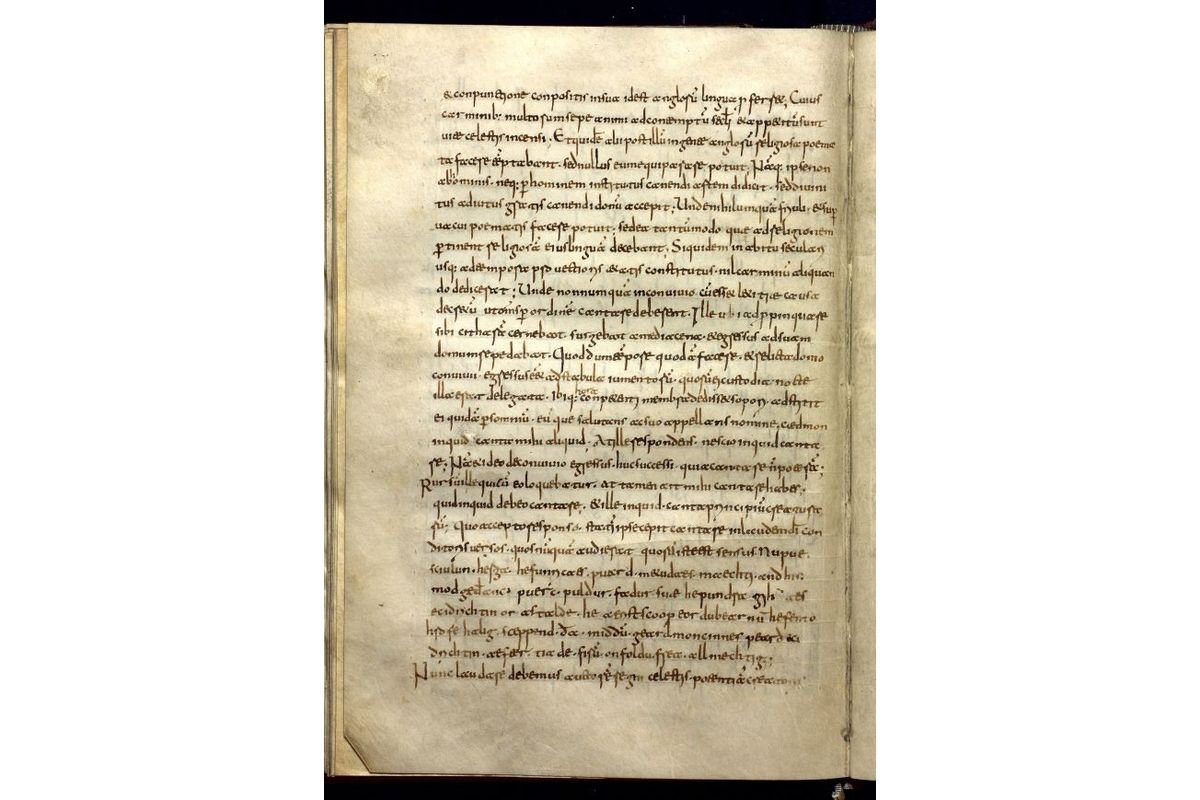
The earliest poem written in English isn’t Beowulf or a work by Shakespeare — it’s a nine-line poem written by a humble English farmer. Researchers have uncovered this poem, known as Caedmon’s Hymn, in a Latin manuscript in Rome after combining traditional archival detective work with modern digitization.
New research published in Early Medieval England and its Neighbours details the poem’s history and how this recently discovered copy reveals how early readers valued Old English literature in a time when Latin dominated written culture.
“The magic of digitization has allowed two researchers in Ireland to recognize the significance of a manuscript now in Rome, containing a poem miraculously composed in Northern England by a shy cowherd a millennium and a half ago,” said Elisabetta Magnanti, one of the researchers behind the discovery, in a press release.
How Researchers Found the Lost Poem in Rome
Researchers began the search with allusions to a manuscript thought to exist in Rome that some scholars weren’t even sure had survived — until librarians at the National Central Library of Rome confirmed its existence and provided a digital copy to the research team for analysis.

Researchers examine a copy of Bede’s Ecclesiastical History at Trinity College Dublin (not the Rome manuscript).
(Image courtesy of Trinity College Dublin)
“I came across conflicting references to Bede’s History in Rome, some pointing to its existence and some indicating it was lost. When its existence was confirmed by the library and the manuscript was digitized for us, we were extremely excited to find that the manuscript contained the Old English version of Caedmon’s Hymn and that it was embedded in the Latin text,” explained Magnanti.
Its placement in in Old English within a Latin text is crucial. Earlier surviving versions of the poem — located in Cambridge and St. Petersburg — include the Old English version only as marginal notes or later additions. In contrast, this newly identified manuscript integrates the poem directly into the main Latin text, suggesting it was not an afterthought or later translation.
Read More: Medieval Japanese Diary Helped Scientists Trace a Historic Solar Storm
What Caedmon’s Hymn Reveals about Early English Literature
Composed more than 1,300 years ago, Caedmon’s Hymn is a short, nine-line poem celebrating the creation of the world. Written in Old English — the earliest form of the language — it is often considered the starting point of English literary history.
“About three million words of Old English survive in total, but the vast majority of texts come from the tenth and eleventh centuries. Caedmon’s Hymn is almost unique as a survival from the seventh century — it connects us to the earliest stages of written English,” said Mark Faulkner, another researcher who helped discover the poem.
The poem is traditionally attributed to Caedmon, a cowherd who worked at Whitby Abbey in England. According to historical accounts, Caedmon had no prior poetic ability before writing his poem, which came to him in a dream.
The Poem’s Journey Through History
The poem survives today because it was copied into manuscripts of Ecclesiastical History of the English People, an 8th-century Latin chronicle written by the monk The Venerable Bede. The Rome manuscript, dated to the early 9th century, is now one of at least 160 known copies of the text — but only the third-oldest surviving version of the Hymn itself.
“Unearthing a new early medieval copy of the poem has significant implications for our understanding of Old English and how it was valued,” explained Faulkner. “Bede chose not [to] include the original Old English poem in his History, but to translate it into Latin. This manuscript shows that the original Old English poem was reinserted into the Latin within 100 years of Bede finishing his History. It is a sign of how much early readers valued English poetry.”
The manuscript’s own story is also quite dramatic. It was once housed at the church of San Bernardo alle Terme, then moved for safekeeping during the Napoleonic Wars — only to be stolen, passed through private hands, and eventually acquired by the Roman library where it resides today.
Read More: A Medieval Preacher’s Meme Helps Solve a 130-Year-Old Literary Mystery
Article Sources
Our writers at Discovermagazine.com use peer-reviewed studies and high-quality sources for our articles, and our editors review for scientific accuracy and editorial standards. Review the sources used below for this article: