
59,000-Year-Old Neanderthal Tooth May Reveal the Earliest Known Dental Procedure — and Pain Treatment
A Neanderthal sitting in a Siberian cave likely had no idea he was making dental history. He probably just wanted the pain in his tooth to stop. Nearly 59,000 years later, researchers found one of his molars contained a hollow that didn’t look natural. When they examined the tooth under a microscope, they realized they were looking at what could be the first evidence of a Stone Age dental procedure.
In a new study published in PLOS One, researchers say a molar discovered in Siberia’s Chagyrskaya Cave preserves signs that someone intentionally drilled into a cavity using a stone tool while the Neanderthal was still alive. This marks the first known example of dental treatment outside of Homo sapiens and the oldest by more than 40,000 years.
This points to Neanderthals’ understanding not just what was causing the tooth pain, but also that removing the damaged area could help stop it, bringing their medical behavior much closer to early humans than to the more instinct-driven healing behaviors seen in other primates.
“Our initial reaction was careful skepticism because the deep concavity didn’t match normal wear or trauma. The real turning point came during microscopic analysis when we spotted parallel striations and V-shaped grooves diagnostic of a rotating stone tool,” senior author Ksenia Kolobova told Discover.
Recreating the Neanderthal Dental Procedure Using Stone Tools
The marks inside the tooth appeared only within the cavity and ran parallel to its edges, as though something had repeatedly rotated against the tooth’s interior walls.

Chagyrskaya 64 molar tooth in five different projections
(Image Credit: Zubova et al., 2026, PLOS One, CC-BY 4.0)
In a tooth this heavily worn, the pulp chamber normally should have been protected by a thick layer of secondary dentin built up over years of chewing. Instead, it was gone entirely.
“Its complete absence, combined with micro-CT evidence of extensive demineralization from caries, told us that decayed tissue had been actively removed rather than worn down over time,” Kolobova told Discover.
Researchers recreated the procedure using modern human teeth and sharp jasper tools modeled after perforators discovered in the same archaeological layer at Chagyrskaya Cave. The experimental grooves matched the fossil almost exactly.
“The experimental replication then provided the final proof,” Kolobova explained. “Finding post-operative wear polish on the cavity edges confirmed the individual survived and used the tooth afterward, ruling out any possibility of post-mortem damage.”
Read More: Waiting for selection…
Neanderthals May Have Understood How To Treat Tooth Pain
Previous discoveries hinted Neanderthals used toothpicks and medicinal plants for dental problems, but this appears to be the first evidence of an actual procedure.

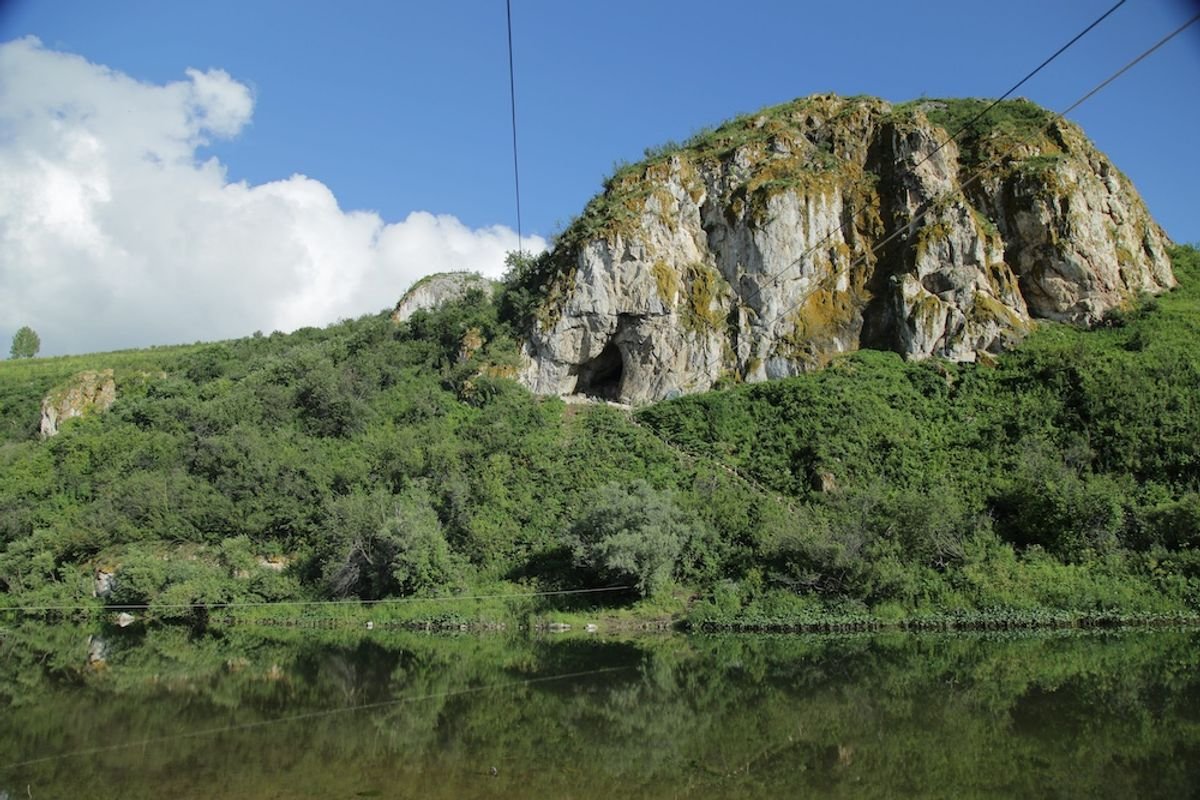
Discovery in Chagyrscaya Cave.
(Image Courtesy of Kolobova Kseniya)
Whoever performed the procedure seems to have understood that the decay inside the tooth was causing the pain and that removing the damaged tissue might help.
“Finding the Chagyrskaya molar tells us they could diagnose the source of pain by connecting an internal sensation to a visible, decayed lesion, which is not an obvious leap without a modern understanding of medicine,” Kolobova told Discover.
The cavity also appears to have been made in several stages. Researchers found three overlapping depressions inside the tooth, pointing to multiple attempts to reach the infected pulp chamber. Experiments showed the most effective technique involved rotating a sharp stone point like a hand drill until it broke through the damaged dentin.
Even in the lab, reaching the pulp chamber could take close to an hour. The procedure must have been incredibly painful, with someone drilling into an infected tooth using a sharp stone tool, all without anesthesia.
“Perhaps most tellingly, the procedure required the individual to tolerate acute pain in the moment for the longer-term goal of relief, a calculated endurance of suffering that speaks to advanced cognitive regulation and strategic thinking about the body,” she explained to Discover.
Neanderthals were often portrayed as primitive and intellectually limited. But discoveries across Europe and Asia have challenged that image, uncovering evidence of social care, craftsmanship, and possibly the earliest known invasive dental treatment.
Read More: Neanderthals Faced a Genetic Crisis During the Ice Age, Setting the Stage for Their Extinction
Article Sources
Our writers at Discovermagazine.com use peer-reviewed studies and high-quality sources for our articles, and our editors review for scientific accuracy and editorial standards. Review the sources used below for this article: