
155-Million-Year-Old Dinosaur May Be the First Jurassic Brachiosaurid Found in South America
Long-necked dinosaurs are often pictured as the giants of prehistoric life, with massive bodies, tiny heads, and necks that stretched for tens of meters. But much of what researchers know about these animals comes from fossils found in the Northern Hemisphere. A discovery in southern Argentina is beginning to change that.
Researchers have identified a previously unknown species of sauropod, Bicharracosaurus dionidei, based on a partial skeleton recovered in Patagonia. The animal measured about 20 meters in length and lived roughly 155 million years ago, during the Late Jurassic, on the southern supercontinent of Gondwana.
Described in the journal PeerJ, the fossil combines features from two major sauropod groups — brachiosaurids and diplodocids — highlighting an unexpected overlap between lineages that are usually considered distinct.
The fossil includes more than 30 vertebrae spanning the neck, back, and tail, along with ribs and part of the pelvis. The structure of the bones indicates the remains belonged to an adult.
“Our phylogenetic analyses of the skeleton indicate that Bicharracosaurus dionidei was related to the Brachiosauridae, which would make it the first Brachiosauridae from the Jurassic of South America,” said first author Alexandra Reutter in a press release.
Sauropod Find Shows Overlap Between Brachiosaurids and Diplodocids
Parts of the skeleton resemble Giraffatitan, a tall, long-limbed species from Africa. Other features, especially in the spine, are closer to Diplodocus and its North American relatives.

Illustration of Bicharracosaurus dionidei.
(Image Credit: Felipe Cutro-Lev/CC BY-SA)
Despite those differences, the overall structure of the skeleton — particularly features of the vertebrae — places B. dionidei within the brachiosaurid group.
Because the skeleton isn’t complete, it’s hard to pin down exactly where it fits. But the mix of features suggests these dinosaur groups may have overlapped more than scientists once thought, especially during the Late Jurassic, when these lineages were still diversifying.
Read More: Unusually Small Dinosaur Fossil Helps Fill a 70-Million-Year Gap in Ornithopod Evolution
Southern Hemisphere Fossil Adds Missing Evidence From Gondwana
This specimen comes from the Cañadón Calcáreo Formation in Argentina’s Chubut Province, a Late Jurassic site in Gondwana — the southern supercontinent that once included South America, Africa, Antarctica, and Australia.
For a long time, one of the only major Southern Hemisphere reference points for sauropods from this period came from sites in Tanzania. Finds like this one in Argentina add new material for comparison, helping build a more complete picture of how these dinosaurs evolved across ancient continents.
From a Chance Discovery to a Key Dinosaur Fossil
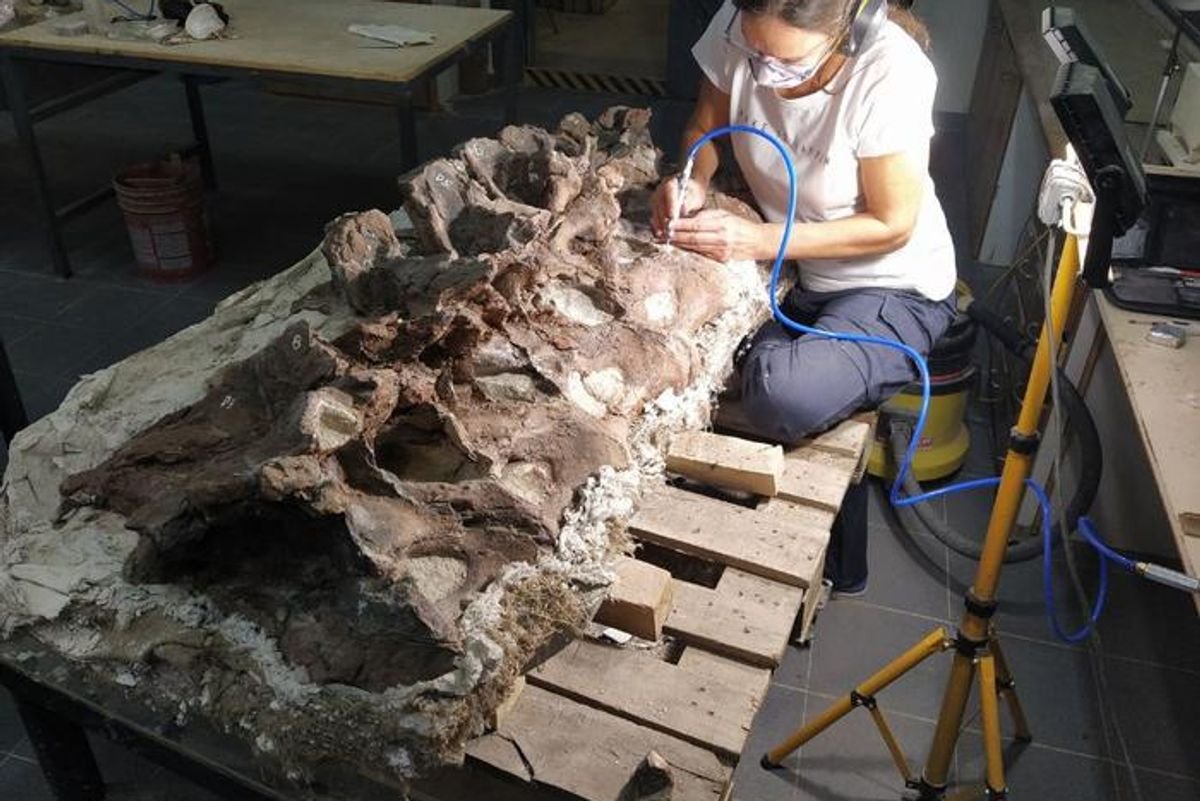
The first bones of B. dionidei were discovered by a local shepherd, Dionide Mesa, on his land. The species name honors Mesa, while the genus name comes from “bicharraco,” a colloquial Spanish word for a large animal.

Fossil extraction of Bicharracosaurus dionidei.
(Image Credit: Pablo Puerta/CC BY-SA)
The remains were likely buried close to where the animal died, with lighter parts lost over time and heavier bones preserved.
Today, the fossil is housed at the Museo Paleontológico Egidio Feruglio in Argentina, where it continues to be studied.
Beyond naming a new species, the discovery highlights how incomplete the global picture of dinosaur evolution still is. By adding new data from the Southern Hemisphere, B. dionidei helps fill a gap in the Late Jurassic record and offers new insight into how these animals evolved and spread.
As lead study author Oliver Rauhut put it, discoveries like this allow researchers to “continuously supplement and reevaluate our understanding of the evolutionary history of these animals.”
Read More: First Fossilized Egg From a Mammal Ancestor Confirmed After 250 Million Years
Article Sources
Our writers at Discovermagazine.com use peer-reviewed studies and high-quality sources for our articles, and our editors review for scientific accuracy and editorial standards. Review the sources used below for this article: