
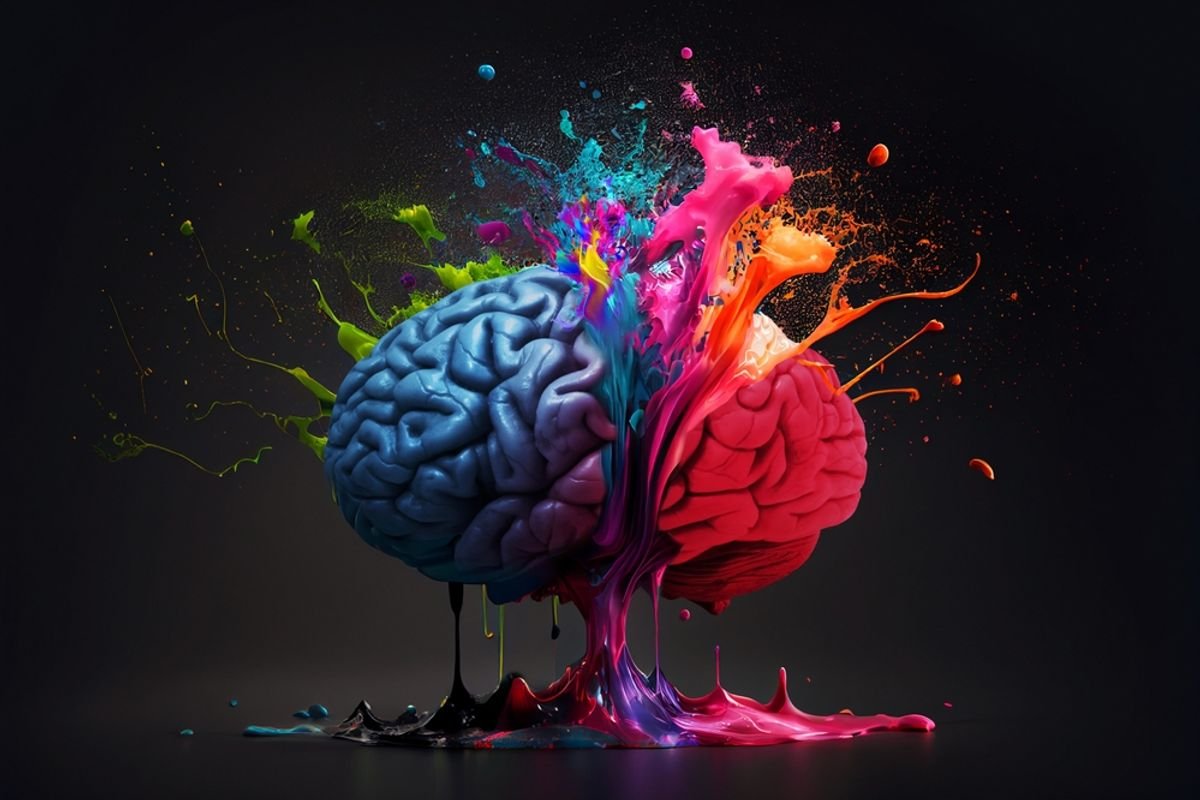
We All See Color Differently, But Our Brains Process Color the Same

The world around you is colorful, but it wouldn’t seem so bright without your brain. In fact, it is your brain that processes the color information from the color-sensitive sensors, or photoreceptors, called cones, in your retinas, allowing you to perceive the shades of your surroundings. But what actually happens in your brain when you see the world’s colors, and is it consistent across people?
Specifically, does your brain react differently to different shades? And does it react to the different shades that you see in the same way as the brains of your friends, your family, and the strangers that you meet on the street?
Seeking to resolve these mysteries, a new study in JNeurosci, the journal of the Society for Neuroscience, has shown that the brain’s specific responses to specific colors are similar between individuals, meaning that neuroscientists can compare your brain activity to that of other people to predict what colors you can see at any particular moment in time.
“We can’t say that one person’s red looks the same as another person’s red,” said Michael Bannert, a study author and neuroscientist from the University of Tübingen, according to a press release. “But to see that some sensory aspects of a subjective experience are conserved across people’s brains is new.”
Read More: The Meaning of Colors
How We See Color
Of course, color plays an important part in the way we interact with the world visually, but up until now, the neuroimaging studies on the patterns of brain activity involved in color processing have been relatively limited.
Aiming to investigate the differences in the perception of different colors, and in the perception of different colors between people, in particular, the study authors turned to functional magnetic resonance imaging (fMRI) to measure and predict the color- and brightness-related brain reactions across people for one of the first times.
To start, Bannert and Andreas Bartels — another study author and neuroscientist from the University of Tübingen — monitored the brain activity of one set of participants as they observed a series of colored screens at both low- and high-level brightnesses. The results revealed that the brain activity in the participants’ visual processing areas, including certain parts of their visual cortices, were different when they viewed screens of different colors and brightnesses, with the distinct patterns of brain activity being similar across all of the participants when they viewed a specific screen.
Based on those results, the study authors then compared the brain responses of the first set of participants to the brain responses of a second set of participants, concluding that the similarities between the two could be used to successfully predict the colors and the brightnesses that the second observed.
“We predicted what color someone is seeing based on their brain activity,” the authors added in their study, “Using only knowledge of color responses from other observers’ brains.”
Read More: How Much Color Do We Really See?
The Sharing of Shades?
While previous studies have harnessed the brain activity of one person to predict the colors that they could see at some other time, this research breaks that mold, suggesting that it is possible to harness the brain activity of other people to arrive at the same predictions. Thus, the research shows that there are some color-related responses that brains have in common — a result that stresses the similarity and predictability of color perception across people.
The study authors suspect that this consistency is tied to some sort of functional or evolutionary process, providing an area for further research. Also available for future study are the differences in the subjective processing and perception of color, since it is possible that a color may appear different to different people, despite activating the same patterns of brain activity.
Nonetheless, the present study still provides neuroscientists with a stronger sense of how the brain works, distinguishing the colors that add depth to our world.
Read More: Size and Color Saturation, a Perceptual Connection?
Article Sources:
Our writers at Discovermagazine.com use peer-reviewed studies and high-quality sources for our articles, and our editors review them for accuracy and trustworthiness. Review the sources used below for this article: