
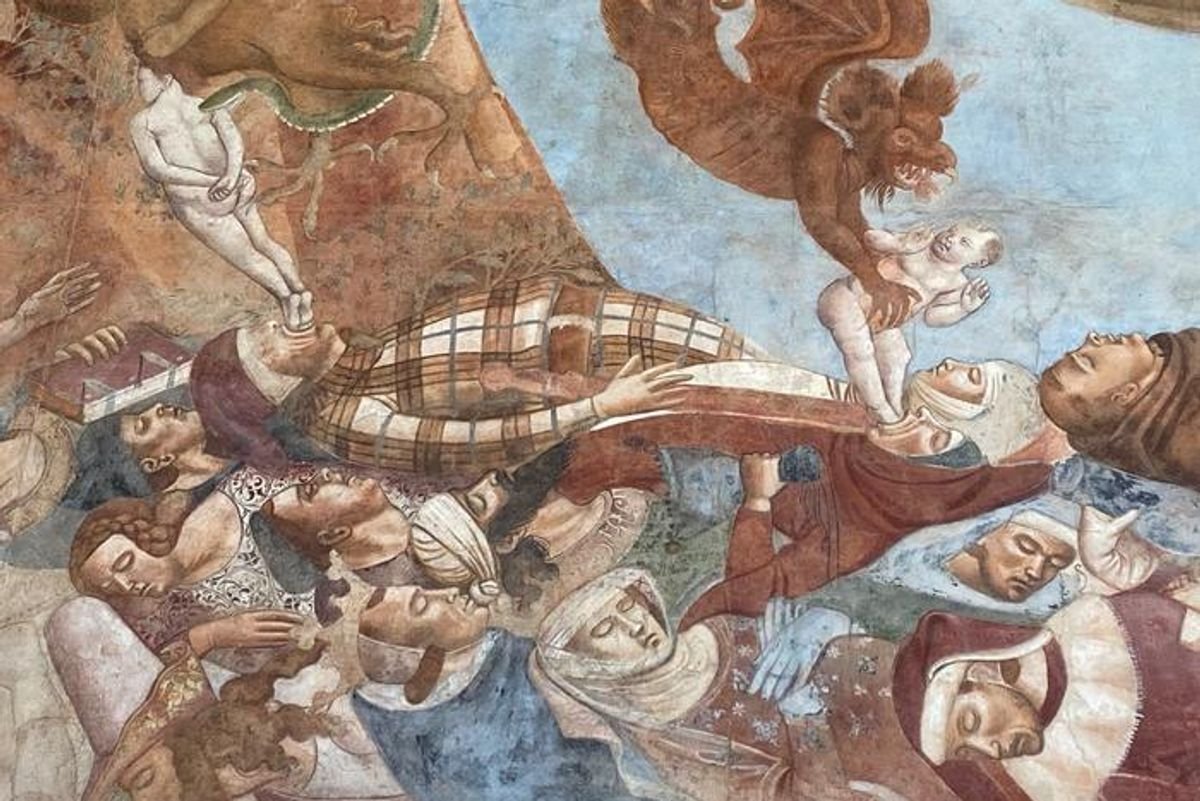
Volcanic Eruptions May Have Been Responsible for the Spread of Black Death in Medieval Europe
Before the Black Death claimed millions of lives across medieval Europe, its arrival on the continent may have been propelled by volcanic eruptions. These eruptions likely brought a string of unusually cold and wet summers, triggering widespread famine across the Mediterranean region and setting the stage for one of the darkest eras in European history.
A new study published in Communications Earth & Environment has deduced that one or more eruptions in 1345 set off a chain of events that spread the bubonic plague to Europe. This domino effect highlights the links between climate change and emerging pandemics, which remain prevalent to this day.
Read More: An Ethiopian Volcano Has Erupted with an Explosion of Ash, Awakening After 12,000 Years of Quiet
A Volcanic Beginning to the Black Death

This atlas was created by Abraham Cresques in the 14th century as a gift for King Charles V of France in 1380. This section highlights the Eastern Mediterranean and Black Sea, marking major grain-trade ports — Genoa, Venice, Messina, Caffa, and Tana. Via Wikimedia Commons.
(Image Credit: Bibliothèque Nationale de France)
The disease that gave rise to the Black Death, caused by the bacterium Yersinia pestis, killed anywhere from 30 to 60 percent of Europe’s population between 1347 and 1353. Scientists now know that Y. pestis originated in rodents somewhere in central Asia, but they’ve never been sure how it managed to spread across Europe.
Researchers behind the new study have seemingly found an answer by looking at tree rings across eight different regions in Europe, gaining insight into a particular climate trend during the mid-14th century. Blue rings in the wood of trees in the Spanish Pyrenees indicated that Europe experienced cold, wet summers in 1345, 1346, and 1347.
At the same time, observations in Europe noted reduced sunshine, increased cloudiness, and dark lunar eclipses, all signs of volcanic activity corroborated by analyses of ice cores from Antarctica and Greenland.
“What we can say from the ice cores is that it must have been one (or several) volcanic eruption(s) in the tropics. The aerosols evidently spread relatively evenly across both the Southern and Northern Hemispheres,” says Martin Bauch, a historian at the Leibniz Institute for History and Culture of Eastern Europe.
The Plague’s Journey on Sea
As crops began to fail during growing seasons in the Mediterranean, some Italian city-states had to shift gears to avoid unrest from famine. Port cities like Venice, Genoa, and Pisa had to rely on grain imports from the Mongols of the Golden Horde in Asia.
But in a stroke of terrible luck, ships carrying the grain also delivered fleas harboring Y. pestis, which then jumped to mammalian hosts and, soon after, humans.
The plague began to rip through these port cities, all while other cities like Rome and Milan — which were more self-reliant and didn’t need grain imports — were largely spared.
The plague eventually made its way throughout Europe, reaching the British Isles and southern Scandinavia. But even as millions of people were dying, economies didn’t entirely plummet as one might believe.
“Maritime trade was neither halted nor regulated — why would it have been? No one could have seen any connection,” says Bauch. “One of the most surprising effects of the Black Death is that it did not lead to economic collapse but rather to a massive redistribution: labor became scarce, wages skyrocketed, and wealth was redistributed across all social strata.”
Surviving a Medieval Pandemic
The researchers say the chain of events triggered by the volcanic activity of 1345 could be considered an early instance of globalization. This is especially relevant today, as the emergence of new zoonotic diseases as a result of climate change is growing more likely.
And just as world governments adapt to modern pandemics like COVID-19, the medieval states of Europe found ways to adapt through quarantines and improvements in public waste removal. While the Black Death left lingering scars on Europe, it also proved that cities in Europe could endure such a costly crisis.
“No political instability emerged from the experience of the pandemic; quite the opposite. In most cases, we find a striking continuity in political systems,” says Bauch. “Even cities that lost very high percentages of their inhabitants remained remarkably stable. If the Black Death was one of the greatest external shocks to European societies—and one can argue that it was, albeit with very different local intensities—then these societies proved to be remarkably resilient.
Read More: How Autoimmune Disease Is Linked to Black Plague Defense
Article Sources
Our writers at Discovermagazine.com use peer-reviewed studies and high-quality sources for our articles, and our editors review for scientific accuracy and editorial standards. Review the sources used below for this article: