
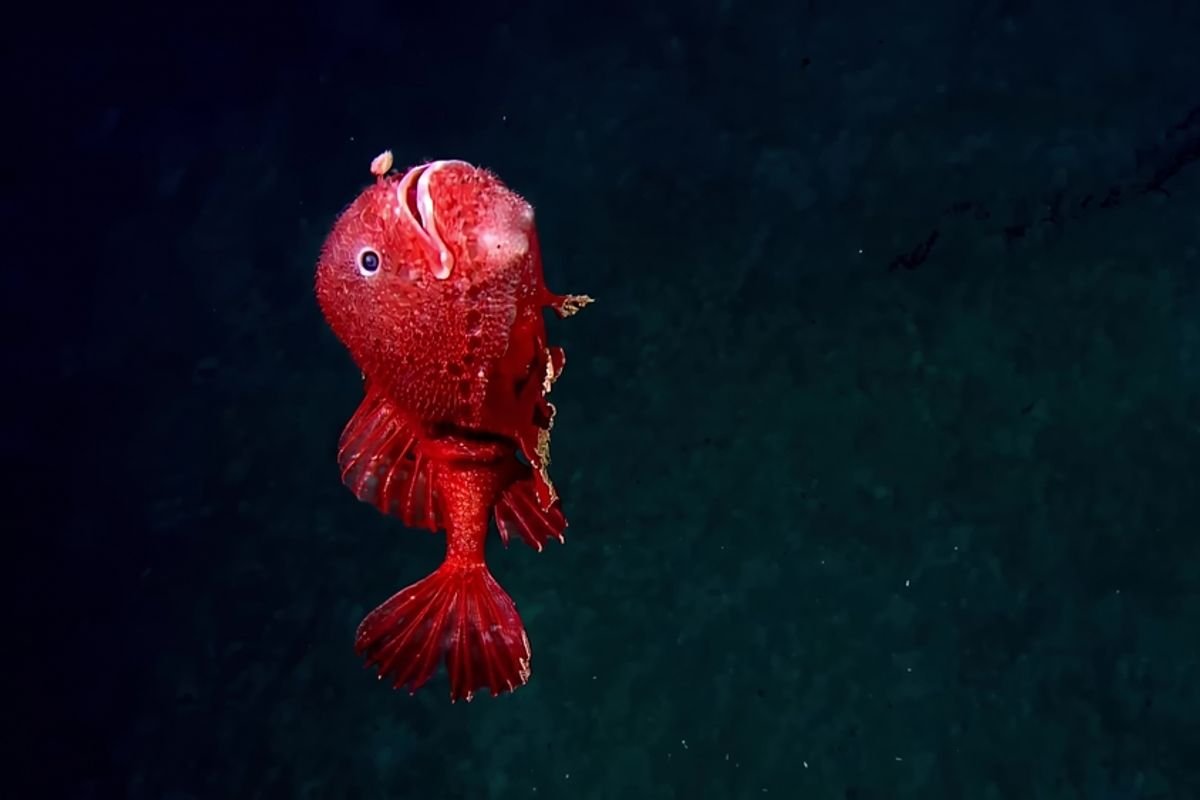
Using Deep Sea Submersibles, Researchers Have Uncovered an Almost Alien World in the Hadal Trenches

The Hadal Trenches are located in the deepest depths of the ocean, from around 3.6 to 6 miles underwater. It’s an alien world, freezing cold with crushing pressure. However, an ecosystem unlike any other on Earth thrives there, existing in darkness and largely depleted of oxygen.
A recent study published in the journal Nature depicts life in the Kuril–Kamchatka Trench and the western Aleutian Trench, two deep-sea depressions in the Western Pacific that are part of the Hadal Trenches. Scientists were able to explore the trenches using a manned submersible called the Fendouzhe.
Read More: Spiky, Star-Shaped Creatures Show the Deep Sea Is a “Connected Superhighway”
How Does Life Survive Without Light and Oxygen?
This is a world of chemosynthetic life, where hydrogen sulfide-rich and methane-rich fluids found in abundance sustain life rather than photosynthesis from the sun. While it was known from other trenches that such creatures existed, it wasn’t clear until this study how widespread such life was in the deep ocean.
“Chemical-rich, mineral-rich waters are coming up out of the sea floor and microbes use them to harness energy and create food for other organisms,” says Katy Croff Bell, a marine explorer who has been on more than 30 oceanographic and archaeological expeditions. “This is in contrast to photosynthetic communities that exist on the surface of the Earth.”
Chemosynthetic life occurs at hydrothermal vents along the ocean floor, where these chemicals are found in abundance. When water seeps down into these vents, it gets enriched with chemicals from the Earth’s core and comes back out of the seafloor, says Bell. This paper documents what happens when methane-rich fluids, likely caused by the compression of two tectonic plates, seep out of the ocean floor.
An Alien Community in the Depths of the Ocean
Bruce Strickrott, an ocean engineer who has spent three decades on the DSV Alvin, a submersible owned by the U.S. Navy, says that on dives this deep, it can take up to three hours just to reach the ocean floor. The submersible quietly sinks for hours until researchers reach their destination: a dark, freezing alien world.
“When we get about 100 meters [about 328 feet] from the bottom, that’s when we start to make our approach,” says Strickrott.
The majority of deep-sea creatures living in the trenches are bivalves, a class of creatures with soft bodies compressed between two shells, and Siboglinidae, tube worms that thrive on organic compounds found on the sea floor.
One such species found in a community nearly 6 miles underwater was frenulate siboglinids, known as beard worms. These long and slender worms have a vestimentum system that retracts in and out, protecting the worm. Bristle worms with “paddle-like” appendages are also found in abundance.
Additionally, M. grandicirra, groups of white, fuzzy-looking creatures that are actually another type of worm, live in communities alongside an array of clam beds, also seen living in large compounds.
A “blue marsh” area is colored by an abundance of methane seeping from the ocean floor, and in another, called the “icy river,” what appear to be snow-like patches on the ocean floor are actually white microbial communities that form what looks like snow mounds. All these species in the Hadal Trenches have evolved to thrive under intense pressure.
“These are huge ecosystems that we’ve never seen before,” Bell says. For Bell, seeing the extent of an underwater world unknown is compelling in itself.
And it’s just the beginning. Her team published a study recently in Science, which found that just .001 percent of the deep sea floor has been visually seen. “This is really important work and there’s so much more yet to be done,” Bell says.
Read More: Exclusive Podcast Episode: We’ve Only Explored 0.001% of the Deep Sea — What’s Lurking Below?
Article Sources
Our writers at Discovermagazine.com use peer-reviewed studies and high-quality sources for our articles, and our editors review for scientific accuracy and editorial standards. Review the sources used below for this article: