
Tiny Tropical Spiders Build Giant Fake Versions of Themselves to Scare Off Predators

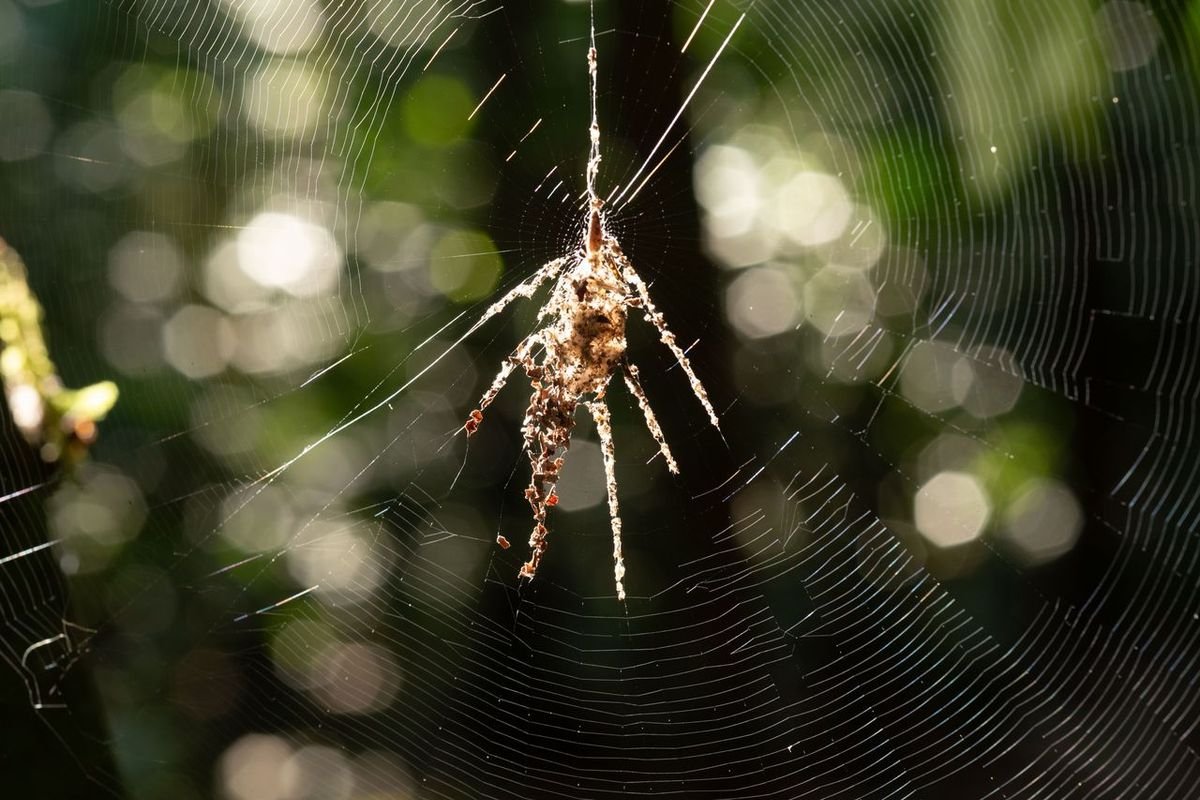
In the depths of the Amazon and across the humid forests of the Philippines, two unassuming orb-weaving spiders have perfected the art of illusion. Instead of retreating into the shadows when danger lurks, these spiders turn their webs into elaborate stages for a show of deception, constructing eerily lifelike “decoy spiders” several times their own size.
A new study published in Ecology and Evolution documents this behavior for the first time, revealing an anti-predator strategy that’s as theatrical as it is effective.
“They don’t just decorate their webs — they meticulously arrange detritus, prey carcasses and silk into a structure that’s not only larger than their own body, but clearly resembles the silhouette of a bigger, menacing spider,” explained lead author George Olah, from the Australian National University, in a press release.
Read More: New Zombie Fungus Is Infecting and Killing Spiders in Irish Caves
Spiders and Decorative Silk Designs
Orb-weaving spiders are famous for their decorative silk designs, known as stabilimenta — distinctive patterns or clumps of silk placed at certain points in their webs. Scientists have long debated their purpose, wondering why these spiders create elaborate decorations.
In these newly studied Cyclosa species, stabilimenta seem to serve an ingenious purpose. Rather than the usual zigzag patterns or random silk patches, these spiders weave intricate sculptures made of prey carcasses, plant fragments, and silk. The resulting stabilimentum isn’t just a random decoration, but a remarkably convincing spider-shaped decoy.
Both the Peruvian and Philippine species of Cyclosa build webs where a central debris mass connects to radiating “legs,” mimicking the outline of a much larger spider. On average, these decoys measure about 3.3 times the size of the real spider, and researchers found both males and females living within these decorated webs. Some females even hide their egg sacs or spiderlings within the debris, adding another layer of camouflage.
Constructing Spider Decoys
The spiders’ behavior is as fascinating as their construction skills. When approached by a predator — or even just a human observer — the spiders will rapidly shake their abdomens, making the decoy appear to vibrate like a living creature. Then, if the threat gets too close for too long, the spider will vanish, turning “their web into a theatre of deception,” according to Olah.
Interestingly, the research team noticed that spiders that built simpler, single-line stabilimenta didn’t display the same shaking behavior. This suggests that only those with full decoy spiders perform this act.
The two species observed also appear to use different survival tactics with their decoys. In the Philippines, the spider hides inside the spider-like structure, while in Peru, it perches just above the decoy, looking like a small extension of it.
“This behavior is not just a quirky biological observation; it illustrates a fundamental evolutionary trade-off in the spider world,” noted co-author Lawrence Reeves, from the University of Florida. “Unlike many orb-weavers that build a physical retreat to hide, these Cyclosa species appear to invest their time and resources into building an expendable visual defense instead.”
What We Can Learn From Decoy Spiders
This study is the first scientific record of spiders arranging debris to mimic a larger spider, and is evidence of a complex visual defense that challenges assumptions about the limits of spider intelligence and adaptation.
Considering there are more than 180 known Cyclosa species across tropical regions, scientists are now asking why only a select few evolved this remarkable mimicry. In the future, the research team hopes to figure out what prompted this unique behavior, whether that be predator pressure, environmental conditions, or just pure evolutionary experimentation.
Read More: Meet the Cannibalistic Caterpillar That Dresses in the Bones of It’s Prey
Article Sources
Our writers at Discovermagazine.com use peer-reviewed studies and high-quality sources for our articles, and our editors review for scientific accuracy and editorial standards. Review the sources used below for this article: