
Thousands of Marine Animals Found Living on Sunken World War II Warheads

All across the world, forgotten remnants of war sit hidden under the water. Although it is illegal now, prior to 1972 countries often used the sea as the dumping ground for explosive weapons that were no longer needed. But these munitions didn’t remain unused for long. Instead, thousands of species of marine wildlife now call these waterlogged weapons home.
In dual studies published in Communications Earth & Environment and Scientific Data, researchers investigated these unique wildlife communities in the hopes to uncover why, and how, these animals live on such dangerous materials.
“Despite the potential negative effects of the toxic munition compounds, published underwater images show dense populations of algae, hydroids, mussels, and other epifauna on the munition objects, including mines, torpedo heads, bombs, and wooden crates,” said the research team in an article.
Read More: 4 Famous Shipwrecks That You Can Visit
Wildlife Living on WWII Warheads
The first study focused on wildlife living within a recently discovered dumpsite in Lübeck Bay, part of the Baltic Sea. Here, the team located a collection of V-1 flying bomb warheads that would’ve been used by Nazi Germany during World War II.
By using a remote controlled submersible, the team was able to identify thousands of organisms living on the hard surface of these warheads. Surprisingly, there were more organisms living on the warheads than living in the surrounding, seemingly safer sediments. The sediments contained about 8,200 organisms per square meter compared to 43,000 organisms per square meter on the warheads.
This observation left researchers with a puzzling question: why would so many organisms choose to live on the discarded weapons — some with concentrations of toxic compounds high enough to be fatal to marine life — instead of in the sediment?
It seems that marine life chooses to call weapons of war home for two main reasons. Firstly, many of the organisms were captured living on the outer casings rather than near any exposed explosive material. This suggests that marine life is actively aware of and avoids the more dangerous areas. Secondly, they just really love hard surfaces. When presented with the options of squishy sediment versus the hard shell of the warhead, most organisms are willing to take the risk for the more stable surface.
These observations show that the discarded warheads have grown to become a crucial part of the habitat in Lübeck Bay. However, researchers believe that the warheads should still be removed and replaced with safer, artificial hard surfaces for the organisms to thrive on without any risk of harm.
Wildlife and War Pollution: A U.S. Example
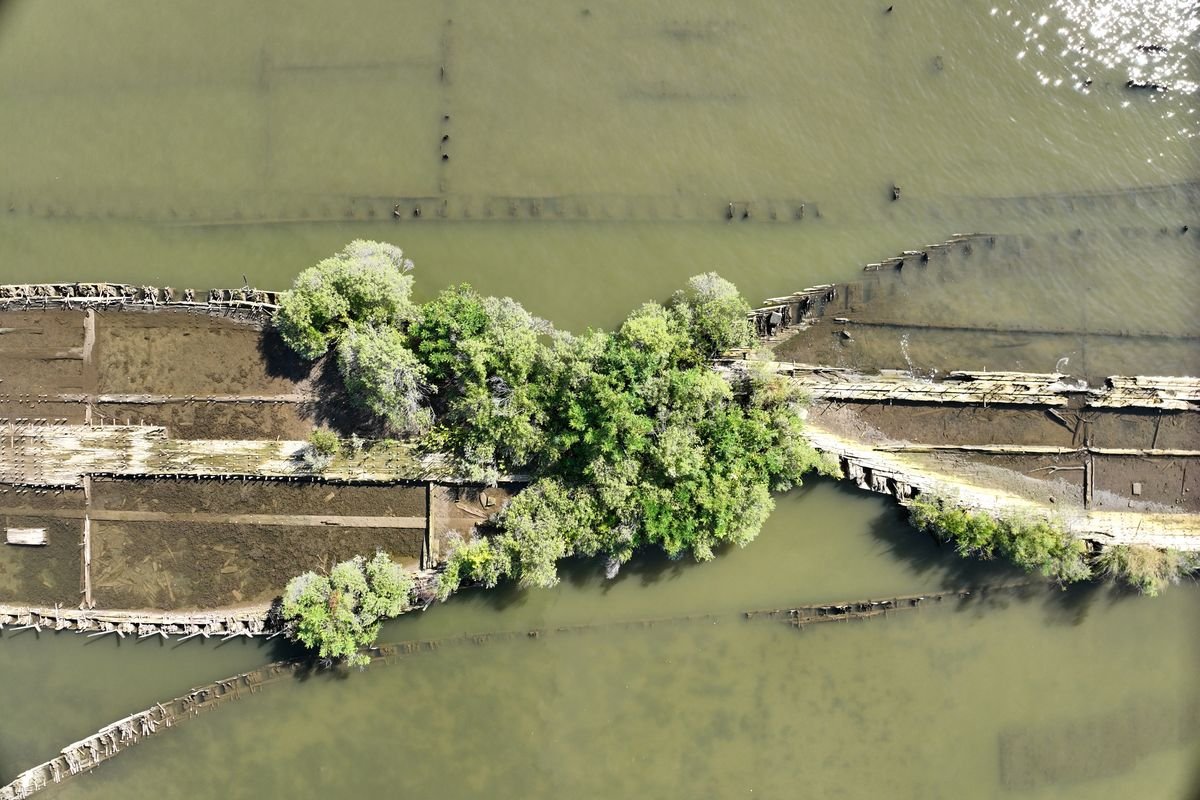
The “Ghost Fleet” of Mallows Bay is the subject of study for the second group of researchers. Located on the Potomac River in Maryland, the “Ghost Fleet” includes 147 deliberately burned and sunk warships built during World War I. Much like the Baltic Sea warheads, these sunken ships have become crucial to local wildlife.
“Not only do shipwrecks hold important cultural and historical resources, but they also present ecological resources as they become important habitats for a variety of species,” said David Johnson and his team in an article. “In the Potomac, large beds of submerged aquatic vegetation in this area provide important feeding and nursery habitats for a variety of birds, fish, reptiles, amphibians, invertebrates, and mammals.”
From the Atlantic sturgeon to ospreys, many different species call these shipwrecks home. To better understand the use of the shipwrecks, researchers created high-resolution photographic maps of each wreck using aerial drones. They hope that this map can be useful for more archaeological, ecological, and cultural studies in the area.
Read More: Shipwrecks Teem With Underwater Life, From Microbes To Sharks
Article Sources
Our writers at Discovermagazine.com use peer-reviewed studies and high-quality sources for our articles, and our editors review for scientific accuracy and editorial standards. Review the sources used below for this article: