
This Frog’s Secret Power? Eating Venomous Murder Hornets Like Popcorn
A single hornet sting can be powerful enough to kill a small mammal. But to pond frogs, the venomous insects appear to be more of a delicacy.
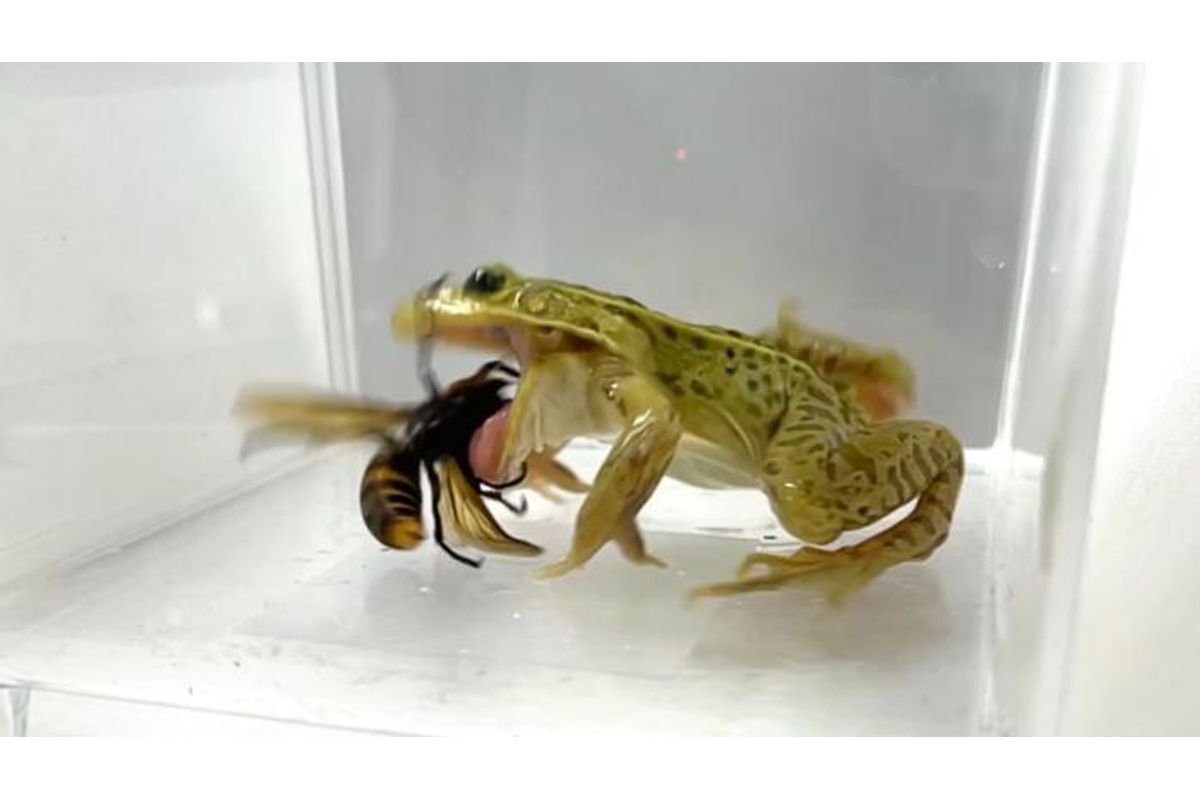
In results reported in Ecosphere, ecologists found that frogs actively attacked and swallowed live hornets — including the world’s largest hornet, commonly referred to as the “murder hornet,” known for its massive size, razor-sharp mandibles, and medically dangerous venom — even after being stung directly in the mouth and eyes. All of the frogs survived and showed no noticeable harm, even after repeated stings.
“While a mouse of similar size can die from a single sting, the frogs showed no noticeable harm even after being stung repeatedly. This extraordinary level of resistance to powerful venom makes the discovery both unique and exciting,” said Shinji Sugiura, Kobe University ecologist, in a press release.
The Dangers of Hornet Venom
Venomous stingers are among the most effective defensive weapons in the animal world. Wasps, bees, ants, and scorpions use them to deter attackers with intense pain, tissue damage, and toxic effects. Hornets — large social wasps in the genus Vespa — are especially well-armed. Their venom is a complex cocktail of biogenic amines, peptides, and enzymes that trigger extreme pain, damage blood cells, and can interfere with heart function.
Yet in nature, adult hornets are not completely untouchable. Birds, spiders, and even amphibians are known to prey on them. That raises a fundamental mystery: when these predators attack hornets, do they survive by skillfully avoiding the stinger — or by somehow tolerating the venom after being stung?
Clues from the wild hinted at a stranger answer. Adult hornets have been found in the stomachs of several amphibians, including the pond frog Pelophylax nigromaculatus. In Japan’s agricultural landscapes, hornets regularly collect nectar and water along pond edges — the same places where these frogs hunt. Those overlaps raised a possibility: rather than merely surviving hornet attacks by chance, some frogs might be biologically adapted to withstand them.
Read More: 20 New Frog Species Found in Madagascar
How Frogs Respond to Live Hornet Stings
To test that idea directly, ecologists conducted controlled laboratory trials with pond frogs and three hornet species: Vespa simillima, Vespa analis, and Vespa mandarinia. Each frog was tested only once and matched in size to its prey, with the largest frogs facing the giant hornets.

This is a sequence of the black-spotted pond frog showing remarkable tolerance to venomous stings from an Asian giant hornet, with close-up views of the hornet’s stinger embedded in the frog’s mouth.
(Image Credit: Shinji Sugiura/CC BY)
The hornets did not hold back. During attacks, they repeatedly drove their stingers into frogs’ faces, eyes, tongues, and throats. But the frogs pressed on. Nearly all attacked their prey, and the majority successfully swallowed the insects whole — 93 percent for V. simillima, 87 percent for V. analis, and 79 percent for V. mandarinia. None of the frogs regurgitated their prey, and all passed hornet remains in their feces days later.
Not a single frog was injured or killed by the stings — even though the frogs weighed far less than mice known to die from a hornet sting. The study also found that larger frogs were more likely to succeed, suggesting body size may provide an added buffer against the venom’s effects.
Blocking Both the Pain and Toxicity of Venom
Previous work has shown that some stinging insects cause extreme pain with little risk of death, while others can be lethal without much pain — suggesting that pain and toxicity do not always go hand in hand. The frogs’ ability to ignore both in hornet stings points to a rare form of dual tolerance.
“This raises an important question for future work,” he added, “namely whether pond frogs have physiological mechanisms such as physical barriers or proteins that block the pain and toxicity of hornet venom, or whether hornet toxins have simply not evolved to be effective in amphibians, which rarely attack hornet colonies,” said Sugiura.
Read More: New Species of Frog Named After the Hobbit Author, J.R.R. Tolkien
Article Sources
Our writers at Discovermagazine.com use peer-reviewed studies and high-quality sources for our articles, and our editors review for scientific accuracy and editorial standards. Review the sources used below for this article: