
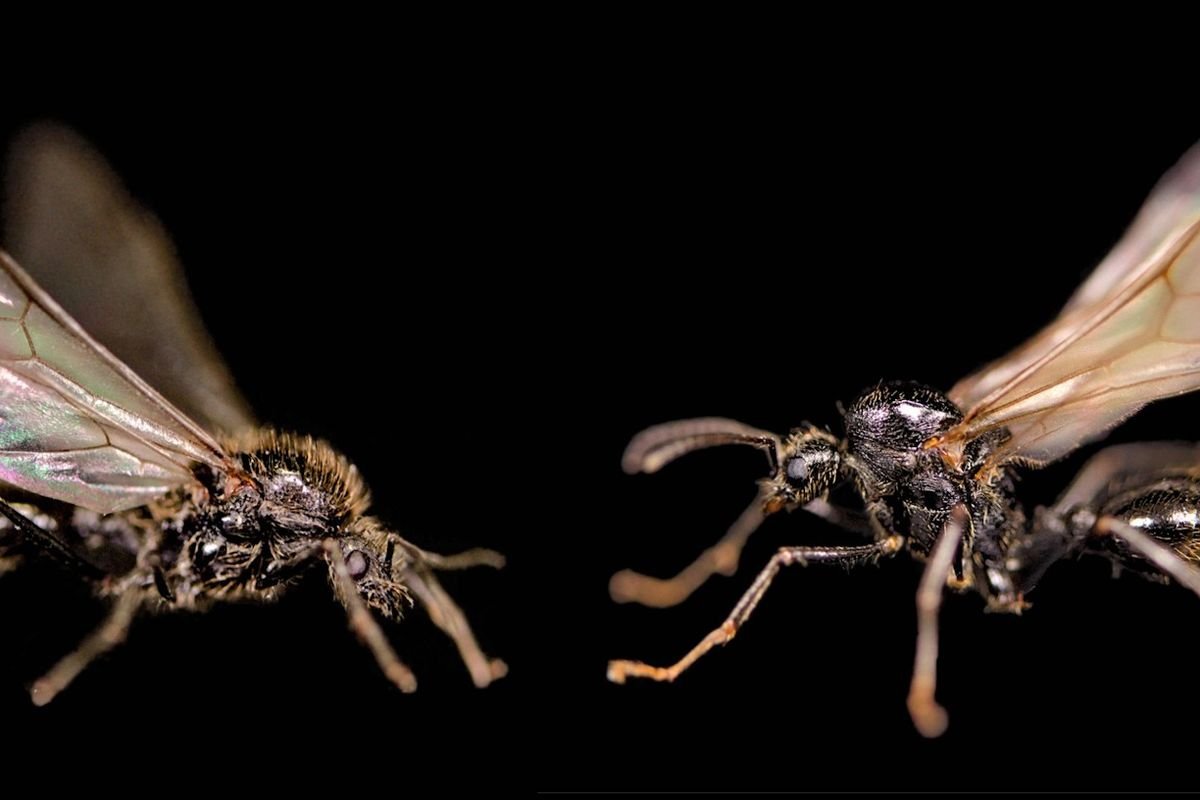
This Animal Mother Is the Only on Record to Bear Offspring That Aren’t the Same Species

Whatever you thought when you were younger, your siblings are the same species as you. It’s a simple rule that rings true for almost all animals, including most insects, from beetles to the tiniest fleas and flies. Still, there are always exceptions, even to the seemingly fundamental laws of life.
According to a new paper published this month in Nature, the mothers, or queens, of the Iberian harvester ant can create two separate species of offspring, churning out siblings that aren’t all that similar at all. To produce future queens, they conceive male offspring of their own species, Messor ibericus, and to produce future workers, they conceive male offspring of another species, Messor structor.
Taken together, these reproduction strategies represent a rare case — the only one on record — of a species cloning another species to complete its own lifecycle.
Read More: When It Comes to Crowning Ant Queens, It All Comes Down to Genetics
Complex Ant Colonies
Ant colonies are complex societies of insects, consisting of female queens, who mate with males to produce offspring, and female workers, who forage for food and carry out other tasks that allow the colony to thrive. But some species of ants, including M. ibericus, rely on outsiders to maintain their complex societies.
In these species, the female queens have to mate with male members of the same species to yield future queens, and they have to mate with male members of other species to yield future workers — a practice called sperm parasitism.
Previous studies have shown that many of the workers in M. ibericus colonies are hybrids of M. ibericus and M. structor ants, hinting at M. ibericus’s reliance on sperm parasitism. But the two species rarely share the same spaces in their Mediterranean habitats today, raising questions about when and where M. ibericus queens and M. structor males meet.
Read More: Asexual Reproduction is Surprisingly Common in the Animal Kingdom
Cloning Ant Lineages
To find out more about these relationships, researchers at the University of Montpellier sampled around 120 populations, sequenced around 400 individuals, and observed around 50 colonies in the lab over the course of five years. Their work revealed that M. ibericus queens run into M. structor males by making them themselves.
Rather than chasing after M. structor males, M. ibericus queens can clone them from their own sperm. With this ability, they can create clonal lineages of M. structor males from the comfort of their own colonies, and they can maintain those lineages over time, meaning they can access M. structor males for reproduction without staying too close to M. structor communities.
The whole thing is weird, and yet, this cloning could have contributed to M. ibericus’s success as a species, providing the ants with flexibility and freedom, allowing them to spread throughout the Mediterranean.
Read More: From Komodo Dragons to California Condors, These Animals May Reproduce On Their Own
Same Mother, Separate Species
According to the researchers, M. ibericus’s cloning abilities enable the ants to produce male siblings, or “brothers,” as a press release about the research put it, with separate genomes — some related to M. ibericus, others related to M. structor. Indeed, the genomes of these two types of offspring are as distinct as those of species that separated around 5 million years ago.
The process also produces offspring with distinct morphologies. While one brother is hairy, the other brother is hairless — a distinction that differentiates many species of ants. While the hairy one is a M. ibericus male, the hairless one is a clone of a M. structor male.
The researchers add that the ants are the only known species that survives off of the cloning of another species — an approach that they’ve called xenoparity (combining the Greek xeno, meaning “foreign” or “different,” and parity, meaning “to give birth to”). Whether other species live off similar strategies, only time will tell, leaving open the possibility of other biological rule breakers that produce individuals of more species than their own.
Article Sources
Our writers at Discovermagazine.com use peer-reviewed studies and high-quality sources for our articles, and our editors review for scientific accuracy and editorial standards. Review the sources used below for this article: