
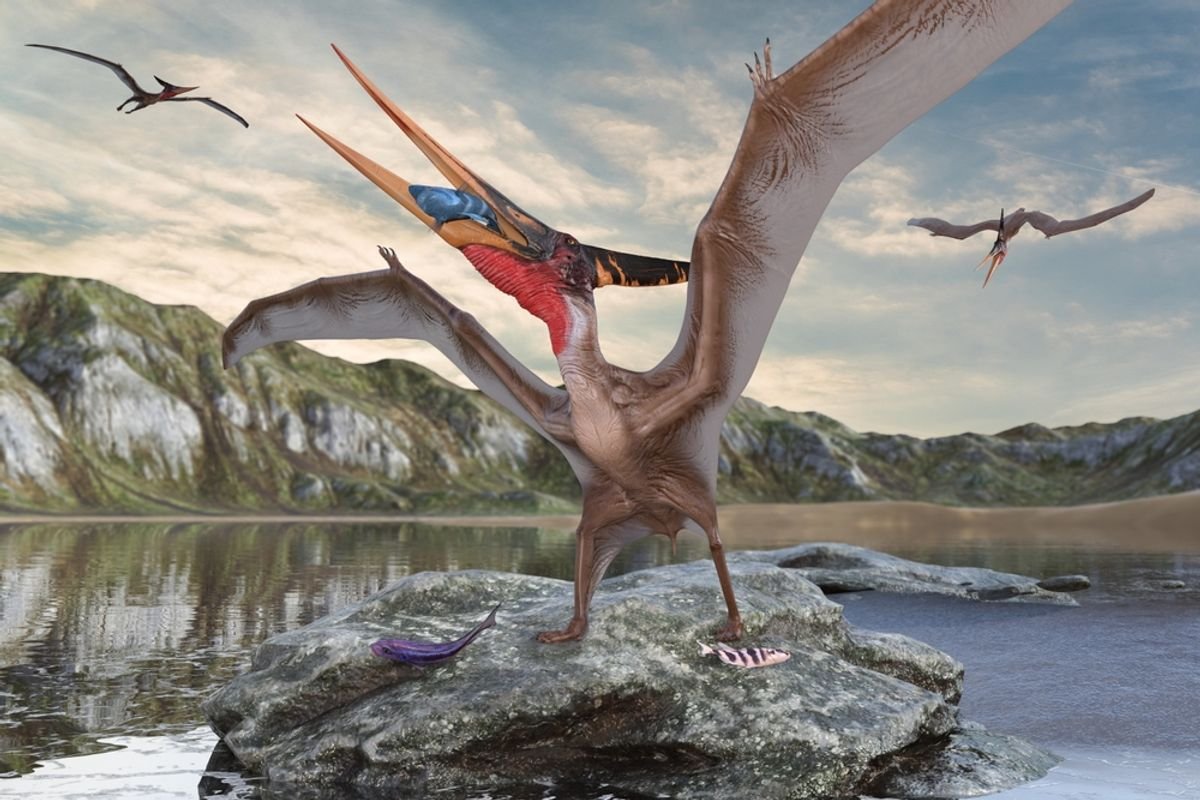
Think Pterosaurs and Plesiosaurs Are Dinosaurs? Here’s Why These and Other Species Are Not
The ancient world was full of massive, menacing creatures, but none have achieved fame on par with the dinosaurs. In fact, many of these lesser-known animals get wrongly lumped in with the likes of T. rex, Stegosaurus, and Brontosaurus, to whom they are only distantly related.
When the English anatomist Sir Richard Owen coined the word “dinosaur” in 1842, its provocative literal translation — “terrible lizard” — captured the public imagination. Soon enough, says Daniel Barta, a dinosaur anatomist at Oklahoma State University, “that became a catch-all for anything that was large and reptilian and lived in prehistory.”
Yet despite their superficial similarities, many scaly, razor-toothed animals were evolutionarily and anatomically distinct. Here are some of the groups most commonly confused with dinos.
Read More: First Ancient Crocodile Relative from 237 Million Years Ago Was Unearthed in Brazil
Pterosaurs: Flying Reptiles, Not Dinosaurs

Quetzalcoatlus
(Image Credit: kamomeen/Shutterstock)
This is perhaps the most understandable mistake. Pterodactyls and other flying reptiles were the dinosaurs’ closest relatives, and their time on Earth overlapped almost exactly. Their shared ancestors were bipedal, using two legs for locomotion, a trait that sets both pterosaurs and dinosaurs apart from other reptiles.
That said, a few defining features allow paleontologists to tell them apart easily. For one thing, there were no flying dinosaurs — though some (like Archaeopteryx and Microraptor) could glide, their wing structures were fundamentally different from those of the pterosaurs.
Dinosaurs also had an open hip joint and a long crest on the humerus, or upper arm bone, which aren’t present in any other reptiles.
Pseudosuchians: Ancient Crocodiles, Not Dinosaurs

(Image Credit: AlexanderLS/Shutterstock)
(Image Credit: AlexanderLS/Shutterstock)
Dinosaurs and pterosaurs (along with modern birds) make up one half of the taxonomic group archosaurs. The other half is the pseudosuchians, a diverse lineage of crocodile-like reptiles that first appeared around the same time as their dinosaur cousins and have now outlasted them by 65 million years.
Unsurprisingly, given their shared archosaur lineage, some pseudosuchians look remarkably like dinosaurs. It takes a trained eye to discern the key difference: ankle arrangement. Dinosaurs have a straightforward, hinge-like ankle joint, whereas crocodiles and their ancient forebears have a more complex joint that allows for ankle rotation.
For the average museum-goer, of course, that would be easy to miss. Even specialists can be misled if they don’t examine skeletons thoroughly. “We have to be very careful anatomists,” Barta says, “in terms of taking into account the entire skeleton and not getting distracted by the convergent similarities.”
Plesiosaurs, Ichthyosaurs, Mosasaurs: Marine Monsters

Plesiosaurs
(Image credit: Bilardo/Shutterstock)
Dinosaurs may have ruled the prehistoric continents, but their territory more or less ended at the shoreline. The ocean depths belonged to seagoing reptiles, which, though just as majestic and fearsome, were creatures of an entirely different sort.
The long-necked plesiosaurs, the dolphin-esque ichthyosaur, and the mosasaurs — which are most closely related to lizards and snakes — all evolved from terrestrial reptiles. But their body plans became substantially modified, with streamlined forms and fins for limbs. They were well adapted to dominate the underwater world; by contrast, no dinosaur (with the possible exception of Spinosaurus) was built for an aquatic lifestyle.
Birds: Latter-Day Dinosaurs

Sandhill Crane
(Image Credit: Cami Neimann/Shutterstock)
We’re so accustomed to birds that it’s easy to forget they are the closest modern relatives of the dinosaurs — indeed, their only living descendants.
There are three main groups of dinosaurs: ornithischians, such as Stegosaurus; sauropods, such as Brontosaurus; and theropods, such as T. rex. Early paleontologists insisted birds could not be related to any of these groups, due to one crucial anatomical detail: Birds have a wishbone (a forked bone between the neck and breast) that wasn’t obviously present in known dinosaur fossils.
Except it was present in some theropods, as later investigators discovered. This was the smoking gun that revealed where birds truly belong in the tree of life. It turns out, as Barta put it, that “there isn’t much at all that separates what we call a bird from a theropod. They’re just one branch — a very big branch — of the theropod lineage.”
Read More: Dimetrodon, a Giant Sail-Finned Predator, Was More Related to Mammals than Dinosaurs
Article Sources
Our writers at Discovermagazine.com use peer-reviewed studies and high-quality sources for our articles, and our editors review for scientific accuracy and editorial standards. Review the sources used below for this article:
- This article references information from Daniel Barta, a dinosaur anatomist at Oklahoma State University.