
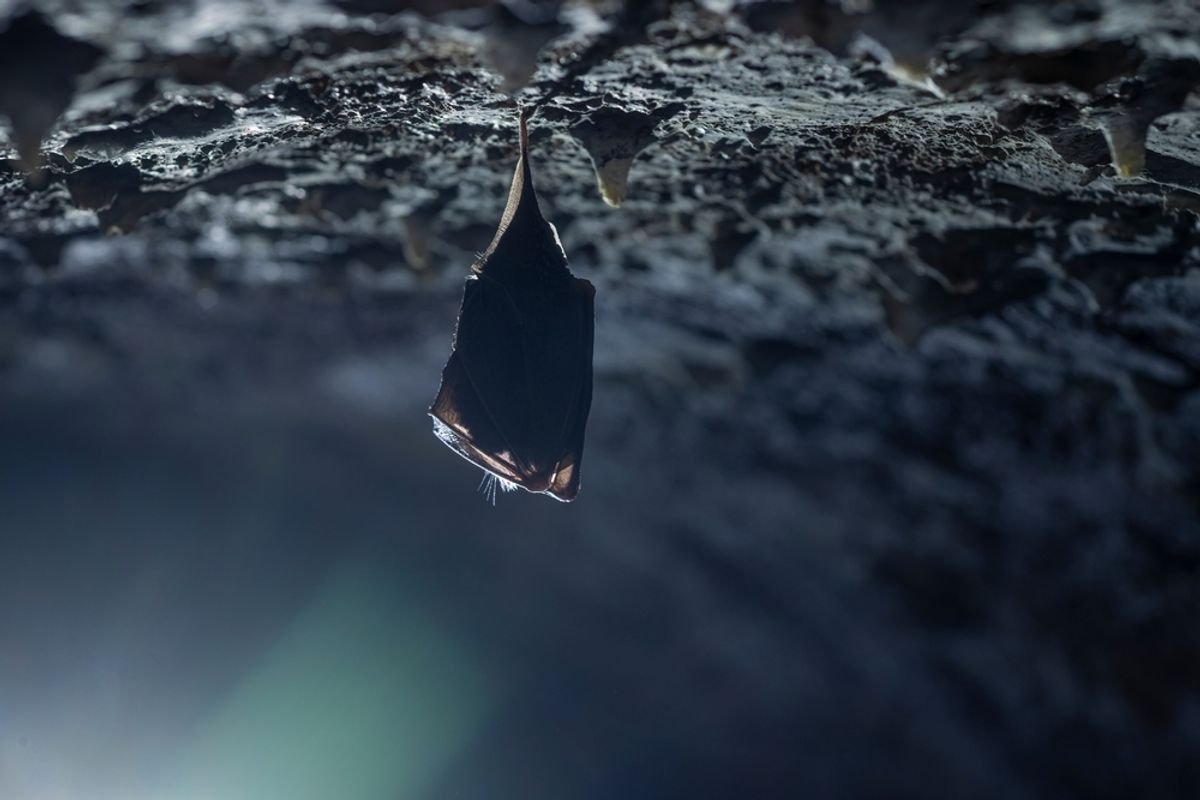
These Bats Glow Green Under UV Light, But the Reason Is Still a Mystery

Squirrels, platypuses, and gophers are all furry mammals that are most active at dawn, dusk, or in the dark. A series of surprising studies have shown that these animals share another, less obvious trait: they all glow when exposed to ultraviolet (UV) light.
Now, researchers from the University of Georgia have added six species of North American bats to the list of oddly luminous mammals in a study published in Ecology and Evolution.
Read More: Migrating Bats Surf Storm Fronts to Save Energy
Understanding Bats’ Glow
The researchers, led by University of Georgia ecologist Steven Castleberry, studied the bats among the display cases of the Georgia Museum of Natural History rather than in dense forest thickets.
The 60 bat bodies in the museum’s archives included specimens of big brown bats, eastern red bats, Seminole bats, southeastern myotis, gray bats, and Brazilian free-tailed bats.
All 60 specimens shared a distinctive green glow, which radiated from the specimens’ hind limbs, wings, and uropatagia (the membrane stretching between the hind limbs and tail).
The glow was present on male and female bats, regardless of how long the specimens had been in the museum. Now that this strong signal has been identified, the challenge for the team is to work out what it means.
“It’s cool, but we don’t know why it happens. What is the evolutionary or adaptive function? Does it actually serve a function for the bats?” said Castleberry in a press release.
Previous analyses of other glowing mammals have only turned up functional dead ends. A study that compared how rats (which are highly photoluminescent) reacted to real-fur models that either included or were stripped of their natural glow. Essentially, the rats didn’t seem to notice or care.
Where Does the Glowing Trait Come From?
Other species of bats have been previously shown to glow under UV light, but the consistent pattern and wavelength emitted by these closely related bat species add a new twist to the tale.
“The data suggests that all these species of bats got it from a common ancestor. They didn’t come about this independently,” Castleberry said.
The authors suggest that UV light may play a role in bat communication, but that further behavioral research on bats will be necessary to confirm whether the photoluminescence is still important to bats today or is merely the fading remnant of an old evolutionary adaptation.
As the same glow was shared between species and sexes, the authors say it is unlikely to be used for mating or species identification. The authors hope that identifying why bats glow could reveal insights into their behavior that haven’t been brought to light by previous studies.
“While it’s still unknown whether photoluminescence may serve an explicit ecological purpose, additional information on adaptive advantages it may provide could be valuable for further understanding bat behavior and ecology,” said Briana Roberson, the study’s lead author, in a press release.
Read More: Protecting the Coolest Types of Bats in North America
Article Sources
Our writers at Discovermagazine.com use peer-reviewed studies and high-quality sources for our articles, and our editors review for scientific accuracy and editorial standards. Review the sources used below for this article: