
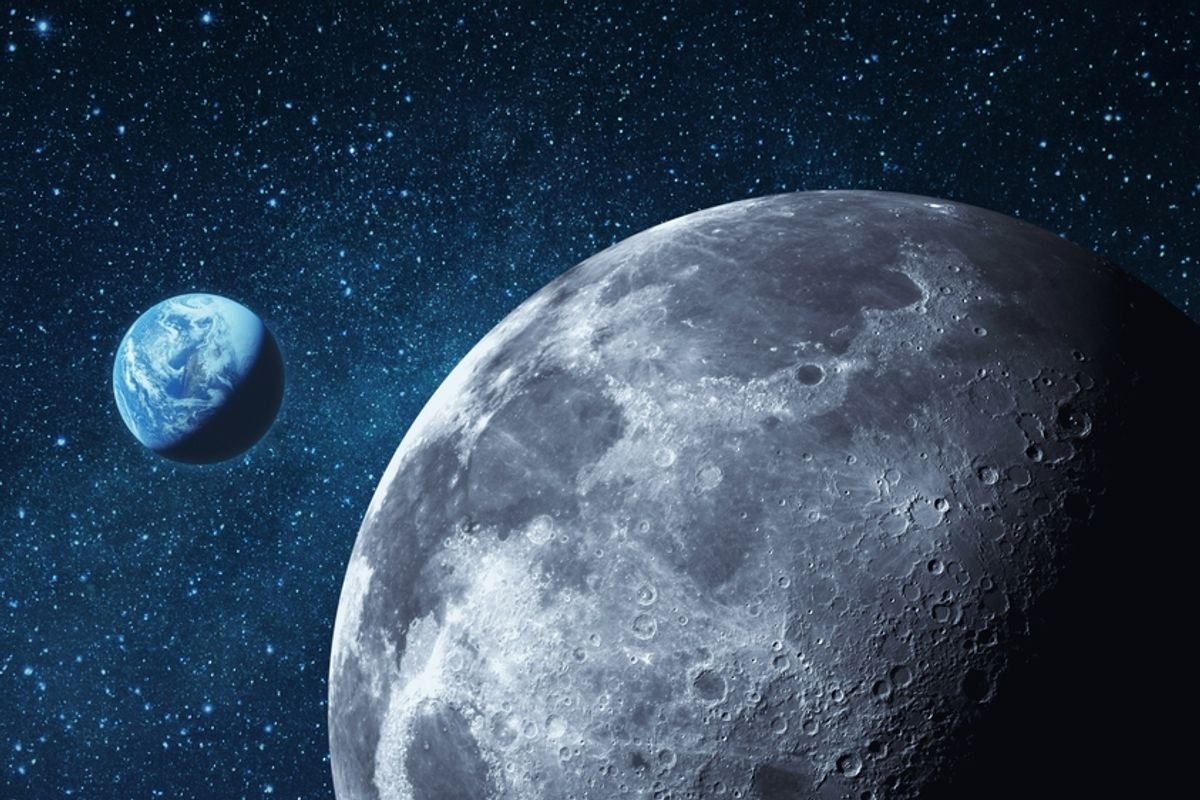
The Moon Is Moving Farther From Earth Each Year, and Tides Are the Reason
The moon is our only natural satellite and has been orbiting Earth for about 4.5 billion years. It helps illuminate the night sky, has great cultural significance to some, and was the first celestial body outside of Earth that humankind ever stepped on.
It’s in synchronous rotation with us and influences the tides. It’s also slowly drifting away from Earth. Yes, that’s right, the moon is slowly drifting away from Earth at a rate of about 1.5 inches per year. But why? And what does that mean for the future of our planet?
Measuring the Moon’s Distance From Us
The moon is about 239,000 miles away from Earth. During the Apollo missions 11, 14, and 15 (along with two unnamed Soviet missions), astronauts placed retroreflectors on the moon’s surface to help set up the Lunar Laser Ranging (LLR) experiment.
Back on Earth, experts aimed a high-powered laser at the retroreflectors and calculated how long it took for the light to bounce back from Earth. With this data, experts can now measure down to a few millimeters the exact distance Earth is from the moon.
Each year, astronomers measure this distance, and each year they note that the moon has drifted another 1.5 inches away.
Read More: Scientists Are Still Pondering These Mysteries of the Moon
The Distance from Earth to the Moon Fluctuates
While the idea of the moon slipping away may seem startling, the distance between the moon and Earth fluctuates all the time. On average, the moon is about 239,000 miles away from Earth. However, because the moon does not orbit in a perfect circle, the distance can vary by about 12,400 miles during its orbit.
This is why the moon may appear larger on certain full moons than on others. But it’s not the moon’s orbit that’s causing it to move away.
Why Is the Moon Drifting Away?
We know the moon has a great impact on our tides. The tides are also what appear to be causing the moon to drift.
The moon’s gravity causes high and low tides, something known as the tidal force. As the tidal force shifts Earth’s mass, it creates a tidal bulge on each side of the planet. As this happens, Earth appears more oval than it does round. While Earth rotates through the bulge, the oceans likely experience two high tides and one low tide.

(Image Credit: TarikVision/Shutterstock)
The moon drift happens because the tidal bulge and the moon don’t quite line up. The moon falls just a little bit behind the bulge, so as Earth rotates, our planet’s gravity is pulling the bulge forward, which in turn is also pulling the moon forward. This action is causing the moon to speed up, increasing the size of its orbit. As the orbit continues to increase, the moon will move farther from Earth.
Each year, 1.5 inches may feel like it will add up quickly, but according to experts, we still have plenty of time before the moon is far enough away that there are any noticeable changes. If the moon was that far away, we wouldn’t have any tides, any eclipses, or the 24-hour day. However, we’re still millions and millions of years away from that.
Read More: The First Civilization in Ancient Mesopotamia Thrived Thanks to Rivers and Tides
Article Sources
Our writers at Discovermagazine.com use peer-reviewed studies and high-quality sources for our articles, and our editors review for scientific accuracy and editorial standards. Review the sources used below for this article: