
The Largest and Oldest Known Maya Monument Could Symbolize a Model of the Universe
At Aguada Fénix, the largest and oldest known Maya monument, a treasure trove of buried artifacts has shed light on ancient rituals performed 3,000 years ago. The monument itself was first discovered in southeastern Mexico in 2020, but now, researchers have gathered conclusive evidence that cements it as one of the most important ceremonial sites in Mesoamerica.
A new study published in Science Advances details significant findings at the monument, including jade ornaments and mineral pigments that were likely deposited as offerings. These objects — along with the arrangement of causeways and corridors — suggest that the site served as a cosmogram, a model of the order of the universe.
Read More: How the Maya Created Their Extraordinarily Accurate Calendar Thousands of Years Ago
The Ceremonial Hub of the Maya

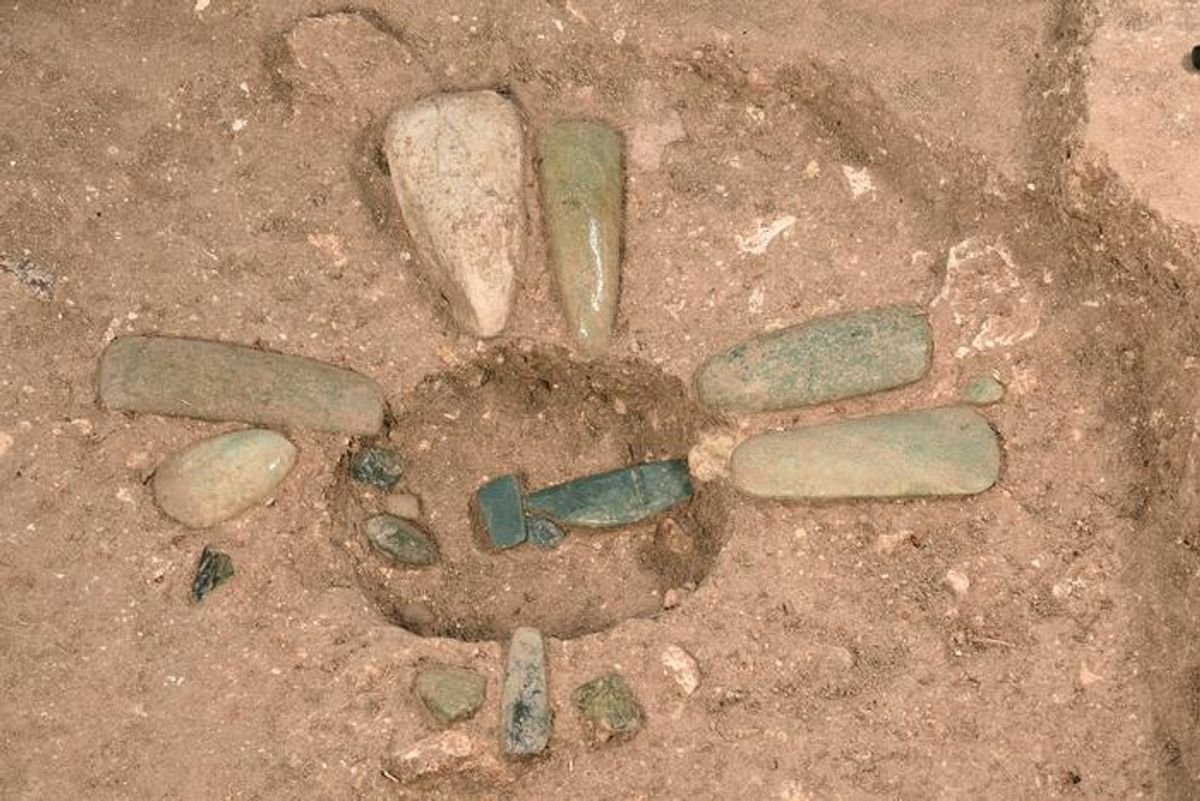
A jade artifact found in the cruciform likely represents a woman giving birth, researchers said.
(Image Credit Takeshi Inomata/University of Arizona)
For being the oldest known Mayan monument, Aguada Fénix boasts a structure that is surprisingly impressive in scale. The site, which dates to around 1,000 B.C.E., measures nearly a mile long and a quarter mile wide, with heights ranging from 30 to 50 feet high.
In the years following Aguada Fénix’s initial discovery, researchers have found nearly 500 smaller sites across southeastern Mexico that were built with similar features.
But given the size of Aguada Fénix, it appears to have been the crown jewel of the early Maya civilization; it’s just as grand as other iconic structures built nearly a thousand years later in Mesoamerican history, like Tikal in Guatemala and Teotihuacan in Central Mexico. This challenges the existing notion that Mesoamerican settlements gradually increased in size over time.
“What we are finding is that there was a ‘big bang’ of construction at the beginning of 1,000 B.C.E., which really nobody knew about,” said Takeshi Inomata, an archaeologist at the University of Arizona, in a statement. “Huge planning and construction really happened at the very beginning.”
A Colorful Cache of Artifacts
The monument’s magnitude is linked to its status as a prominent ritual setting, something its builders clearly had in mind when constructing it. The centerline of the monument, for example, aligns with the rising sun on October 17 and February 24; this 130-day span, researchers say, could represent half of the 260-day cycle of the Mesoamerican ritual calendar.
The new study also lends credence to the monument’s ritualistic purpose, with the excavation of a cross-shaped pit (called a “cruciform”) providing new insight. In this pit, researchers first came across several ceremonial axes made of jade. Further digging revealed jade ornaments carved into different shapes, like a crocodile, a bird, and one that may depict a woman giving birth.
At the bottom of the pit, they found small piles of blue, green, and yellowish soil. These mineral pigments were arranged in each cardinal direction, something never seen before, according to the researchers. Radiocarbon dating estimates that the cache of pigments dates to 900-845 B.C.E.
Along with the artifacts, the researchers also observed raised causeways and sunken corridors that followed the site’s orientation with the sun, as well as canals and a dam to divert water from a nearby laguna.
Ruling Smarter, Not Harder
While some Mesoamerican sites were ruled by powerful kings, the researchers behind the new study surmise that Aguada Fénix’s leaders were more intellectual than authoritarian. Rather than force others to do their bidding, these leaders likely had a hand in designing and planning the construction of the cosmogram with their astronomical observations.
“People have this idea that certain things happened in the past — that there were kings, and kings built the pyramids, and so in modern times, you need powerful people to achieve big things,” Inomata said. “But once you see the actual data from the past, it was not like that. So, we don’t need really big social inequality to achieve important things.”
Read More: The Maya Civilization’s Religion Was More Than Just Ritual Sacrifices
Article Sources
Our writers at Discovermagazine.com use peer-reviewed studies and high-quality sources for our articles, and our editors review for scientific accuracy and editorial standards. Review the sources used below for this article: