
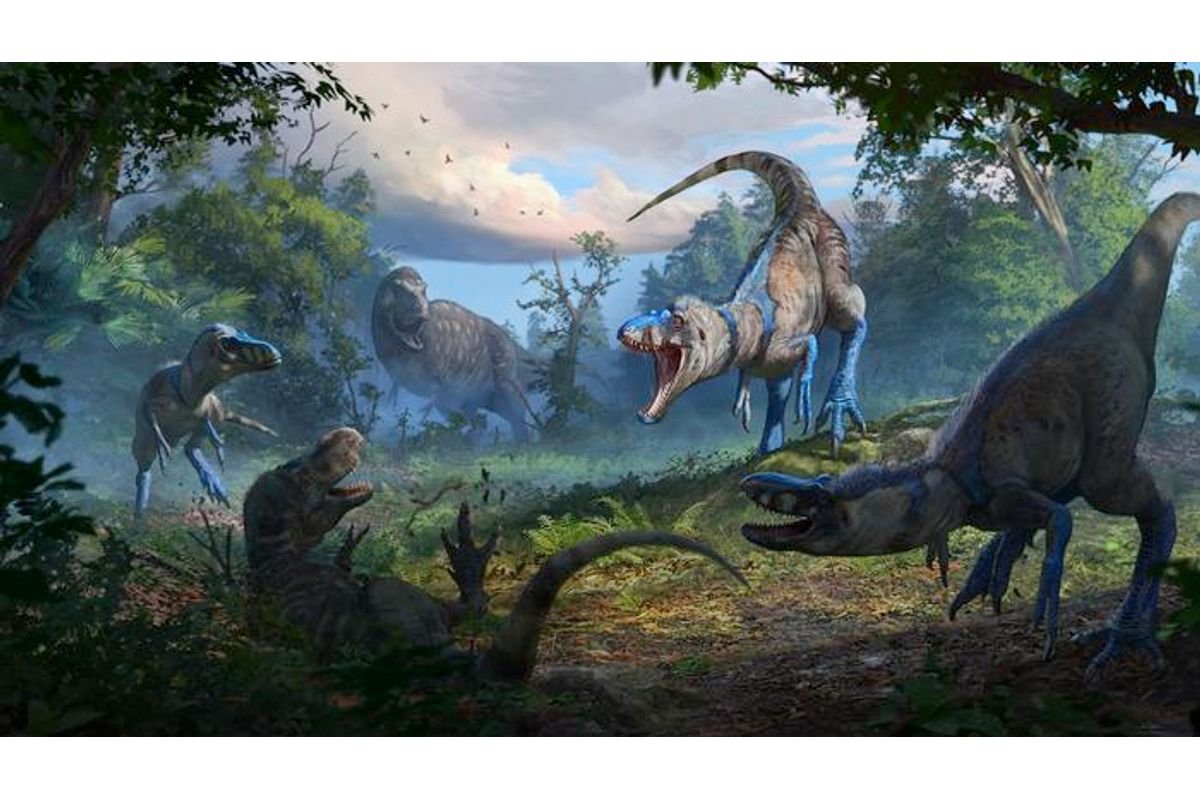
The Dueling Dinosaurs Mystery May Have Been Solved — The Baby T. rex Was Instead a Nanotyrannus
In the badlands of Montana, time doesn’t pass so much as settle. Beneath layers of sandstone and ancient river mud, two dinosaurs — a horned Triceratops and a smaller, sharp-toothed predator — entombed together since the final days of the Cretaceous. To paleontologists, the fossilized pair, known as the “Dueling Dinosaurs,” was both a spectacle and a riddle: Was the smaller skeleton a young Tyrannosaurus rex, or something else entirely?
Now that mystery has been answered. New research published in Nature reveals that the smaller predator wasn’t a juvenile T. rex at all, but a fully grown Nanotyrannus lancensis — a species that rewrites the tyrant’s family story.
“This fossil doesn’t just settle the debate. It flips decades of T. rex research on its head,” said Lindsay Zanno, co-author of the study, in a press release.
Read More: The Tyrannosaurus Rex Origin Story May Not Have Started in North America
Juvenile T. rex, or Nanotyrannus lancensis?
For over a century, T. rex has been the celebrity of paleontology — a model organism for studying dinosaur biology, from feeding and locomotion to growth and life history. But that fame, experts say, may have blinded science to a crucial truth hiding in plain sight.
“For Nanotyrannus to be a juvenile T. rex, it would need to defy everything we know about vertebrate growth,” said James Napoli, co-author of the study. “It’s not just unlikely — it’s impossible.”
The finding forces a re-examination of decades of T. rex research. Many studies on growth, feeding, and biomechanics may have unknowingly combined two separate animals — species that actually lived side by side in the last million years before the asteroid impact.
Paleontology’s Fiercest Feud
To ensure their results could withstand close scrutiny, Zanno and Napoli carried out an exceptionally detailed study of the fossil’s bone tissue — among the most comprehensive histological investigations ever applied to a tyrannosaur. Thin-section analysis revealed growth rings marking about 20 years of life, showing the animal had already reached maturity by the time it died.

Lindsay Zanno, associate research professor at North Carolina State University and head of paleontology at the North Carolina Museum of Natural Sciences, with the Dueling Dinosaurs fossil.
(Image Credit: N.C. State University/CC BY-NC-ND)
The anatomy told an even clearer story. The dinosaur’s mouth held noticeably more teeth than a typical T. rex, and its forelimbs — particularly the hands — were proportionally and absolutely longer than those of even the biggest tyrant lizards, according to Nature. For such features to transform into those of T. rex, its limbs would have to shorten, and teeth would need to disappear during growth — a pattern virtually unheard of in vertebrate evolution. Together, these details, along with other subtle skeletal distinctions, made the argument decisive.
While comparing more than 200 tyrannosaur specimens, the researchers also revisited the well-known “Jane” skeleton, determining that it was still growing yet destined to remain far smaller than an adult T. rex. On the basis of those findings, they named a new species, Nanotyrannus lethaeus — a tribute to the mythic River Lethe, for how this predator’s identity was forgotten for generations.
Their phylogenetic analysis places Nanotyrannus just beyond the core Tyrannosauridae lineage, hinting at a more intricate evolutionary tree of apex hunters flourishing in the last days before the dinosaurs vanished.
Rival Predators in the Shadow of Extinction
The findings suggest that, even in the planet’s final million years before the asteroid strike, tyrannosaurs were radiating into new forms rather than fading away.
“This discovery paints a richer, more competitive picture of the last days of the dinosaurs,” Zanno said in the press release. “With enormous size, a powerful bite force, and stereoscopic vision, T. rex was a formidable predator — but it did not reign uncontested. Darting alongside was Nanotyrannus — a leaner, swifter, more agile hunter.”
Read More: T-Rex Arm Sleeping Is a Common Habit That Helps Us Feel Secure and Relaxed
Article Sources
Our writers at Discovermagazine.com use peer-reviewed studies and high-quality sources for our articles, and our editors review for scientific accuracy and editorial standards. Review the sources used below for this article: