
The Deadliest Spider in the World Ends Lives in Hours, But Its Venom May Inspire Medical Miracles

If you’re going for a stroll in eastern Australia, there’s one spider you don’t want to come across: the Sydney funnel-web spider, otherwise known as the world’s deadliest spider. The venom of this infamous arachnid is strong enough to kill a human in under an hour, potentially even in as little as 15 minutes.
The Sydney funnel-web spider isn’t the only one with a lethal reputation. A January 2025 study from BMC Ecology and Evolution revealed that it has two close relatives, the Southern Sydney funnel-web and the Newcastle funnel-web. These spiders were previously thought to be Sydney funnel-webs, but they’ve now branched out to become their own separate species.
This triple threat is not to be trifled with, but there’s more to them than meets the eye. Find out why their venom not only has the ability to kill, but also the potential to save lives.
Read More: Spiders Will Hunt in Groups and Share Meals if They Have Enlarged Brain Structures
The Deadliest Spider in the World
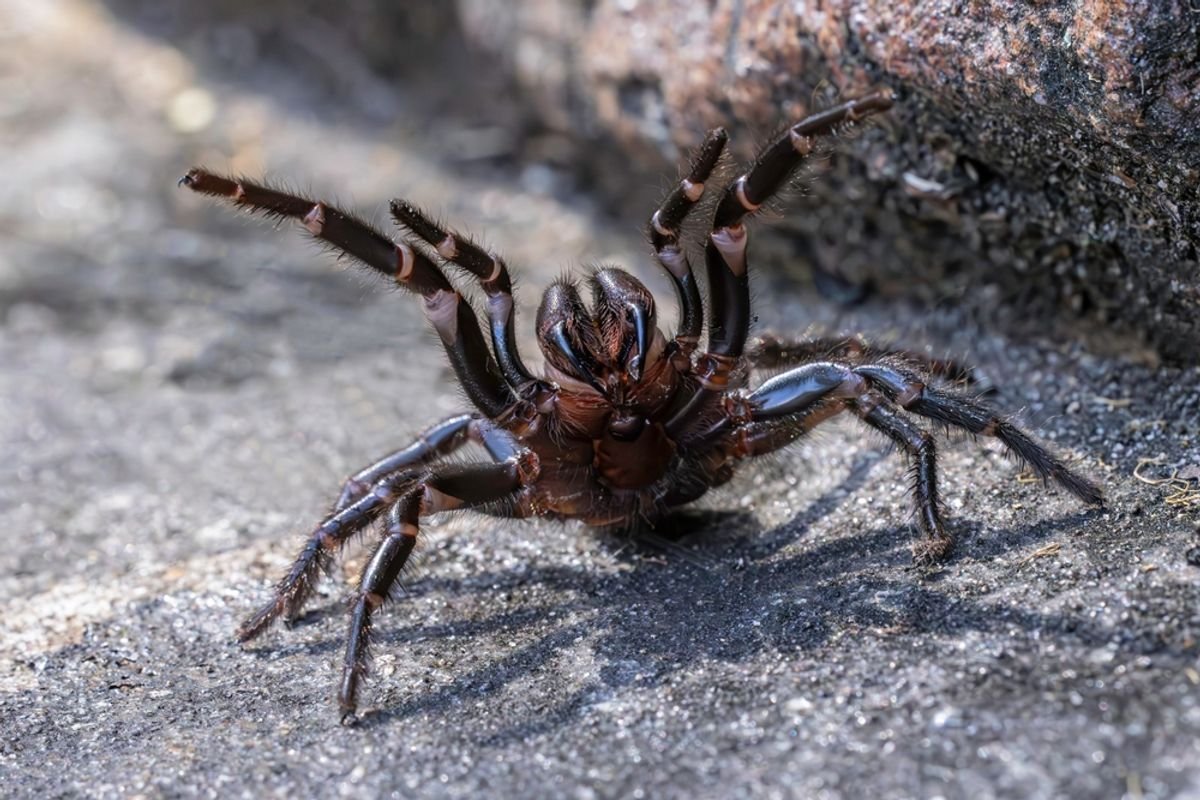
If you flip over a log or a rock within 160 kilometers (about 100 miles) of Sydney, you may be greeted with a Sydney funnel-web spider hiding within a fortress made of silk. The spider, which sports a black and shiny exoskeleton, prefers to live in humid, sheltered burrows.
Don’t think about sticking your hand in its home — if you do, you’ll first see an aggressive display of raised limbs. Ignore this warning, and you’ll probably be bitten.
A bite from a Sydney funnel-web doesn’t always contain venom, but if it does, the venom begins to attack the nervous system. Soon after, symptoms like nausea and vomiting, abdominal pain, breathing difficulties, and rapid heart rate start to set in. Within a few hours, respiratory or circulatory failure leads to an unpleasant death.
It sounds as if this venom could cause mass casualties, but shockingly, no one has died from a Sydney funnel-web bite for over 40 years, despite 30 to 40 bites occurring every year. This is because antivenom for bites was introduced in 1981. Before this, there were 13 recorded deaths caused by the spider.
An Unlucky Weakness to Funnel-Webs
The Southern Sydney funnel-web and the Newcastle funnel-web have similarly venomous bites — and the latter is doubly intimidating, with males growing so large that the species is nicknamed the “Big Boy”.
The venom of the Sydney funnel-web and its two cousins contains a neurotoxin called delta-hexatoxin, which disrupts sodium channels in humans, causing disturbances in respiration, blood pressure, and heart rate. Weirdly enough, this venom only appears to harm humans and other primates (along with smaller prey of the spiders). Many other mammals aren’t the least bit affected by envenomation. Why, then, did humans get the short end of the stick?
A 2020 study chalks it up to an “unfortunate evolutionary coincidence.” Funnel-web venom is really only a threat in male spiders, and this is because the males have always needed it to deter predators when they wander out of their burrows in search of female mates.
But since primates weren’t even around when funnel-web spiders evolved 150 million to 200 million years ago, the venom’s lethality against humans remains an enigma. Unfortunately, our bodies may just be extra sensitive to the delta-hexatoxins.
Saving Lives with Spider Venom
The venom of funnel-webs may be deadly, but it may also turn out to be a lifesaver. That’s because researchers are using it to treat a variety of life-threatening conditions.
The venom contains small proteins or peptides that can modify the ion channels and receptors in mammalian neurons. In some cases, these building blocks can target certain channels to combat epilepsy, abdominal pain, and stroke.
In the case of stroke, the venom of the K’gari funnel-web spider (which lives off the southern coast of Queensland on the island of K’gari) is making a big difference. A molecule in the venom, called Hi1a, is being studied for its ability to prevent neuron death and brain damage during an ischemic stroke.
These therapies, along with several others being investigated right now, are proving that funnel-web spiders are much more than just a scary face.
Read More: Why Does Australia Have Some of the Deadliest Creatures on Earth?
Article Sources
Our writers at Discovermagazine.com use peer-reviewed studies and high-quality sources for our articles, and our editors review for scientific accuracy and editorial standards. Review the sources used below for this article: