
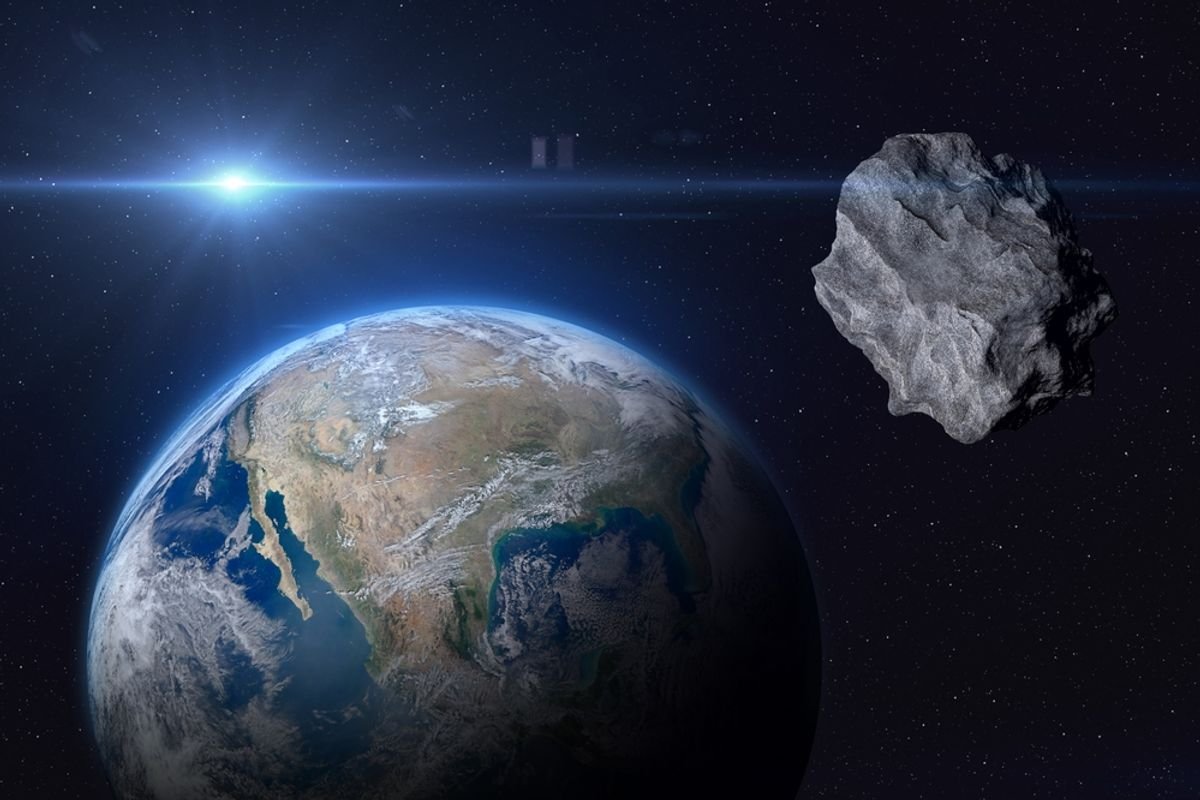
The City-Killer Asteroid May Hit the Moon in 2032 — What Would Happen If We Blasted It With Nukes First?

The asteroid that could’ve killed cities could still collide with the moon. That’s what the models of Asteroid 2024 YR4 say, after previously suggesting that the probability that the asteroid would impact Earth in December 2032 was around 3 percent. Since those past predictions, the asteroid’s chances of hitting Earth have sunk, while its chances of hitting the moon have soared. Today, the likelihood of a lunar impact is sitting at around 4 percent.
Despite this low probability, scientists are already considering possible prevention strategies, aimed at deflecting or destroying the asteroid before its potential impact. In fact, a team of scientists — including several scientists from NASA — published a preprint paper on arXiv in September 2025, weighing possible interventions, with one option being to blast the asteroid with nuclear devices.
But what, exactly, will happen if scientists set off a nuclear explosion on or near the surface of 2024 YR4, and what will happen if they don’t?
Read More: Asteroid Has a 1% Chance to Impact Earth in 2032 — Should We Be Worried?
Nuking Asteroid 2024 YR4
Though the testing of the idea is limited, it’s thought that nuclear devices could deflect or destroy 2024 YR4 — that is, if scientists start working on the approach soon.
To deflect the asteroid, scientists would detonate a nuclear device around a strategically selected surface, obliterating one of its faces and changing its course through the creation of thrust. Meanwhile, to destroy the asteroid, scientists would shoot a nuclear device straight toward its core, smashing it into smithereens.
According to the study authors, nuclear deflection isn’t feasible for 2024 YR4, whether scientists reuse old spacecraft or construct new ones.
“Deflection missions were assessed and appear impractical,” the team stated in its paper, thanks to the lack of information about the asteroid’s structure.
Indeed, while scientists have a sense of the asteroid’s diameter — around 220 feet across, according to NASA — less is known about its mass and composition, which would deeply affect any nuclear deflection plan. And while a reconnaissance mission could reveal more about the asteroid, there isn’t much time for such a mission to occur, and to bring back the details required for the development of a nuclear deflection approach, before 2024 YR4 arrives.
“The best reconnaissance mission options launch in late 2028,” the study authors added in their paper, “leaving only approximately three years for development.”
Nuclear Destruction or Robust Disruption
The better option, the team states, is nuclear “robust disruption,” or destruction — to blast the asteroid apart before it approaches with two nuclear devices. Just one of these devices would probably destroy the asteroid, the study authors suggested in their paper, leaving the second device as a back-up, “in case it is needed.”
The development for such missions could start immediately, allowing for additional years of planning. “Nuclear robust disruption missions are also available,” the team added in its paper, “with launches between late 2029 and late 2031.”
Other, non-nuclear options are also up for consideration, deflecting or destroying the asteroid by smashing it with a spacecraft. With these “kinetic” options, deflection is once again less achievable than destruction, with “robust disruption” missions being available “with launches between April 2030 and April 2032,” according to the paper.
Read More: City-Killer Asteroid Won’t Harm Earth, But It May Hit the Moon Instead
A No-Nuke Approach?
Of course, yet another option would be to do nothing. While an impact from 2024 YR4 would not alter the moon’s orbit, it would create another massive crater on the lunar surface, sending significant debris towards Earth. While most of this debris would burn up in Earth’s atmosphere, some would stick around, increasing micrometeoroid impacts and threatening satellites, including the ISS and the astronauts within it.
According to the study authors, asteroid prevention strategies should be planned, whether or not the models of 2024 YR4 continue to predict a collision.
“The lunar impact would most likely be ruled out or in” in 2028, when the asteroid makes its closest approach to the moon before 2032, the team added in its paper. “Even if lunar impact is ruled out, there is significant potential utility in deploying a reconnaissance mission to characterize the asteroid.”
Read More: Chances of City-Killer Asteroid Impacting the Moon Raised from 3.8 to 4.3 Percent
Article Sources
Our writers at Discovermagazine.com use peer-reviewed studies and high-quality sources for our articles, and our editors review for scientific accuracy and editorial standards. Review the sources used below for this article: